The African Development Bank Group has approved €68.39 million in additional financing to help complete Kenya’s Thwake Dam.
The project is about 90% complete and is central to Kenya’s Vision 2030 infrastructure agenda.
For communities in Makueni, Kitui and nearby areas, completion could mean safer water, stronger farming, clean energy and greater resilience in a dry region.
A Dam Near Completion Gets Lifeline
For Kenya’s lower-eastern counties, water is not only a development need. It is the difference between resilience and repeated scarcity.
The African Development Bank Group has approved €68.39 million in additional financing to support completion of Phase I of the Thwake Multipurpose Water Development Program, a strategic national project designed to strengthen water security, irrigation, hydropower and livelihoods in one of Kenya’s semi-arid regions.
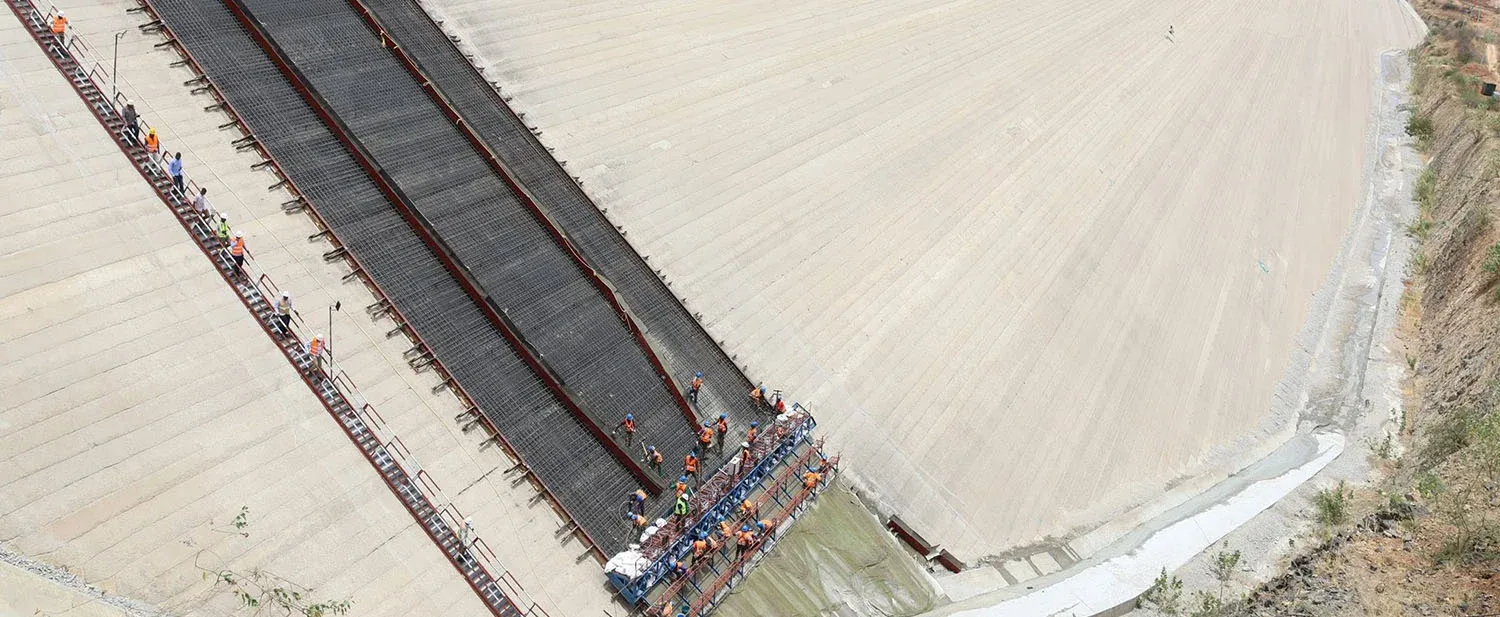
The financing comes as construction of the dam nears 90% completion. The new support is expected to fund critical engineering refinements and safety enhancements, including raising the dam height, strengthening core foundations and constructing two additional saddle dams to protect the reservoir’s long-term reliability.
Located around the confluence of the Athi and Thwake rivers, near the border of Makueni and Kitui counties, Thwake is more than a construction project.
It is a climate adaptation asset for communities that have lived with drought, irregular rainfall and limited access to reliable water for decades.
Water Security Meets Climate Resilience
Thwake Dam is part of Kenya’s Vision 2030 development strategy and is designed as a multipurpose infrastructure platform.
Its benefits are expected to extend beyond bulk water storage to household supply, irrigation, hydropower, sanitation and local economic activity.
Earlier project information shows that the dam is designed as an 80.5-metre-high embankment structure with a large storage capacity, supporting future phases for treated water supply, hydropower generation and irrigation development. The broader programme is expected to serve communities in Kitui, Makueni and parts of Machakos, including Konza Techno City.
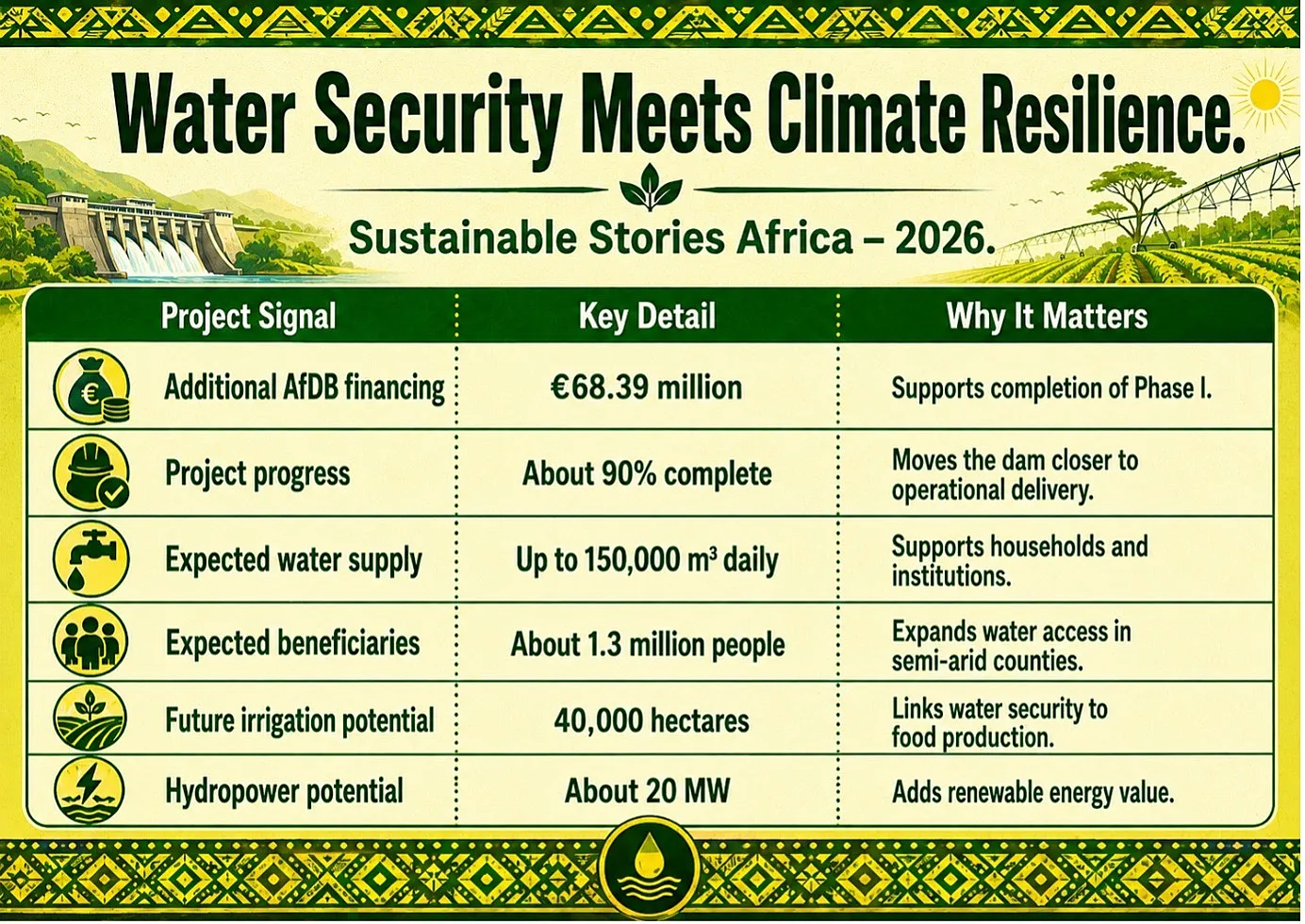
For a household in Makueni or Kitui, the project’s importance is practical.
Reliable water can reduce the burden of long-distance collection, improve sanitation, support small livestock, keep schools and clinics running, and give farmers a better chance of producing through dry seasons.
For Kenya’s economy, the dam represents a wider infrastructure logic: climate resilience must be built into water, food and energy systems before drought shocks become more expensive than prevention.
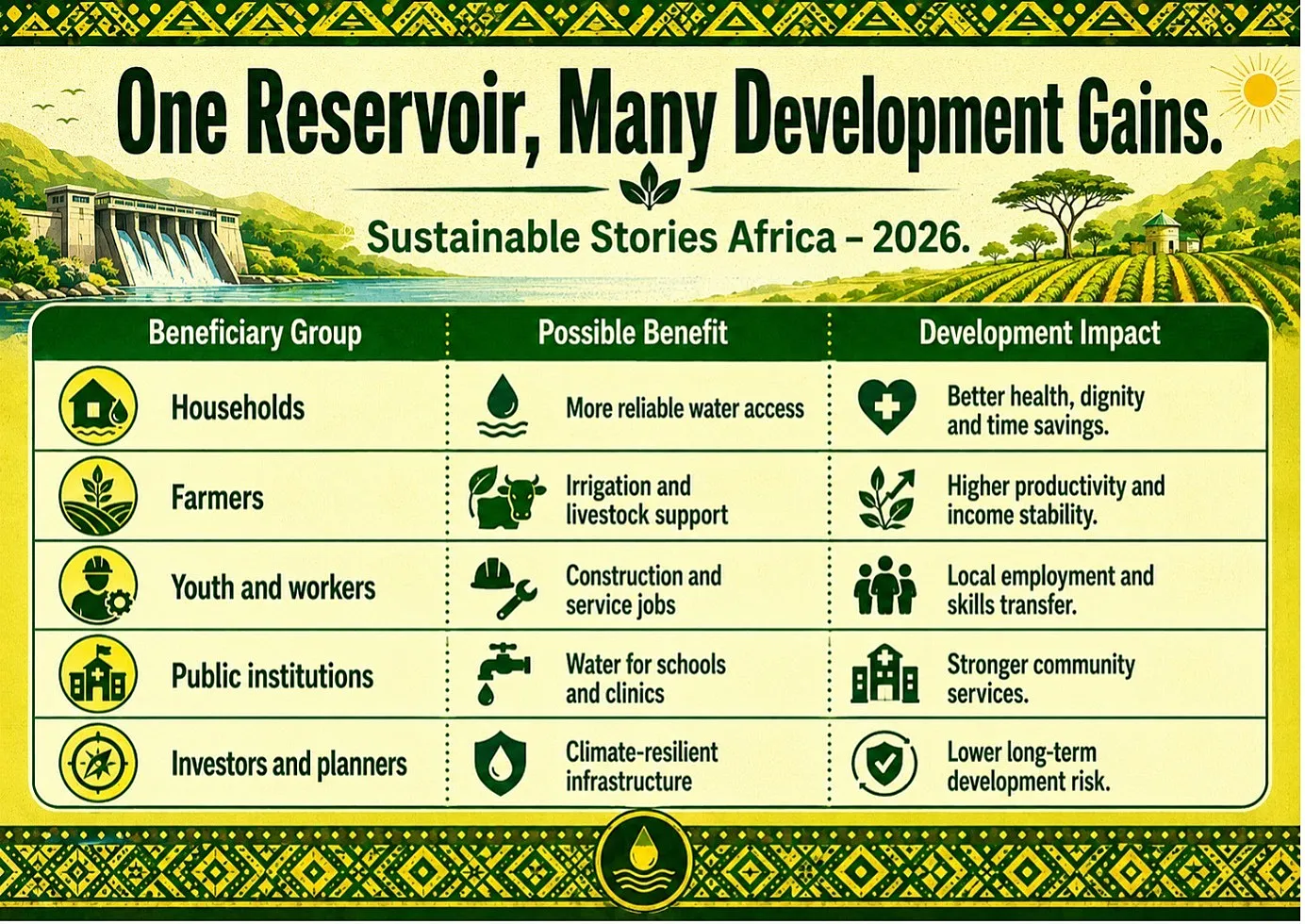
One Reservoir, Many Development Gains
If completed and managed well, Thwake Dam could help convert a water-stressed region into a more productive economic corridor.
The most immediate gain is water security.
- A dependable reservoir can support domestic supply and reduce pressure on communities that often face scarcity.
The second gain is food production.
- Irrigation potential can allow farmers to move beyond rain-fed uncertainty, improve yields and support more stable local markets.
The third gain is energy.
- Hydropower, even at a modest scale, can support renewable generation and strengthen the project’s development value.
The fourth gain is local enterprise.
- Water infrastructure can support construction jobs, agribusiness, sanitation services, transport, small trade and public health improvements.
However, the promise is not automatic. Dams require careful social, environmental and financial management.
Water quality, catchment protection, maintenance, fair access and transparent governance will determine whether the project becomes a durable development asset or another underperforming infrastructure story.
Complete The Asset, Protect The Impact
Kenya’s next task is to turn financing into disciplined delivery.
That means completing remaining works safely, managing environmental and social obligations, protecting the Athi River catchment, and ensuring that future phases for water treatment, irrigation and hydropower are financed and sequenced effectively.
Policymakers should also prioritise affordability and access.
- Large water infrastructure can change lives only when the last mile works: pipes reach communities, water quality is protected, tariffs are fair, irrigation schemes are managed responsibly, and local institutions have the capacity to operate and maintain systems.
For development finance institutions. Thwake offers a wider lesson.
- Africa’s climate resilience agenda cannot be separated from the completion of the infrastructure. Projects that are 90% built still need final-mile capital, technical oversight and governance discipline to become productive assets.
For citizens, the project’s real measure will not be the height of the dam wall.
- It will be whether water reaches homes, farms, schools, clinics and small businesses.
Path Forward – Make Water Infrastructure Deliver Resilience
The priority now is completion with accountability: finish the dam, protect the catchment, finance future phases and ensure communities receive reliable water.
If delivered well, Thwake can advance Kenya’s ESG and sustainability objectives by linking water security, food production, clean energy and rural livelihoods.
The test is turning stored water into shared development.