
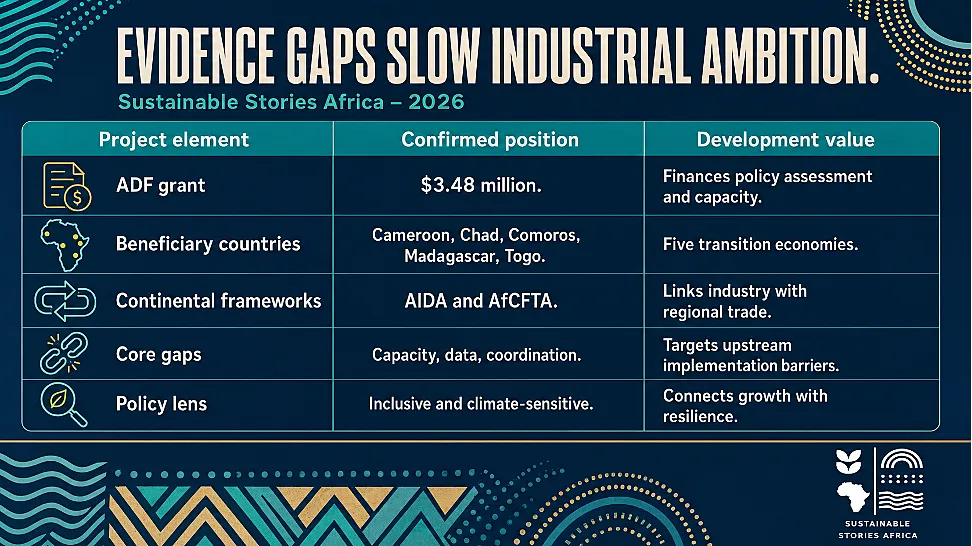
The African Development Fund has approved a $3.48 million grant for Cameroon, Chad, Comoros, Madagascar and Togo.
The project will assess the African Union’s industrial development framework and support implementation of the African Continental Free Trade Area.
Better data, institutional capacity and coordination could help five transition economies design more inclusive and climate-sensitive policies.
Five Countries Gain Policy Support
The African Development Fund has approved a $3.48 million grant to strengthen industrial and trade policy in Cameroon, Chad, Comoros, Madagascar and Togo.
The financing will support impact assessments of the African Union’s Accelerated Industrial Development for Africa framework and help the five transition economies implement the African Continental Free Trade Area.
The amount is modest considering the infrastructure deficits confronting the countries.
However, the intervention targets an upstream constraint: governments struggle to direct investment and negotiate trade priorities when data are weak, institutions are stretched, and policy responsibilities are fragmented.
Evidence Gaps Slow Industrial Ambition
The project is designed to create a standardised and analytically robust method for assessing industrial and trade dynamics while adapting the analysis to national realities.
It will strengthen government experts’ technical capacity and support institutions that produce, analyse and use evidence.
“The project responds to these challenges by providing a standardised and analytically robust methodology, tailored to national realities,” said Memory Dube, the African Development Bank Group’s project team leader.
She added that it would reinforce the mechanisms needed to produce, analyse and use new evidence.
The five countries face different geographies and market structures, from Cameroon and landlocked Chad to island economies Comoros and Madagascar; however, they share the challenge of establishing continental frameworks into workable domestic choices.
Tariffs, logistics, energy, skills, finance, standards and climate exposure interact; treating them in separate policy silos can produce incentives that cancel one another out.
Reliable evidence can also improve negotiations with investors and development partners.
Governments that understand logistics costs, supplier capabilities, and market demand can target public support more precisely and avoid expensive projects disconnected from viable value chains.
A Common methodology may additionally help the five countries compare progress without erasing national differences.
Better Policy Can Crowd Investment
Evidence-led policy can help governments identify sectors with realistic demand, value-chain links and employment potential.
It can also improve the quality of public-private dialogue by replacing broad industrial slogans with measurable constraints, responsibilities and timelines.
Climate-sensitive design is particularly important. New industrial capacity must compete while managing energy costs, water stress, extreme weather and changing export requirements.
Inclusive analysis should also show how women-owned businesses, young entrepreneurs, small producers and informal firms can access opportunities created by AfCFTA rather than being displaced by larger competitors.
If the work is done well, businesses should see clearer rules and governments should gain a stronger basis for sequencing infrastructure, skills and financing interventions.
Regional bodies can then identify where standards, customs procedures or transport links require collective action.
That is how a small technical-assistance grant can influence much larger investment decisions.
Convert Assessments Into Decisions
Each country should publish a baseline, define a small number of priority reforms and assign accountable institutions.
Data systems need common definitions and regular updates, while ministries of trade, industry, finance, infrastructure and environment should coordinate around shared outcomes.
The Fund and beneficiary governments should report what changed as a result of the grant: policies adopted, officials trained, bottlenecks removed, firms reached and trade or investment outcomes improved.
Technical assistance creates value only when evidence moves into budgets, regulation and delivery.
The project should therefore be judged not by assessments completed, but by better decisions implemented.
Civil society, industry associations and research institutions should be involved in validation rather than consulted only after priorities are concluded.
Their participation can improve data quality, expose distributional impacts and create wider ownership of reforms.
Public dashboards would help firms plan while allowing citizens to see whether promised industrial gains are materialising.
Path Forward – Convert Better Evidence Into Industrial Delivery
Beneficiary governments should publish baselines, prioritise reforms and assign accountable institutions across trade, industry, finance and infrastructure.
Data must inform budgets and regulation.
The Fund should track policies changed, capacity retained and firms reached, rather than only reports delivered.
AfCFTA gains will depend on practical national implementation.
Culled From: African Development Fund Approves $3.48 million Grant to Boost Industrial and Trade Policy in Five African Countries