African startups announced $1.36 billion in funding during the first half of 2026, only 6% below the same period last year.
The stable headline masks a sharper retreat in participation: just 190 ventures raised at least $100,000, the lowest half-year tally since 2021.
For founders and ecosystems, capital is concentrating while the pipeline beneath Africa’s largest deals grows thinner.
Funding Holds, Participation Weakens
African venture funding entered the second half of 2026 with a reassuring headline and an uncomfortable warning. Startups on the continent announced $1.36 billion in the first six months, broadly level with the $1.44 billion recorded in H1 2025.
However, only 190 ventures raised at least $100,000, the lowest half-year count since Africa: The Big Deal lowered its tracking threshold to that level in 2021.
The divergence matters because ecosystems are not sustained by aggregate capital alone.
They also need a wide, renewable pipeline of companies to secure first cheques, test products, employ teams and graduate into larger rounds.
When funding stagnates while the number of recipients decreases, the market supports fewer, more mature winners without replenishing the base.
The Headline Conceals Concentration
Equity funding reached about $900 million.
That remained relatively steady against $962 million in H1 2025 and $979 million in H2 2025, although it continued a gentle decline from $1 billion in H2 2024.
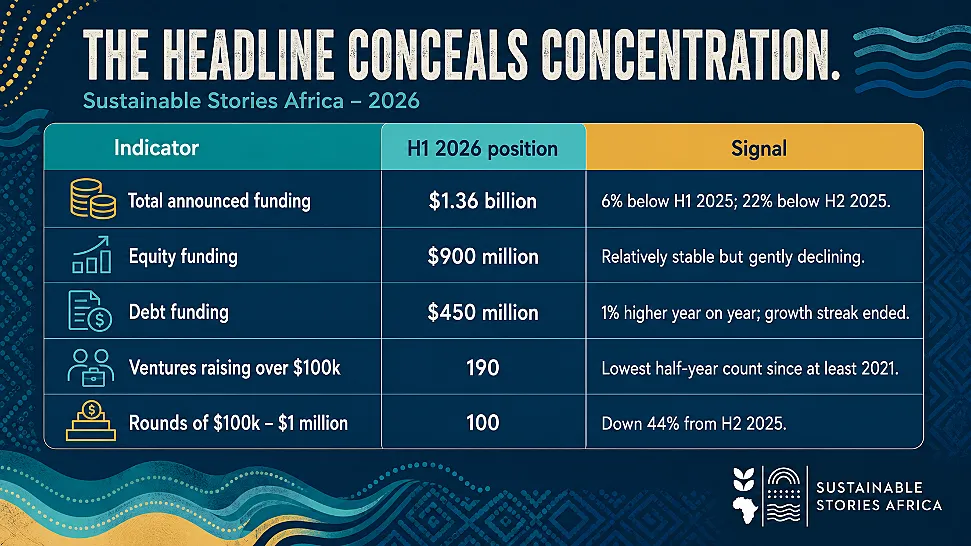
Debt funding was also broadly stable at about $450 million, 1% higher year on year, but it ended three consecutive half-years of growth.
The resulting mix shifted to roughly 66% equity and 33% debt, compared with 56% equity and 42% debt in H2 2025.
The sharper deterioration appeared below the headline. Ventures raising between $100,000 and $1 million fell from 179 in H2 2025 to 100 in H1 2026, a 44% half-on-half decline.
These are often the rounds that finance product validation, local hiring and the first move beyond a founder’s home market.
Losing them today can mean fewer investable Series A businesses tomorrow.
The total was also 22% below the $1.7 billion announced in H2 2025, suggesting that the rebound seen late last year did not carry cleanly into 2026.
A strong June helped rescue the half-year total, but a market dependent on a few large months and deals is more vulnerable to delays, currency shocks and fragile investor risk appetite.
A Wider Pipeline Builds Resilience
The positive reading is that African technology businesses can still attract substantial equity and debt in a selective global market.
- The task is to convert that resilience into breadth.
- More seed funds, local institutional participation, angel syndicates, catalytic guarantees and revenue-based finance could help businesses that are too early for large funds but already beyond grants.
A broader market would distribute opportunities across countries, sectors and founder profiles.
- It would also strengthen future returns: investors need many credible early-stage companies to produce the smaller group that later absorbs growth capital.
- If the feeder pipeline contracts for several periods, competition for quality assets may rise even as overall innovation slows.
Measure Breadth, Not Totals Alone
Policymakers and ecosystem builders should track the number of funded ventures, first-time fundraises, median round size and follow-on conversion alongside aggregate dollars.
Development finance institutions can use guarantees and fund-of-funds structures to attract private capital into smaller tickets.
Regulators can simplify cross-border investment and employee ownership rules.
Fund managers should resist treating the H1 total as proof that the correction is over.
The stronger response is to publish deployment data, protect early-stage allocation and build founder support around governance, sales and capital readiness.
Africa has held the amount; it must now restore the deal flow that makes the amount sustainable.
Path Forward – Broaden Capital Before The Pipeline Narrows
Investors should rebuild smaller-ticket deployment while governments remove barriers to domestic and cross-border venture capital.
Reporting must show who receives capital, not only how much is announced.
Catalytic finance, capable local fund managers and stronger founder readiness can keep today’s concentration from becoming tomorrow’s innovation shortage.
A healthy ecosystem needs both landmark rounds and a deep bench.
Culled from: H1 2026: Amounts hold. Deal count suffers.