African agricultural research is advancing, but its impact remains limited without investment, infrastructure, credit and policy support.
The warning comes as climate stress, weak markets and demographic pressure reshape farming across the continent.
For smallholder farmers, the real question is whether science can leave laboratories and reach the field.
Science Alone Cannot transform African Farming
Africa’s agricultural future will not be secured by scientific breakthroughs alone. That is the central warning from agricultural researcher Pape Abdoulaye Seck, who argues that research only changes lives when governments, financiers, markets and institutions help move innovation from laboratories to farmers’ fields.
Writing in Down To Earth, Seck says agriculture remains the “lifeblood” of Africa, with more than 60% of households directly or indirectly dependent on land for livelihoods.
The continent accounts for approximately 60% of the world’s uncultivated arable land.
However, the sector is also exposed to climate change, market volatility, weak infrastructure and demographic pressure.
The message is urgent: Africa does not lack ideas, seed research, universities or scientific talent.
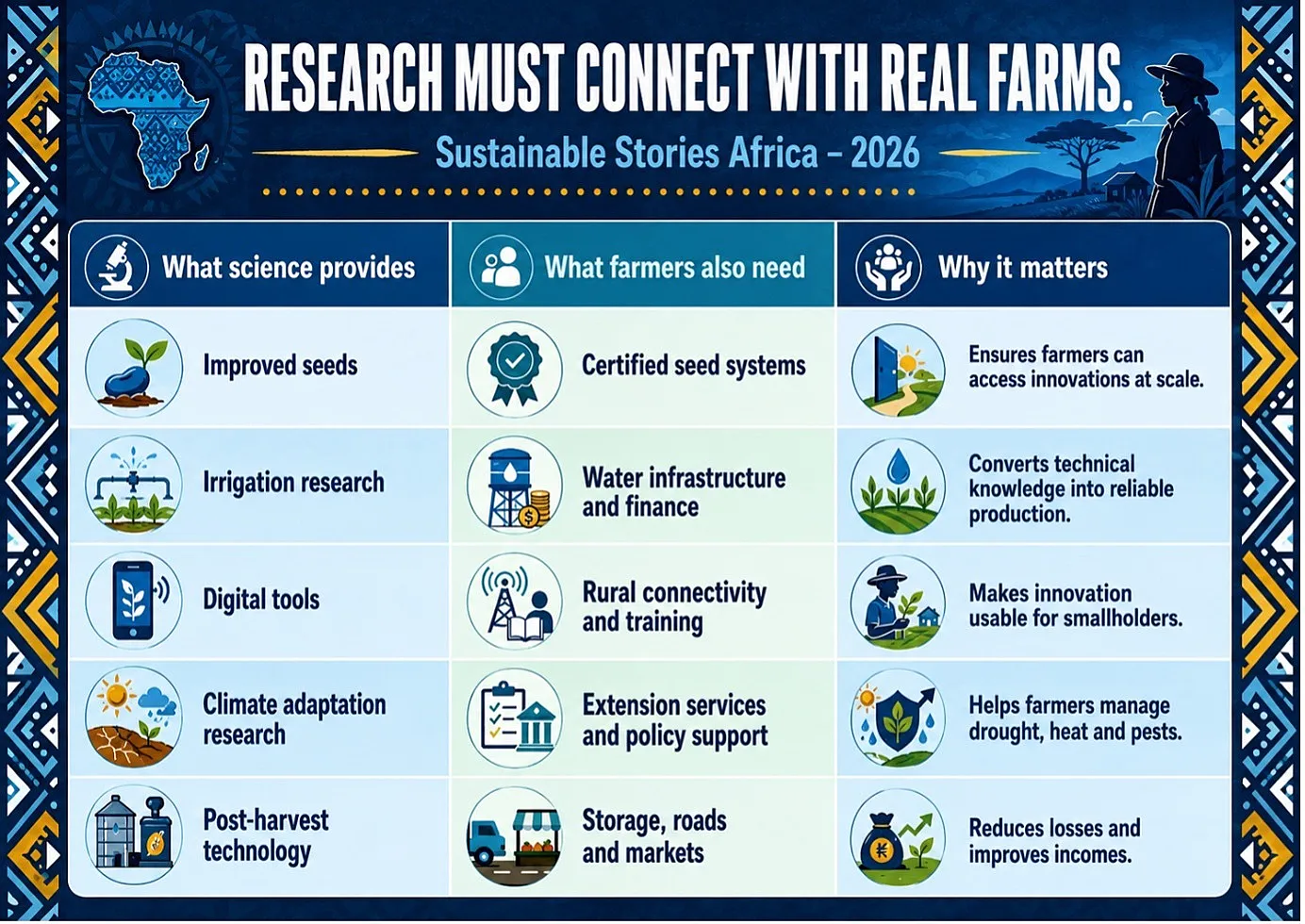
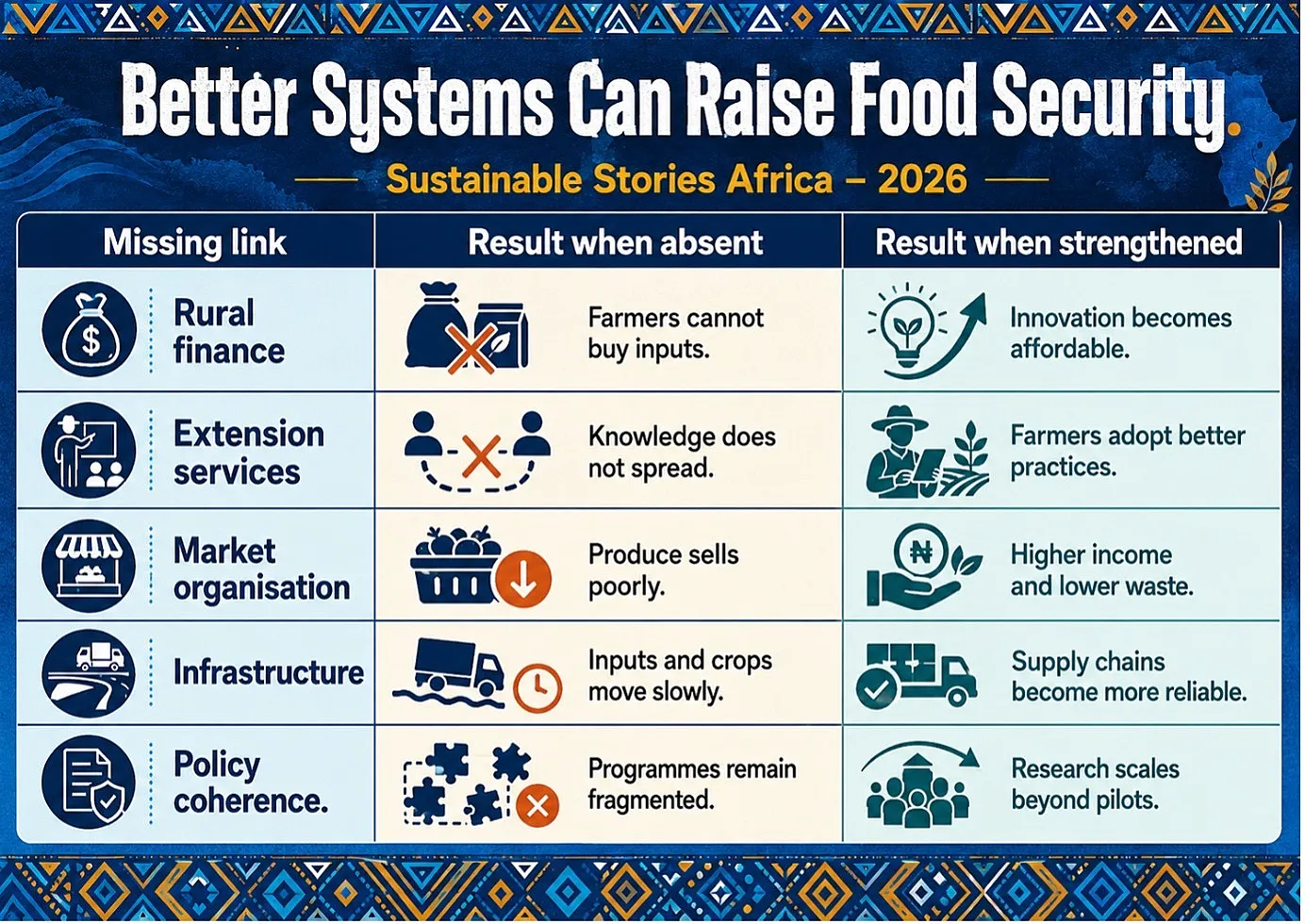
What it often lacks is the full ecosystem that turns discovery into productivity, certified seeds, irrigation, extension officers, rural roads, credit, storage, markets and predictable public policy.
Research Must Connect With Real Farms
Seck’s argument challenges a familiar criticism: that agricultural research is expensive and delivers too little. He says that the view wrongly assumes scientists alone are responsible when innovations fail to scale.
In reality, research delivers impact only when linked to producers, finance, institutions and markets.
The lesson is visible in Asia’s Green Revolution. Improved wheat and rice varieties mattered, but they worked because governments also invested in irrigation, extension, rural infrastructure, credit systems and market organisation.
India and Vietnam succeeded because science operated inside a coherent system.
Across Africa, some examples show what is possible. Seck points to Rwanda and Ethiopia, where stronger links among research, extension systems, public investment, and farmer support helped accelerate technology adoption and productivity gains in crops such as maize, rice, cassava, beans and soybeans.
Better Systems Can Raise Food Security
The strongest part of the argument is not academic. It is human
- A farmer may hear about a drought-tolerant seed but be unable to buy a certified supply.
- A cooperative may learn about better storage, but lack credit.
- A young agripreneur may see opportunity in digital agriculture but face poor connectivity and weak market links.
Seck also cites New Rice for Africa varieties developed through AfricaRice, combining the productivity potential of Asian rice with the resilience of African rice, including tolerance to drought, poor soils and local stresses.
In countries where governments, seed systems, extension services and development partners worked together, farmers adopted the varieties and food production improved.
The gain from fixing these systems is significant. Improved agricultural innovation can improve food security, rural incomes, climate resilience, public health and social stability.
The loss from inaction is also clear: research remains trapped in reports, pilot projects, and research stations while farmers continue to face low yields, high risk and unstable markets.
Policy Must Carry Science To Farmers
Africa’s agricultural transformation needs a sharper public-policy bargain.
- Governments should treat research as strategic infrastructure, not a discretionary cost. That means funding agricultural research institutions, strengthening extension systems, supporting seed certification, expanding rural credit and building markets that reward productivity.
- Development finance institutions and private investors also have a role. They can back irrigation, storage, mechanisation, climate-smart agriculture and local processing.
- Universities and research centres must work more closely with farmer groups, agribusinesses and ministries so research priorities reflect field realities.
Seck’s conclusion is clear: blaming science for weak impact hides the failure of wider development systems.
As Africa faces the challenge of feeding a growing population without destroying natural ecosystems, weakening research would be the wrong response.
The task is to build stronger alliances among science, policy, finance, private-sector actors, farmers, universities and civil society.
Path Forward – Investment Must Follow The Evidence
The next phase of African food security must be built around practical delivery: finance the research, connect farmers to inputs, train extension workers, improve rural roads, organise markets and make public policy predictable.
For African ESG and sustainability goals, agriculture is central. Stronger research systems can cut hunger, protect livelihoods, improve climate adaptation and turn rural economies into engines of inclusive growth.