Africa's automotive industry is entering a decisive growth phase as investment, electric vehicles and regional integration reshape manufacturing across the continent.
A new Brookings analysis argues that Africa can transform from a vehicle importer into a competitive automotive production hub.
The opportunity could create jobs, strengthen industrial value chains and accelerate sustainable economic development across African markets.
Africa's Automotive Future Is Being Rewritten
Africa's automotive industry is no longer viewed simply as an emerging market—it is increasingly being recognised as one of the world's next industrial growth frontiers.
A new commentary from the Brookings Institution highlights how rising investment, electric vehicle (EV) manufacturing, digital technologies and the African Continental Free Trade Area (AfCFTA) are creating an unprecedented opportunity for Africa to become a globally competitive automotive manufacturing hub.
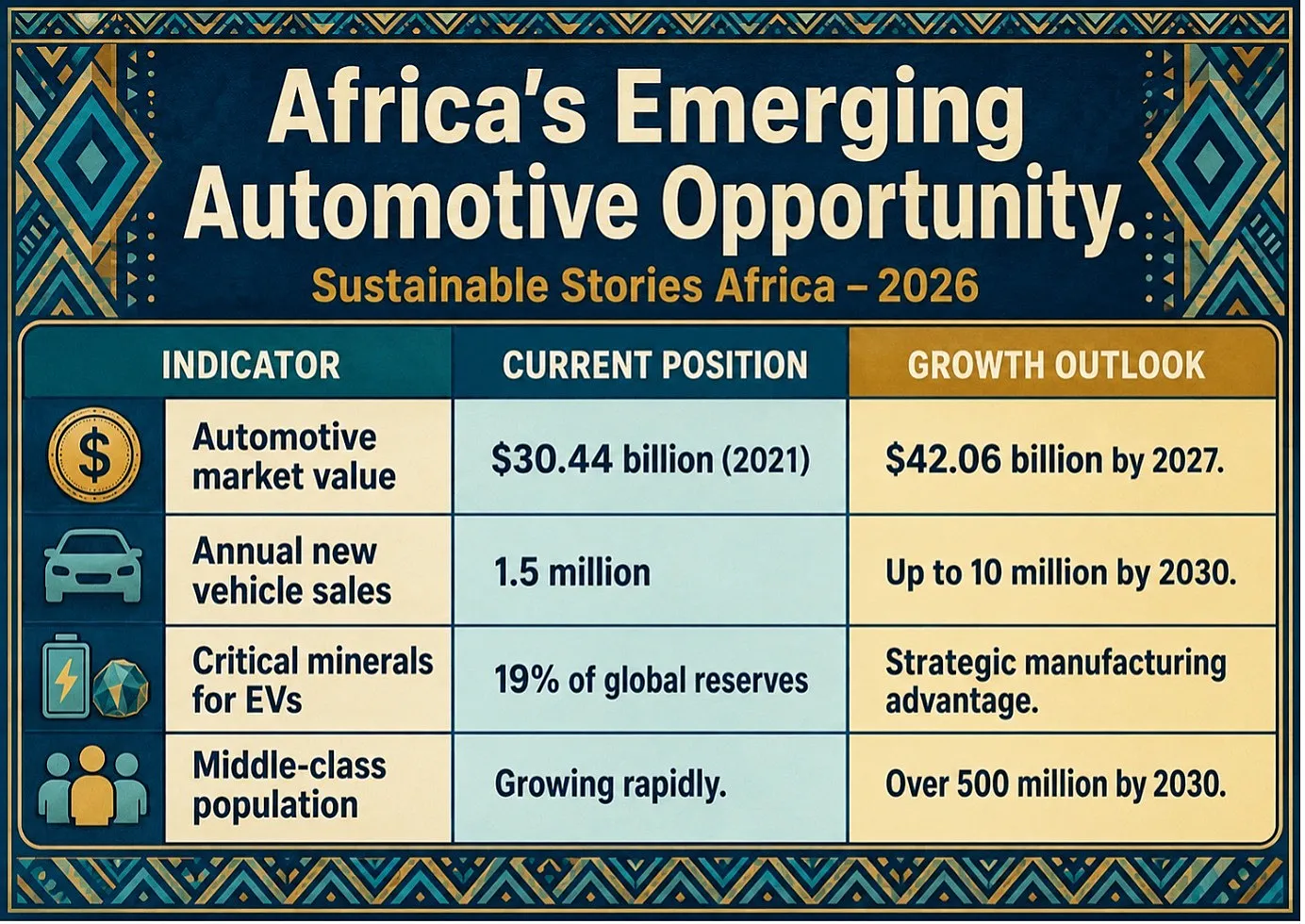
The report projects the continent's automotive market will expand by 40%, growing from $30.44 billion in 2021 to $42.06 billion by 2027.
According to Brookings Senior Fellow Landry Signé, Africa's automotive sector is experiencing an investment boom after decades on the sidelines, driven by growing consumer demand, abundant critical minerals and increasing interest from global manufacturers.
The momentum extends beyond vehicle assembly. It reflects a broader industrial transformation capable of creating jobs, expanding exports and strengthening Africa's position within global clean mobility value chains.
Electric Mobility Drives New Industrial Momentum
Africa's automotive story is shifting from vehicle imports toward industrial value creation.
Brookings notes the continent currently records just 1.5 million new vehicle sales annually, about 1% of global sales. However, with over 500 million Africans joining the middle class by 2030, that figure could reach 10 million units, making it one of the world's fastest-growing markets.
Morocco and South Africa lead production efforts: Morocco has attracted a $6.5 billion EV battery gigafactory and became the EU's largest automotive supplier by value in 2023, overtaking China and Japan, while South Africa expands hybrid and electric vehicle manufacturing.
Resource advantages reinforce this momentum; Africa holds roughly 19% of critical EV battery minerals, with Morocco controlling 72% of global phosphate reserves. Morocco, the DRC, and Zambia are pursuing integrated EV value chains.
Digital transformation follows suit: 91% of South African fleet managers plan digital investments, and 58% expect AI adoption within five years.
Manufacturing Can Become Africa's Next Growth Engine
If current investment trends continue, Africa's automotive industry could become a powerful engine for industrialisation.
Brookings argues that opportunities extend far beyond vehicle assembly into battery manufacturing, component production, software development, logistics, digital mobility services and vehicle financing.
The report also highlights growing opportunities in electric two-wheelers that require lower technological barriers while addressing affordable mobility needs across African cities.
Equally important is the potential for regional integration.
By leveraging AfCFTA, African manufacturers can build regional supply chains that reduce dependence on imported components, improve economies of scale and encourage greater local value addition.
For investors, success will increasingly depend on combining advanced manufacturing technologies with workforce development, digital innovation and strategic partnerships that build resilient regional ecosystems.
Build Regional Value Chains Before Demand Accelerates
Despite the optimism, Brookings identifies several structural challenges.
Used vehicle imports continue to dominate many African markets due to affordability, while shortages of skilled labour, limited EV charging infrastructure and global supply chain disruptions remain significant constraints.
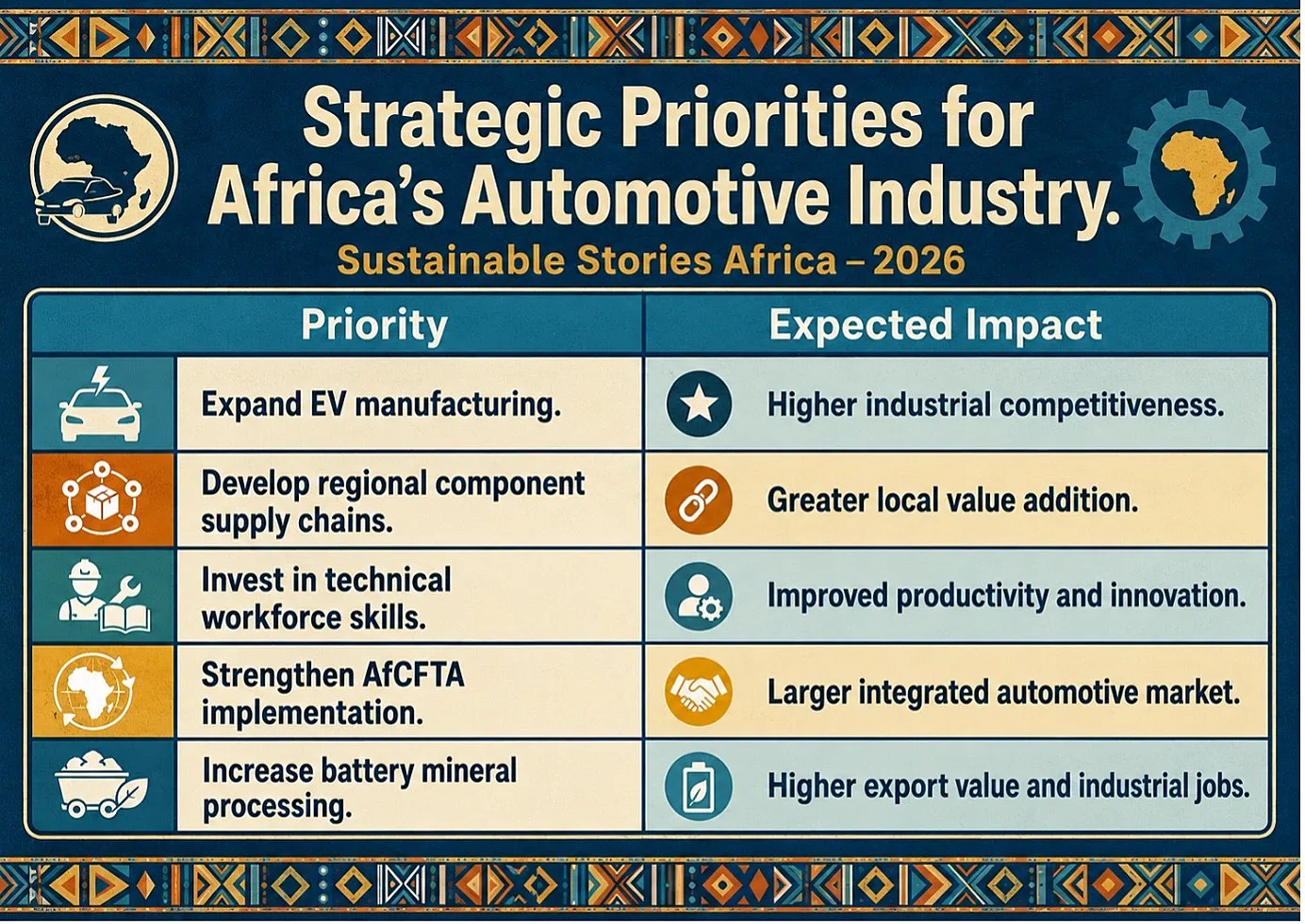
The report recommends several strategic priorities: investing in advanced manufacturing technologies, strengthening regional value chains under AfCFTA, expanding downstream mineral processing, increasing local component production and accelerating workforce skills development.
Brookings concludes that, with coordinated policy and private-sector investment, Africa could manufacture between four and five million vehicles annually and add more than 20 full-scale automotive manufacturing plants by 2035, fundamentally reshaping the continent's industrial landscape.
Path Forward – Accelerating Sustainable Automotive Industrial Transformation
Africa's automotive opportunity will depend on transforming mineral wealth into manufacturing capability through stronger regional integration, targeted investment and industrial innovation.
Governments, investors and manufacturers must align policies that encourage local production, skills development and resilient supply chains.
Success would advance ESG objectives by creating quality jobs, supporting cleaner mobility, strengthening industrial competitiveness and positioning Africa as a critical player in the global transition to sustainable transportation.
Culled From: Africa’s auto advantage: Strategies to seize emerging market potential | Brookings