Africa’s climate adaptation initiatives are delivering measurable results, strengthening resilience across agriculture, water systems, and disaster preparedness. However, financing gaps, institutional capacity constraints, and rising climate risks threaten to slow progress.
An African Union assessment shows adaptation investments are already reducing vulnerability and stabilising livelihoods. Yet scaling these gains will require significantly greater capital mobilisation, policy coordination, and infrastructure investment.
Africa’s resilience trajectory now depends on execution speed.
Africa’s Adaptation Investments Deliver Results, Challenges Persist
Africa’s climate adaptation programmes are strengthening resilience across vulnerable sectors, delivering measurable progress in agriculture, disaster risk management, and water systems, according to recent assessments by the African Union.
These initiatives are reducing climate vulnerability and protecting livelihoods across economies exposed to climate threats.
However, adaptation financing remains significantly below required levels, while institutional, infrastructure, and technical capacity constraints continue to slow implementation.
As climate risks intensify, accelerating investments in adaptation has become essential for economic stability and development.
Africa’s adaptation success now hinges on scaling proven solutions.
Africa Strengthens Climate Resilience Through Adaptation
Africa has emerged as a global leader in implementing climate adaptation initiatives, reflecting the continent’s frontline exposure to climate risks and its urgent need to protect economic and social systems.
Adaptation investments are improving drought resilience, strengthening early warning systems, and stabilising food production in vulnerable regions.
These efforts not only reduce climate risks but also support long-term economic resilience.
Adaptation Programmes Deliver Measurable Economic Protection Benefits
Climate adaptation initiatives are already delivering tangible results across multiple sectors.
Key Climate Adaptation Progress Areas
Adaptation Area | Strategic Intervention | Resilience Outcome |
|---|---|---|
Climate-resilient agriculture | Drought-resistant crops, irrigation expansion | Stabilised food production |
Disaster preparedness systems | Early warning infrastructure deployment | Reduced disaster-related losses |
Water resource management | Improved storage and distribution systems | Enhanced water security |
Climate risk planning | National adaptation strategies implementation | Strengthened institutional preparedness |
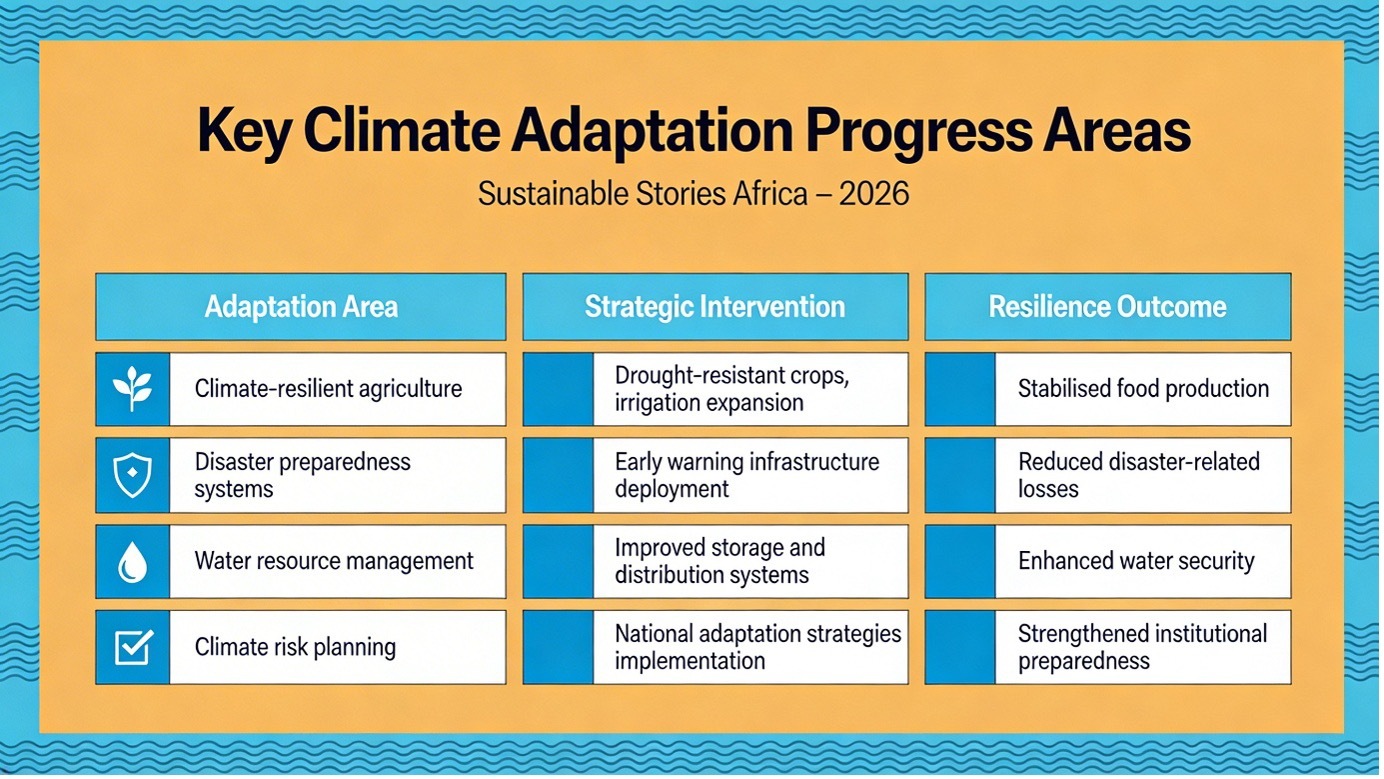
These interventions help reduce economic losses, protect infrastructure, and improve long-term development stability.
However, implementation remains uneven across countries due to resource constraints and varying institutional capacity.
Scaling Adaptation Unlocks Economic Stability Benefits
Climate adaptation represents a critical investment in Africa’s long-term economic resilience and development sustainability.
Without adaptation, climate impacts could significantly reduce agricultural productivity, damage infrastructure, and weaken economic growth.
Strategic Economic Benefits Of Adaptation Investment
Strategic Benefit | Economic Impact | Long-Term Outcome |
|---|---|---|
Reduced climate vulnerability | Lower economic disruption risks | Improved economic stability |
Infrastructure protection | Reduced repair and recovery costs | Enhanced fiscal resilience |
Agricultural resilience | Stable food production systems | Strengthened food security |
Investment confidence | Improved economic predictability | Increased capital inflows |
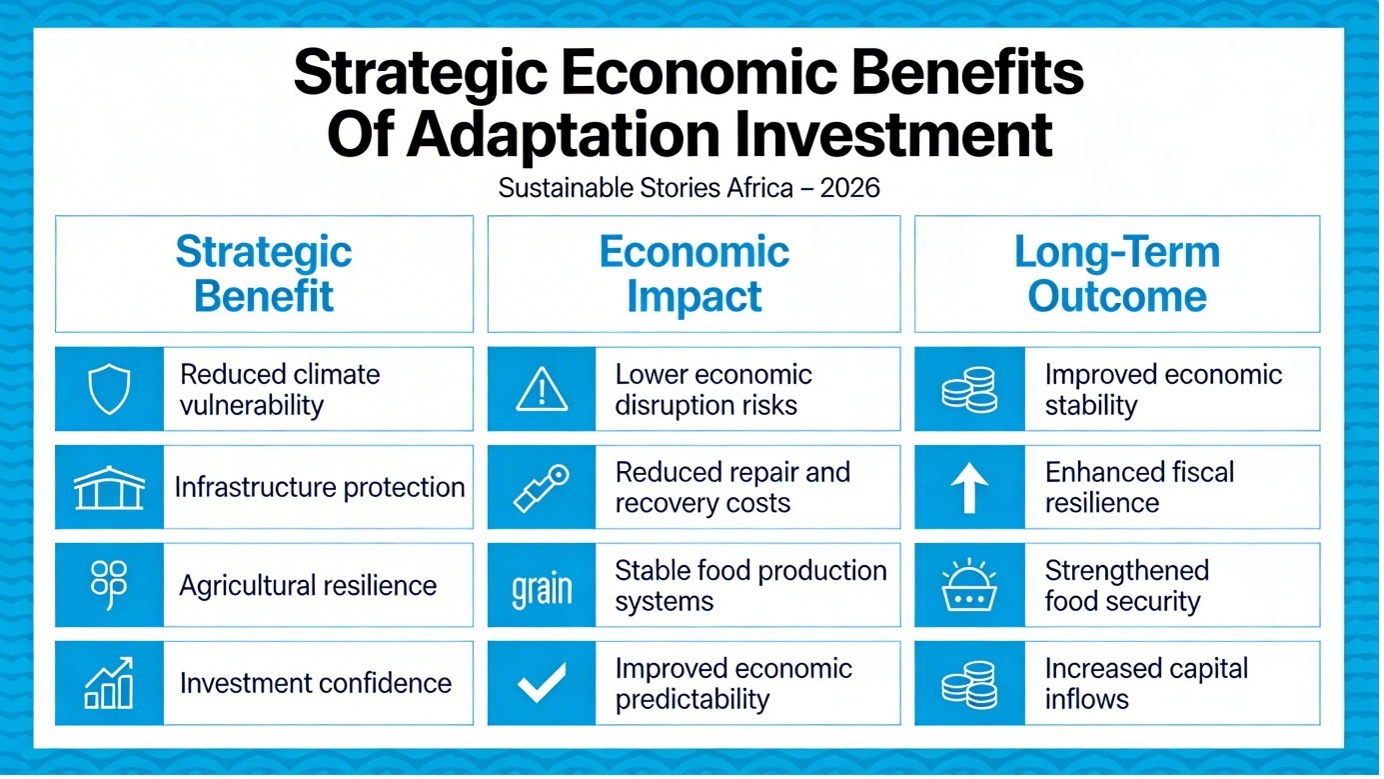
Adaptation investments strengthen economic resilience, enabling countries to sustain development despite climate pressures.
Financing Expansion Critical To Sustain Progress
Despite progress, Africa faces a significant gap in adaptation financing that threatens to slow implementation.
Public finance alone is insufficient to meet adaptation needs, requiring increased private sector participation and international climate finance support.
Governments must strengthen adaptation planning, improve institutional capacity, and integrate climate resilience into infrastructure development and economic planning.
Mobilising finance and strengthening execution capacity are essential to sustain the progress of adaptation.
Path Forward – Accelerated Financing Enables Scalable Adaptation Implementation
Scaling climate adaptation requires expanded financing, stronger institutional capacity, and integrated infrastructure planning. Increased public and private investment will accelerate implementation and strengthen resilience outcomes.
Strategic coordination between governments, development institutions, and private investors will ensure adaptation programmes deliver sustained economic protection and development stability.
Strategic Analysis – Why Adaptation Investment Matters Now
Climate adaptation has emerged as a central pillar of Africa’s economic resilience strategy.
As climate risks intensify, adaptation investments help stabilise agricultural systems, protect infrastructure, and strengthen economic continuity.
Africa has demonstrated that adaptation initiatives can deliver measurable results.
However, sustained progress will depend on closing financing gaps, strengthening institutional execution, and scaling proven adaptation solutions, ensuring resilience becomes a foundation for long-term economic transformation.
Culled From: https://panafricanvisions.com/2026/02/africas-climate-adaptation-initiatives-work-but-challenges-remain-au-report/