Africa has rapidly expanded its climate finance rules, introducing new ESG frameworks, disclosure standards, and sustainability taxonomies. But enforcement remains uneven, allowing weak oversight and greenwashing to persist across many markets.
New evidence highlights that while regulatory ambition is increasing, institutional capacity, legal clarity, and monitoring systems often fall behind.
Without stronger enforcement, Africa risks undermining investor confidence, slowing climate finance flows, and weakening the credibility of its green transition.
Rules Expand, Enforcement Falls Behind
Africa has made significant progress in building climate finance rules over the past decade, introducing sustainability reporting frameworks, green bond guidelines, and ESG disclosure requirements.
New evidence suggests that these policies are often weakly enforced, limiting their real-world impact on corporate behaviour, investor confidence, and environmental outcomes.
Across major African markets, regulators have adopted climate finance standards aligned with global frameworks such as the Task Force on Climate-related Financial Disclosures (TCFD) and the International Sustainability Standards Board (ISSB).
However, enforcement capacity remains uneven, creating gaps that allow greenwashing and inconsistent compliance to persist. The result is a growing mismatch between policy ambition and practical accountability.
According to the research, many African countries now have formal climate finance rules covering ESG disclosures, sustainable finance taxonomies, and green bond issuance. Nigeria, South Africa, Kenya, Morocco, and Egypt have introduced frameworks requiring companies to report environmental and social risks.
Yet enforcement mechanisms are often under-resourced. Regulators lack the staffing, technical tools, and legal authority needed to verify disclosures, investigate non-compliance, and apply meaningful sanctions.
In several markets, ESG reporting remains largely voluntary or inconsistently applied, with limited penalties for inaccurate claims. This weak oversight allows some firms to exaggerate sustainability credentials while continuing environmentally harmful practices.
Climate Finance Regulation vs Enforcement Capacity
| Area | Regulatory Progress | Enforcement Reality |
|---|---|---|
| ESG reporting | Frameworks adopted | Limited verification |
| Green bonds | Guidelines issued | Weak monitoring |
| Taxonomies | Developed in key markets | Inconsistent application |
| Penalties | Defined in policy | Rarely enforced |
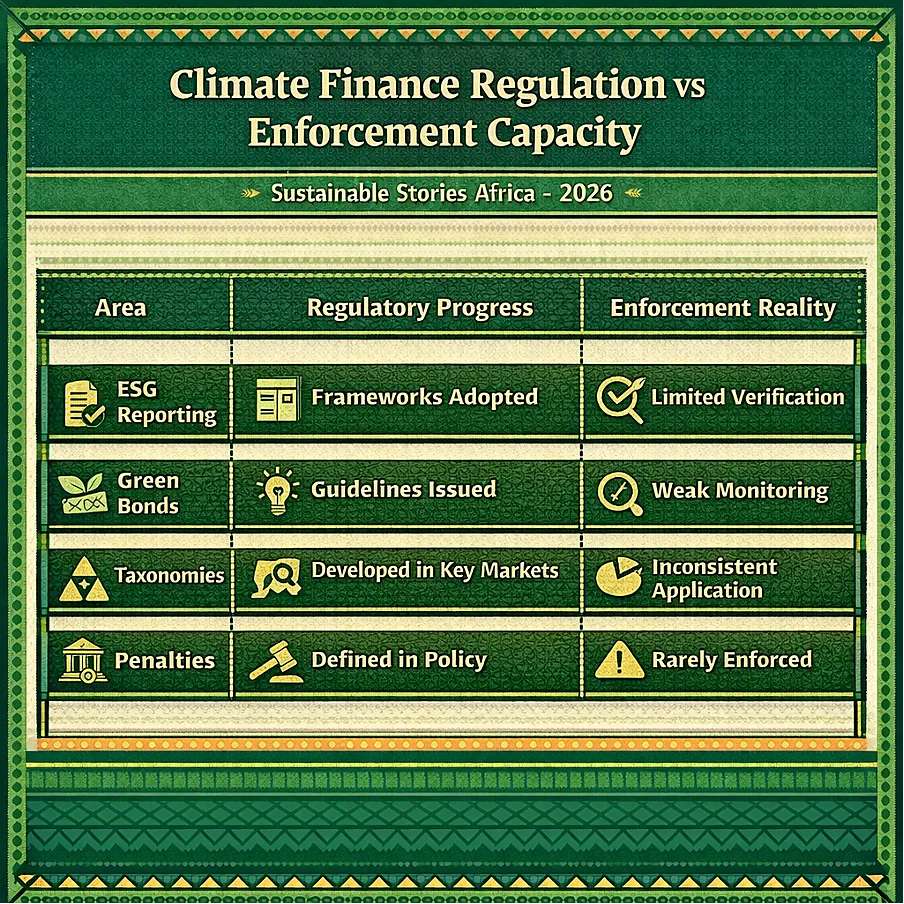
Experts note that while Africa's climate finance ecosystem is evolving, enforcement institutions have not kept pace with policy design.
Stronger Rules, Real Market Confidence
Effective enforcement could unlock major benefits for African economies. Clear accountability would strengthen investor confidence, attract long-term climate finance, and improve the credibility of sustainable finance markets.
Investors are increasingly demanding transparent, verifiable ESG data. Without enforcement, Africa risks being identified as a high-risk destination for green investment, despite its vast renewable energy and adaptation opportunities.
Stronger oversight would also protect local communities by ensuring that climate projects deliver appropriate environmental and social benefits, rather than just marketing claims.
Why Enforcement Matters
| Benefit | Impact |
|---|---|
| Investor confidence | Higher capital inflows |
| Market integrity | Reduced greenwashing |
| Community trust | Better project outcomes |
| Policy credibility | Stronger global standing |
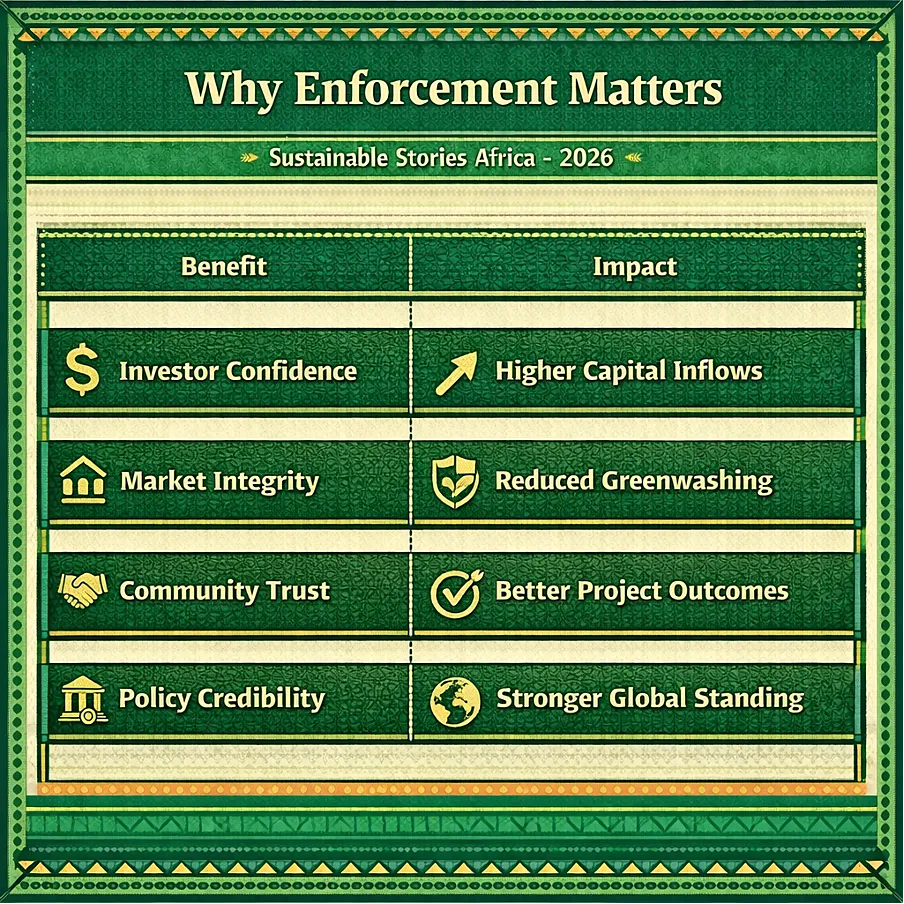
For Africa to fully benefit from climate finance, rules must translate into measurable action.
From Paper Policies to Practice
The research highlights the urgent need for governments, regulators, and financial institutions to move beyond policy adoption toward effective enforcement.
Key priorities include:
- Strengthening regulatory institutions with technical capacity
- Clarifying ESG reporting obligations
- Introducing meaningful penalties for non-compliance
- Enhancing data transparency and verification systems
Without these steps, Africa's climate finance rules risk becoming symbolic rather than transformative.
The credibility of Africa's green transition depends not just on writing rules, but on enforcing them.
PATH FORWARD – Turning Rules Into Real Results
Africa's climate finance frameworks are expanding, but enforcement must now catch up. Regulators need stronger tools, clearer mandates, and greater institutional capacity to ensure compliance.
By prioritising accountability, Africa can protect investors, improve project quality, and unlock the full potential of sustainable finance for economic growth and climate resilience.
Culled From: Africa's climate finance rules are growing, but they're weakly enforced, new research suggests