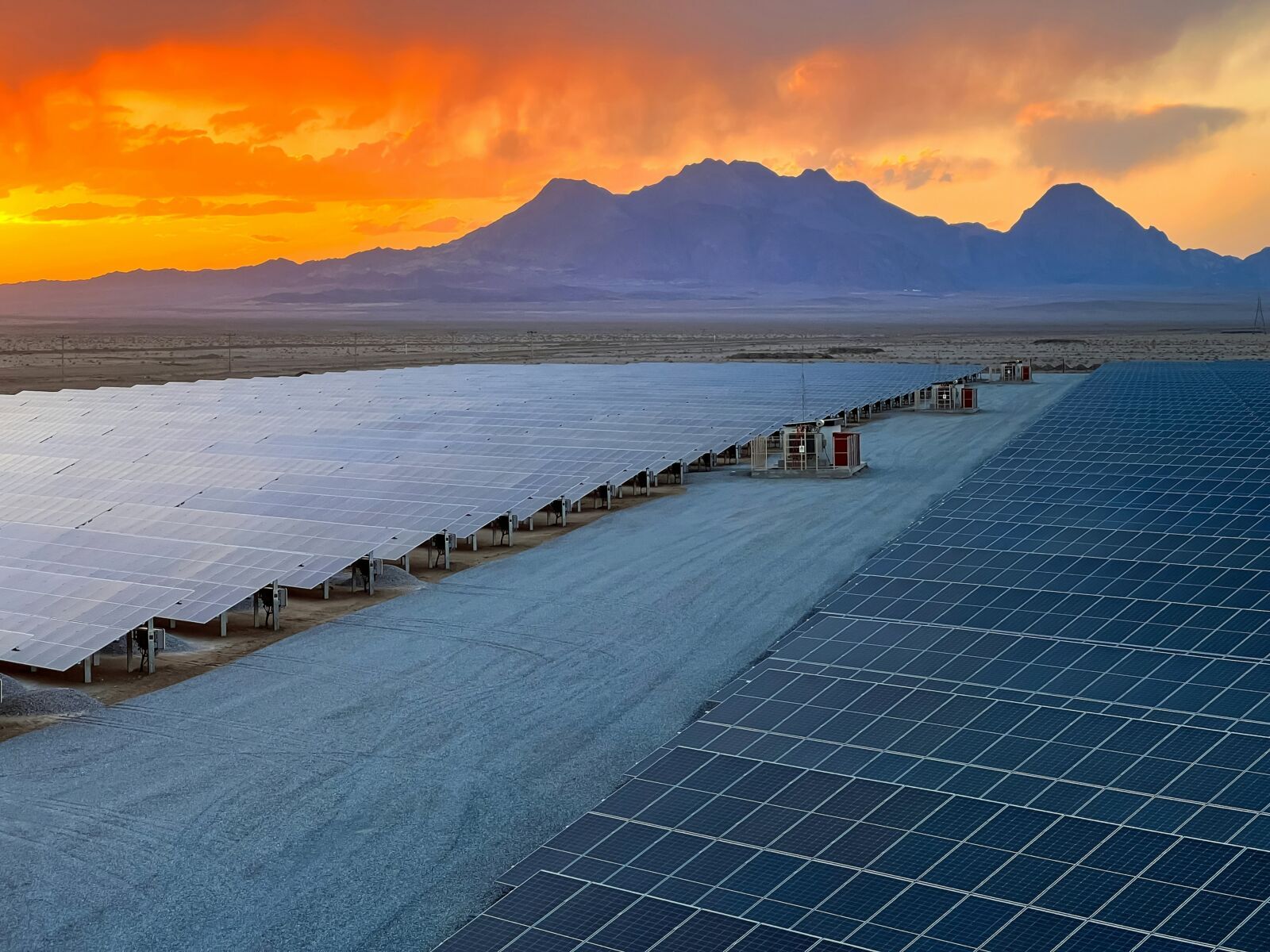
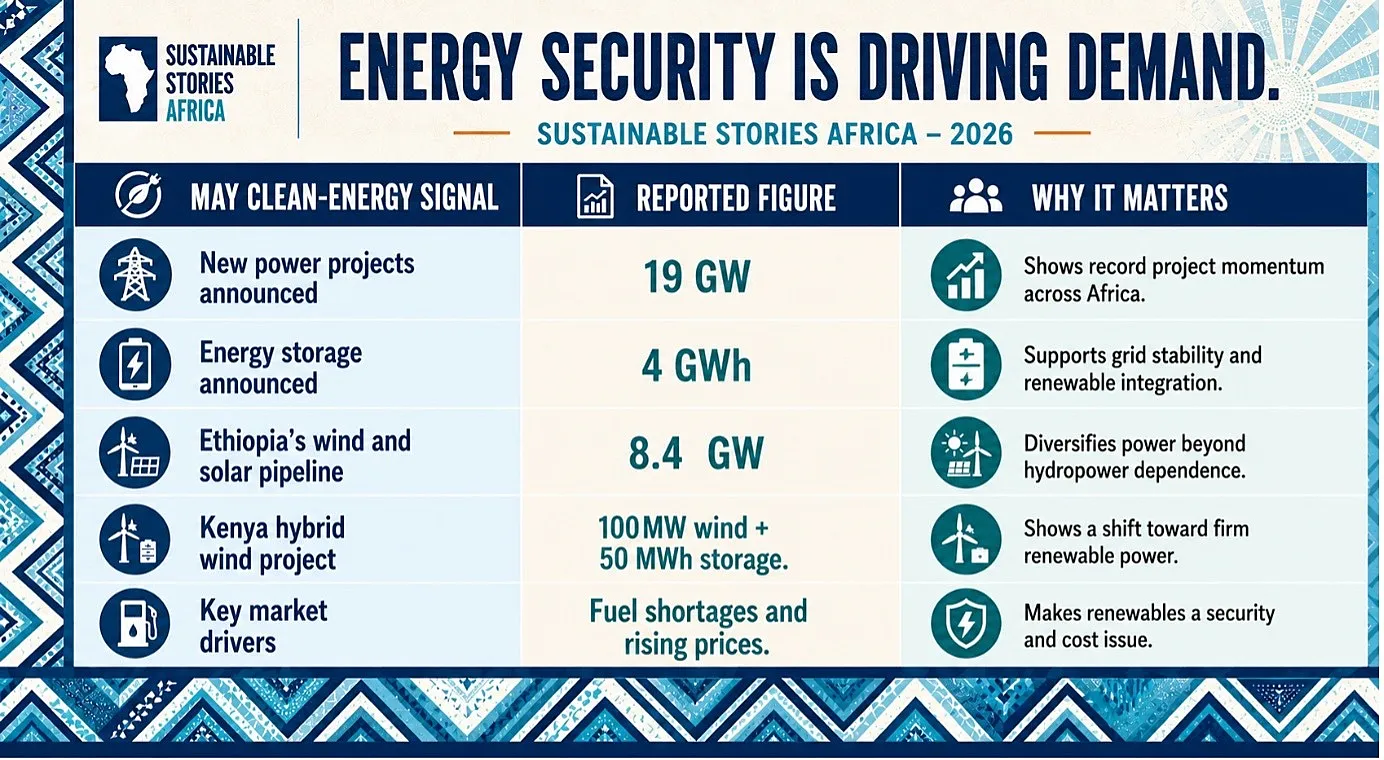
Africa recorded 19 GW of new power projects announced in May, alongside 4 GWh of energy storage.
The surge shows how energy security, fuel price pressure and industrial ambition are accelerating renewable energy decisions across the continent.
For households, factories and governments, the shift could mean cheaper power, fewer outages and stronger local clean-energy value chains.
Africa’s Power Pipeline Breaks Records
Africa’s renewable energy market recorded a sharp acceleration in May, with 19 GW of new power projects and 4 GWh of energy storage announced across the continent, according to Renewables Rising.
The record month points to a deeper shift in African energy planning. Countries are no longer treating renewables only as climate assets.
They are increasingly seeing solar, wind, storage and hybrid systems as tools for energy security, industrial growth and protection against fuel price volatility.
Ethiopia led the month’s announcements with 8.4 GW of wind and solar projects, as the country seeks to diversify its electricity system, which has historically been anchored by hydropower.
Kenya also entered a new phase of hybrid power development, launching its first wind-and-storage project combining 100 MW of wind capacity with 50 MWh of battery storage.
For families and businesses, the numbers matter because power shortages are not just technical problems.
They close workshops early, raise the cost of food processing, disrupt hospitals and force small enterprises to spend scarce cash on diesel.
Energy Security Is Driving Demand
The scale of May’s project pipeline reflects rising concern over fuel shortages and price pressures since February, which have driven governments and companies to accelerate the adoption of renewables.
Across the continent, the clean-energy conversation is moving from promises to project pipelines. Solar imports are rising, battery storage is gaining traction, and hybrid systems are becoming more attractive in countries where grid reliability remains a major constraint.
Ethiopia’s position is especially significant. Hydropower has long been central to its electricity system; however, climate variability and rising demand are making diversification more urgent.
Adding solar and wind can reduce dependence on rainfall patterns and improve system resilience.
Kenya’s hybrid project also reflects a practical lesson now spreading across African markets: renewable power needs storage, flexibility and smarter grids to deliver reliable electricity.
A wind farm backed by batteries can reduce intermittency and make clean power more useful to homes, businesses and utilities.
Desire: Clean Power Can Cut Costs
If May’s momentum turns into completed projects, the benefits could be wide-ranging.
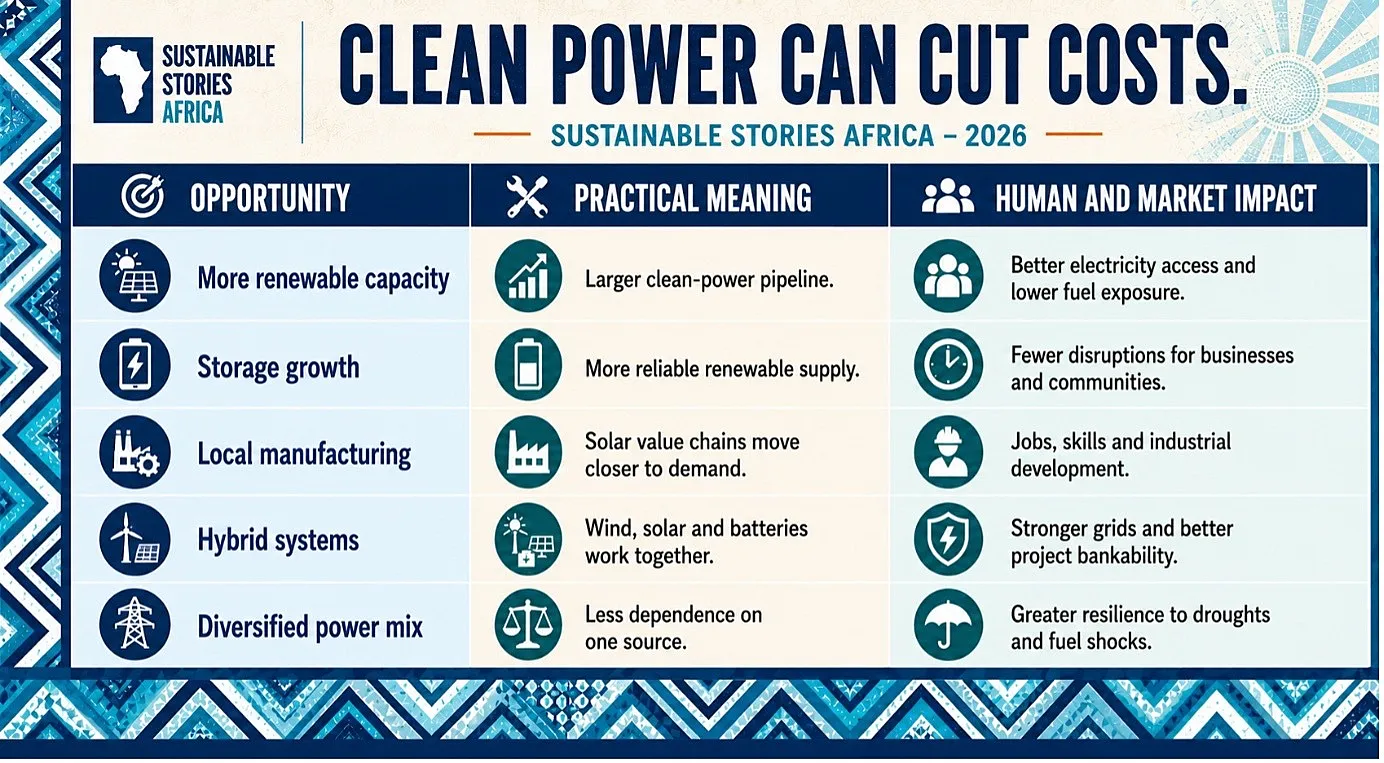
More renewable energy generation can reduce reliance on imported fuels, lower long-term electricity costs, and strengthen power supply for industrial zones, farms, schools and clinics.
For a food processor in Kano, a textile workshop in Addis Ababa or a cold-chain operator near Nairobi, reliable power is the difference between growth and stagnation.
When electricity fails, machines stop, goods spoil, and workers lose hours. When power is stable, businesses invest, hire and expand.
The surge in renewable energy also creates a manufacturing opportunity.
Renewables Rising noted that major solar importers, including South Africa, Nigeria and Egypt, are localising solar manufacturing to support industrialisation and job creation as demand for solar products rises.
The risk is that project announcements do not automatically become working infrastructure.
Permitting delays, weak grids, currency pressure, financing gaps and policy uncertainty can slow delivery. Africa’s clean-energy pipeline is growing, but execution remains the real test.
Turn Announcements Into Delivery
Governments now need to convert the record May pipeline into bankable, connected and operational projects.
That means faster approvals, stronger transmission planning, clearer procurement rules and better credit support for utilities and private buyers.
Investors also need predictable regulation. Renewable projects are capital-intensive, and developers need confidence that tariffs, grid access and payment frameworks will remain stable.
For African policymakers, the core message is clear: renewable energy must be treated as economic infrastructure.
It should power factories, support agriculture, strengthen public services and reduce exposure to imported fuel shocks.
The opportunity is not simply to add gigawatts. It is to build cleaner, more resilient energy systems that improve daily life and support long-term industrial growth.
Path Forward – Build Projects, Grids, and Jobs
Africa’s record May pipeline should now move from announcement to execution. Governments must prioritise bankable projects, storage, transmission and transparent procurement.
The next phase should link clean power to jobs, manufacturing and energy security.
If delivered well, the 19 GW surge can become more than a market milestone; it can become a foundation for resilient African growth.
Culled From: May sees record 19 GW of new capacity