Africa’s pharmaceutical sector is moving from dependency to strategic possibility as governments, investors and health institutions push for more local production.
The opportunity matters now because Africa still imports most of its medicines while demand for affordable, quality healthcare continues to rise.
If reforms succeed, the continent could build health security, industrial jobs and stronger supply chains for 1.5 billion people.
Africa’s Medicine Deficit Meets Opportunity
Africa’s pharmaceutical industry is approaching a defining moment: the continent can remain heavily dependent on imported medicines or build a stronger manufacturing base that improves health security and industrial growth.
A Brookings analysis by Landry Signé argues that Africa’s pharmaceutical transformation is now both an economic opportunity and a public health necessity.
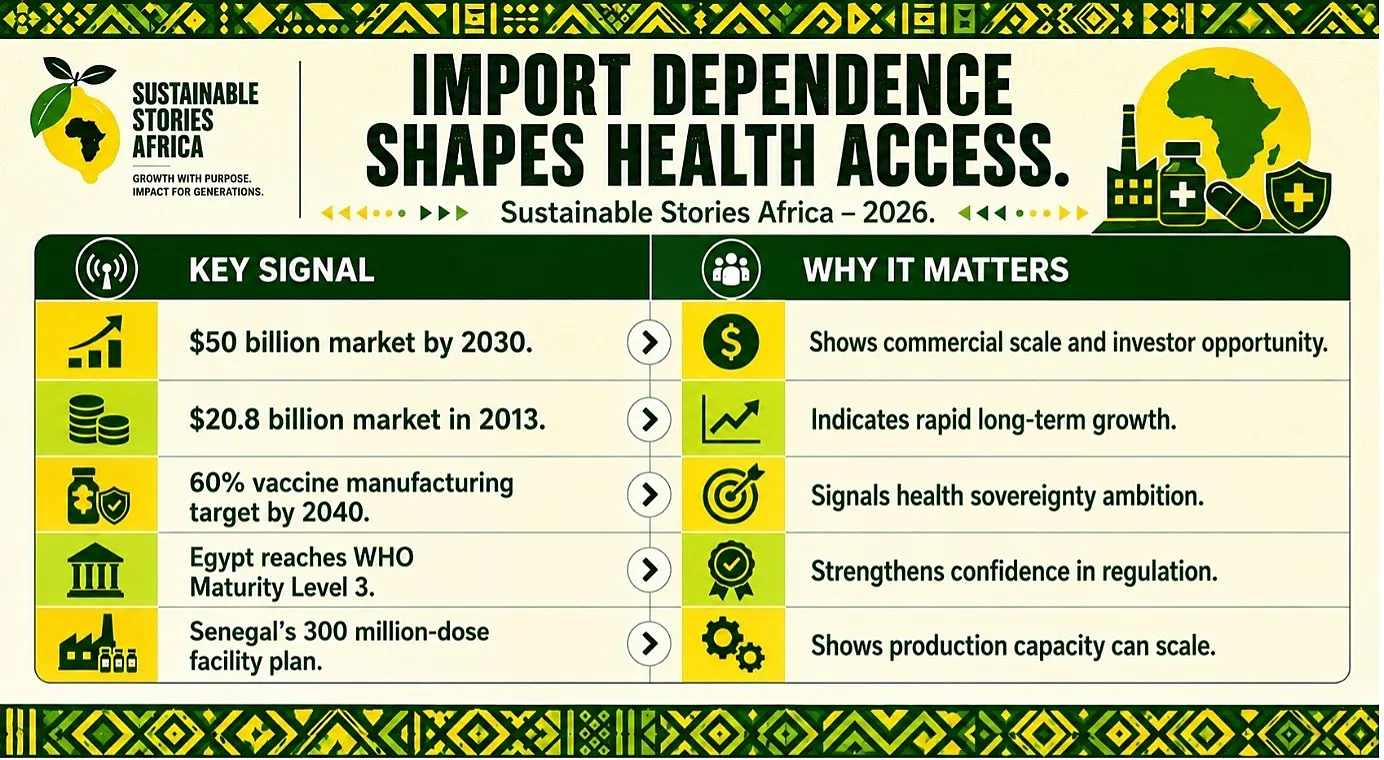
The continent’s pharmaceutical market is projected to reach $50 billion by 2030, up from $20.8 billion in 2013, while African leaders are pursuing plans to manufacture locally by 2040, 60% of vaccine needs.
The lesson from COVID-19 still hangs over the sector. When global supply chains tightened, many African countries found themselves waiting for medicines, vaccines and essential health products produced elsewhere.
That experience turned pharmaceutical production from a technical policy issue into a question of sovereignty.
Interest: Import Dependence Shapes Health Access
For millions of African households, the pharmaceutical gap is not abstract. It appears when a clinic lacks essential medicine, when a parent cannot afford treatment, or when a hospital depends on delayed imports for supplies that should be produced closer to patients.
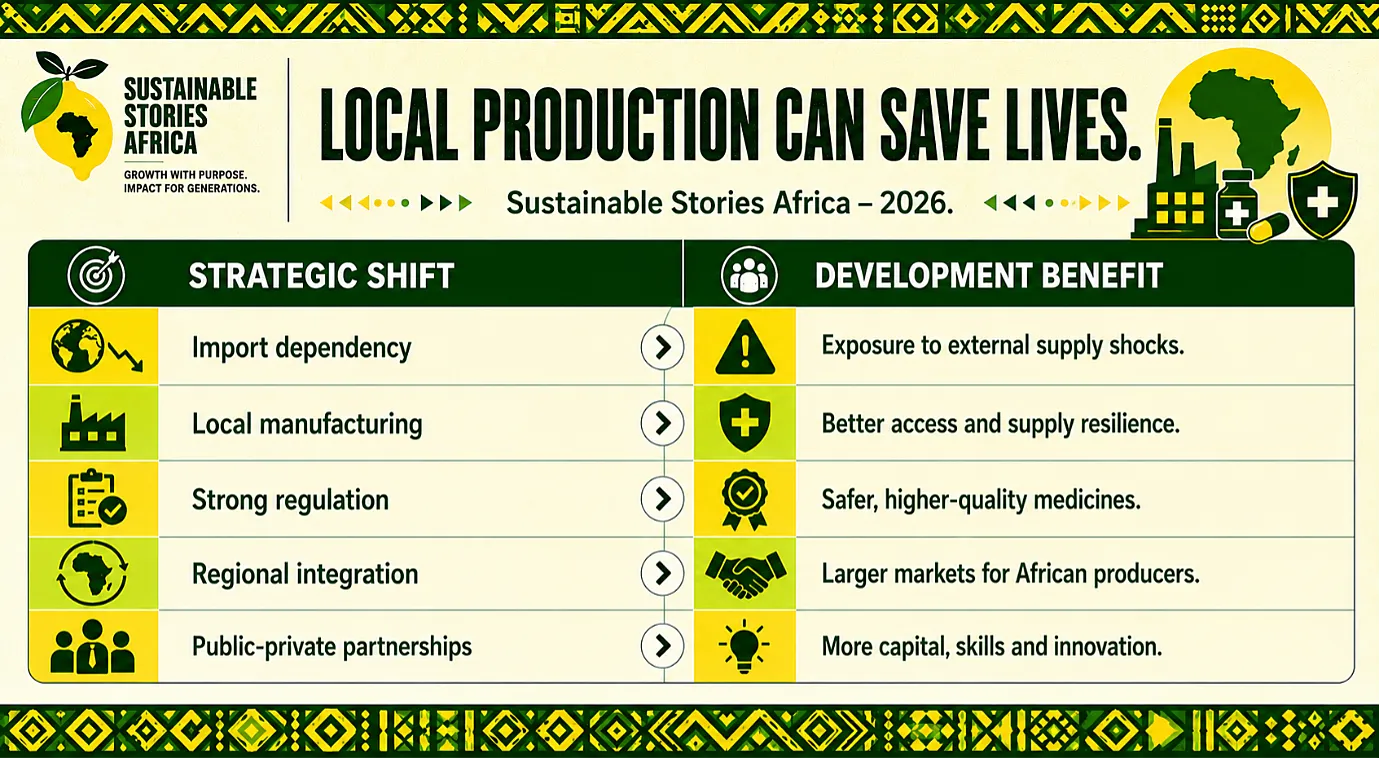
Brookings notes that Africa has long been a major importer of medicines, but is increasingly positioned to move up the value chain as a producer, innovator and supply-chain participant. Signé identifies regulatory capacity, local manufacturing, AfCFTA-enabled market integration and public-private partnerships as critical levers for this shift.
There are already signs of movement. Egypt has become the first African country to reach WHO Maturity Level 3 for medicines regulation, Senegal is building capacity to produce 300 million vaccine doses annually, and Gavi’s African Vaccine Manufacturing Accelerator has mobilised $1.2 billion in pledges.
Local Production Can Save Lives
The prize is beyond factory output.
A stronger African pharmaceutical sector could reduce import vulnerability, shorten supply chains, improve medicine availability, create skilled jobs, support research and development, and retain more economic value on the continent.
The Brookings argument also connects pharmaceuticals to industrialisation.
Medicine production requires laboratories, logistics, energy, reliability, regulation, skilled workers, finance, quality assurance and regional markets.
In that sense, every successful pharmaceutical cluster becomes more than a health asset; it becomes an industrial ecosystem.
AfCFTA could be decisive. Fragmented national markets make it harder for manufacturers to scale.
A more integrated African market would help producers serve larger demand pools, reduce duplication and attract long-term investment.
Reform Must Match The Ambition
Africa’s pharmaceutical future will not be built by ambition alone.
- Governments must strengthen medicine regulation, improve procurement systems, support industrial parks, expand technical training and create predictable incentives for manufacturers.
- Investors will also need bankable demand. That means pooled procurement, reliable payment systems, stronger public health budgets and clearer market access rules.
- Development finance institutions can help by reducing risk for early-stage manufacturing, especially in vaccines, active pharmaceutical ingredients and essential medicines.
- The private sector has a role beyond capital. It must invest in quality systems, workforce development, technology transfer and local supplier networks.
- Universities and research centres should be connected more deliberately to industry so that Africa not only manufactures medicines but also innovates around African disease burdens.
The call to action is clear: health policy, trade policy and industrial policy must move together.
Without that coordination, Africa may build factories that struggle to compete.
With it, the continent can build a pharmaceutical base that serves patients, workers and markets at once.
Path Forward – Build Health Security Through Industry
Africa’s pharmaceutical opportunity now requires coordinated regulation, financing, manufacturing capacity, skills development and regional market integration.
The goal is not only to make medicines locally, but to build trusted systems that deliver quality and affordability.
If implemented well, the sector can advance public health, ESG-aligned investment and inclusive industrialisation.
Africa’s medicine market can become a platform for resilience, jobs and sovereignty.
Culled From: Realizing Africa’s pharmaceutical potential | Brookings