
Generative AI’s workplace problem now has a name: workslop.
A recent Meet The Leader episode argues that low-quality AI output is less a technology failure than a leadership warning sign.
For African firms, the lesson is urgent: without standards, coaching, and accountability, AI could scale confusion faster than productivity.
AI Is Exposing Weak Leadership Systems
The promise of artificial intelligence was simple: faster work, sharper decisions and more productive teams.
However, a growing workplace problem, now called AI “workslop,” is challenging that promise and forcing leaders to confront a harder truth: poor AI output often reflects poor management systems.
In a recent Meet The Leader podcast episode, BetterUp Co-Founder and CEO Alexi Robichaux argued that workslop is not merely a staff performance issue. It is often a signal that teams lack clear standards, strong direction and useful feedback before AI is introduced at scale.
The episode defines workslop as low-quality work produced through poor human-AI collaboration, wasting time and limiting productivity gains that executives expect from AI.
That framing matters for companies across Africa and the Global South, where businesses are racing to adopt AI for reporting, customer service, research, content, finance, compliance and operations.
The risk is not that employees use AI. The risk is that they use it inside systems where no one has clearly defined what good work looks like.
The Hidden Cost of Poorly Polished Work
Workslop — AI-generated content that appears polished but lacks substance; it is quietly becoming an operational liability.
It arrives dressed as a report, slide deck, or strategy note, yet beneath the formatting lie missing context, weak analysis, and absent judgment.
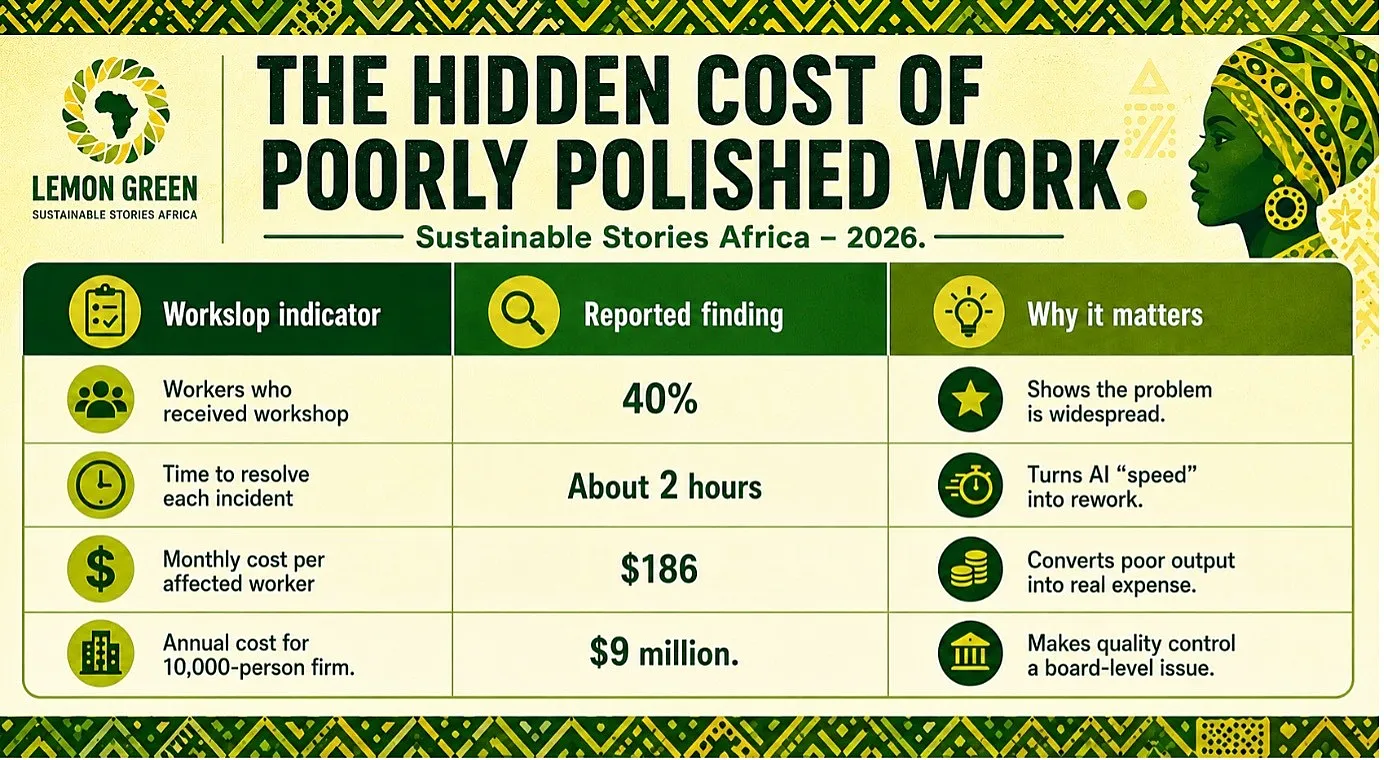
Research by BetterUp Labs and Stanford Social Media Lab found that 40% of U.S. desk workers received workslop within a single month.
Each incident takes roughly two hours to resolve, costs $186 per affected employee monthly, and could burden a 10,000-person organisation with $9 million in annual productivity losses.
Harvard Business Review reinforces this concern, warning that workslop shifts the thinking burden downstream, forcing colleagues to interpret, correct, or redo work that should never have been shared.
Its prescription is clear: leaders must model responsible AI use, set guardrails and treat AI as a collaborator, not a shortcut.
For African organisations, the risk is sharper. AI-generated drafts routinely miss local regulation, market nuance and stakeholder context, turning a time-saving tool into a time-consuming problem.
Better AI Use Can Build Better Teams
Workslop is fixable, and can even sharpen organisational performance. Companies that define clear standards, train managers and build stronger review cultures can transform AI from a liability into a genuine productivity multiplier.
The World Economic Forum's Meet The Leader podcast, featuring BetterUp CEO Alexi Robichaux, highlights a practical entry point: leaders should rehearse direction giving and feedback using AI coaching tools before those habits spread across teams.
For African markets, the stakes extend beyond efficiency. Poor AI-generated output can distort sustainability reports, weaken investor communication, produce misleading climate disclosures and undermine compliance.
Conversely, disciplined use of AI can accelerate research, improve disclosure quality and extend capabilities to smaller organisations. The choice is not whether to use AI; it is whether to use it well.
Action: Leaders Must Set The Standard First
The fix begins at the top. Leaders must stop treating AI adoption as a vague instruction to “use the tools” and start treating it as an operating discipline.
That means defining when AI should be used, when it should not, who reviews outputs, what evidence is required, and how teams disclose AI assistance internally. It also means rewarding judgment, not just speed.
The most important leadership question is no longer, “Are our people using AI?” It is, “Is AI helping our people produce better work?”
For boards, CEOs and managers, the call to action is clear:
- Build AI governance into everyday work.
- Create review checklists.
- Train teams in prompt quality, fact-checking and source evaluation.
- Protect staff from unrealistic productivity demands.
- Make managers accountable for clarity.
AI should not become a machine for producing more documents. It should become a system for producing better decisions.
Path Forward – Standards Before AI Scale
African firms should treat workslop as an early governance warning, not a passing workplace annoyance.
The priority is to define quality, accountability and review standards before AI becomes embedded in daily operations.
The next phase of AI adoption must focus on human capability: better managers, clearer briefs, stronger feedback and responsible use.
That is how AI moves from noise to value.