Nearly two-thirds of surveyed sustainability leaders expect Asia-Pacific’s influence on the global agenda to increase over the next three years.
GlobeScan and BSR also found rising expectations for the European Union and China, while 43% foresee a decline in US influence.
The shift gives Africa an opening to shape standards and solutions rather than receive them.
Sustainability’s Centre Is Multiplying
The future of corporate sustainability is becoming less concentrated in one geography. In a GlobeScan and BSR survey, 62% of senior sustainability professionals expected Asia-Pacific’s influence to increase over the next three years.
The European Union and China followed at 51% each, while respondents were more likely to see United States influence decreasing than increasing.
- The findings do not identify a single replacement for Western leadership.
- They point instead to a more distributed system in which regulation, technology, capital and consumer expectations emerge from several markets at once.
- For multinational companies, a single global playbook written at headquarters will be less capable of reading these signals.
Influence Is Rebalancing Across Regions
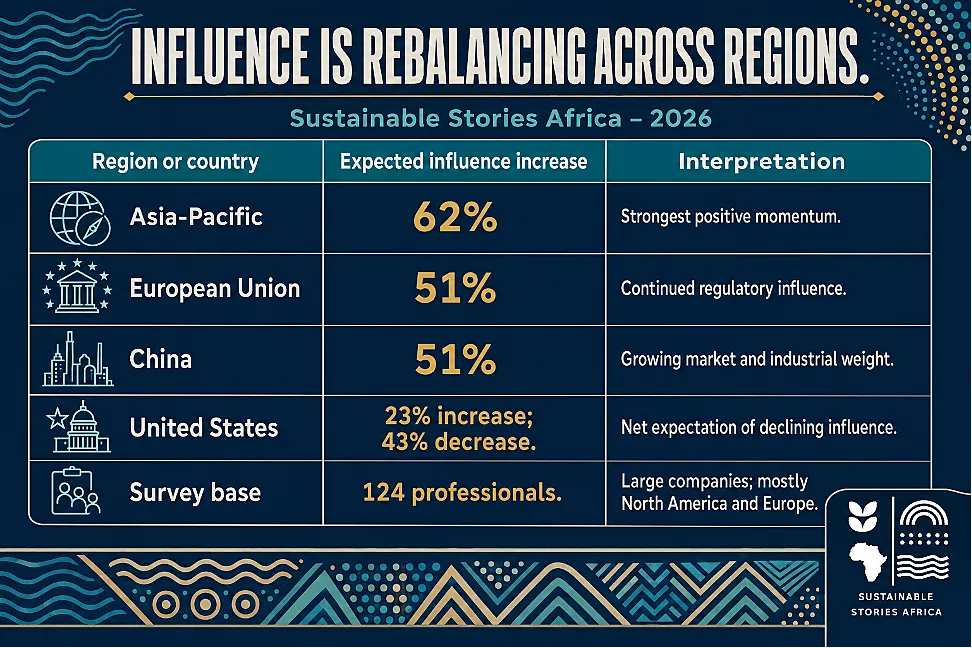
43% of respondents expected US influence on sustainability to decline, compared with 23% who expected it to rise.
Latin America, the Middle East and North Africa were also seen as gaining ground. The EU remains a powerful standard-setter, while China’s manufacturing scale and Asia-Pacific’s investment, technology and market growth are increasing their agenda-setting weight.
The survey covered 124 sustainability professionals working at companies with annual revenue of at least $1 billion.
It was conducted online in April and May 2026, with most respondents based in North America and Europe.
That composition is an important limitation: the results show the expectations of large-company practitioners, not a representative global public survey.
- The rebalancing arrives as corporate sustainability teams report tighter resources, more focus on compliance and narrower priorities.
- This can make geographic intelligence even more important.
- A company deciding where to source materials, build a factory or launch a product must understand several regulatory and stakeholder environments without losing a coherent global standard.
Africa Can Become A Rule-Maker
Africa is not yet highlighted as a leading centre in the published figures, but a distributed landscape creates room for greater influence.
The continent holds critical minerals, fast-growing cities, renewable resources, young consumers and deep experience in adaptation, energy access and inclusive finance.
These realities can shape practical sustainability solutions if African institutions convert them into research, standards and investable models.
Local relevance also improves implementation. Global commitments often fail when they ignore informal economies, community land rights, infrastructure gaps or the cost of capital.
Strong African participation can make sustainability strategy more credible by connecting ambition to the conditions in which projects and livelihoods actually operate.
This does not require lowering global expectations. It requires recognising that the route to an outcome may differ.
A just energy transition in a market with near-universal access is not identical to one where households and businesses still face unreliable supply.
Distributed leadership can make those differences visible while preserving shared goals on climate, nature and human dignity.
Build Intelligence Across Multiple Markets
Boards should ask whether their sustainability strategies are informed by the teams and stakeholders in the markets where impacts occur.
Companies need regional listening systems, comparable core principles and enough flexibility to respond to local laws, culture and development priorities.
African governments, exchanges, universities, civil society and business groups should invest in original data and coordinated positions at global forums.
Influence is earned through evidence, implementation and coalition-building. If the agenda is becoming more distributed, Africa should not wait to be invited into a new map drawn by others.
Path Forward – Build Global Strategy Through Local Intelligence
Companies should combine common sustainability principles with stronger regional intelligence and decision-making.
Local teams must help interpret regulation, stakeholder expectations and development realities.
African institutions should produce data, standards and coalitions that carry the continent’s priorities into global forums.
Distributed influence is an opportunity only if Africa actively uses it.
Culled From: The Future of Sustainability Is Becoming More Globally Distributed