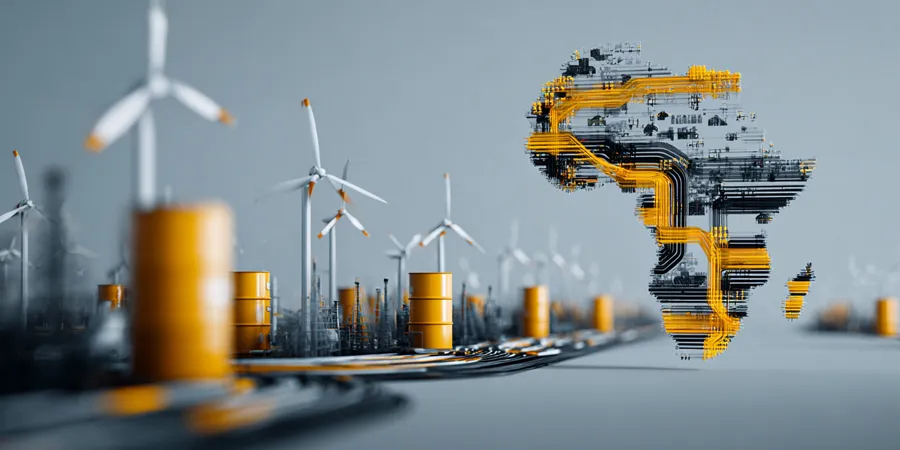
Asian and Arab investors are rapidly scaling capital flows into Africa’s energy transition, positioning the continent as a strategic frontier for global decarbonisation and industrial growth.
Sovereign funds, infrastructure investors, and state-linked companies are accelerating investments across renewables, green hydrogen, and critical minerals.
This surge reflects both Africa’s resource advantage and the efforts of the Asia-Middle East countries to secure future energy supply chains.
For African economies, the investments signal a rare alignment between climate ambition and economic transformation.
However, execution risks, policy stability, grid infrastructure, and financing frameworks will determine whether these bets deliver lasting industrial change.
Asians, Arabs Reshape Africa’s Transition Financing Landscape
Africa’s energy transition is increasingly being shaped by investors from Asia and the Arab world, who are committing billions of dollars to renewable energy, green hydrogen, and strategic minerals.
The shift reflects growing recognition of Africa’s central role in future global energy systems and industrial decarbonisation.
Asian industrial economies, including China, South Korea, and India, are investing to secure critical mineral supply chains and diversify renewable energy assets.
Meanwhile, Gulf sovereign wealth funds and state-linked energy firms are deploying capital to expand clean energy portfolios and reposition themselves for a post-oil global economy.
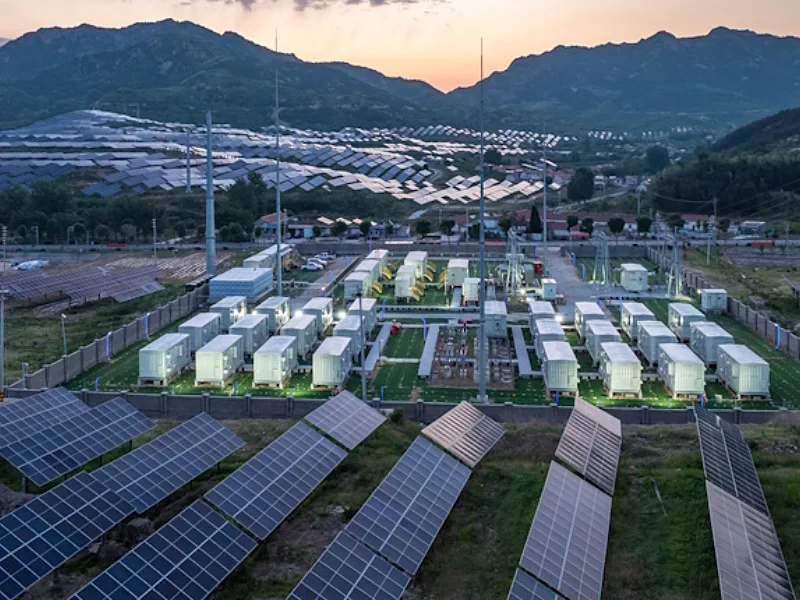
These investments are concentrated in solar generation, transmission infrastructure, green hydrogen corridors, and mineral processing hubs across countries such as Egypt, Morocco, Namibia, South Africa, and Kenya.
Global Capital Repositions Africa Transition Leadership
Africa is emerging as one of the most strategically important investment destinations in the global energy transition, driven by its vast solar potential, mineral reserves, and growing energy demand.
Asian and Arab investors see Africa not merely as a resource base, but as a partner in future energy value chains, from raw materials to refined industrial production.
This capital inflow represents a structural shift from extractive investments toward integrated energy infrastructure and industrial development.
Sovereign Funds Target Strategic Energy Security
Asian and Gulf investors are pursuing Africa’s transition as part of broader national energy security and economic diversification strategies.
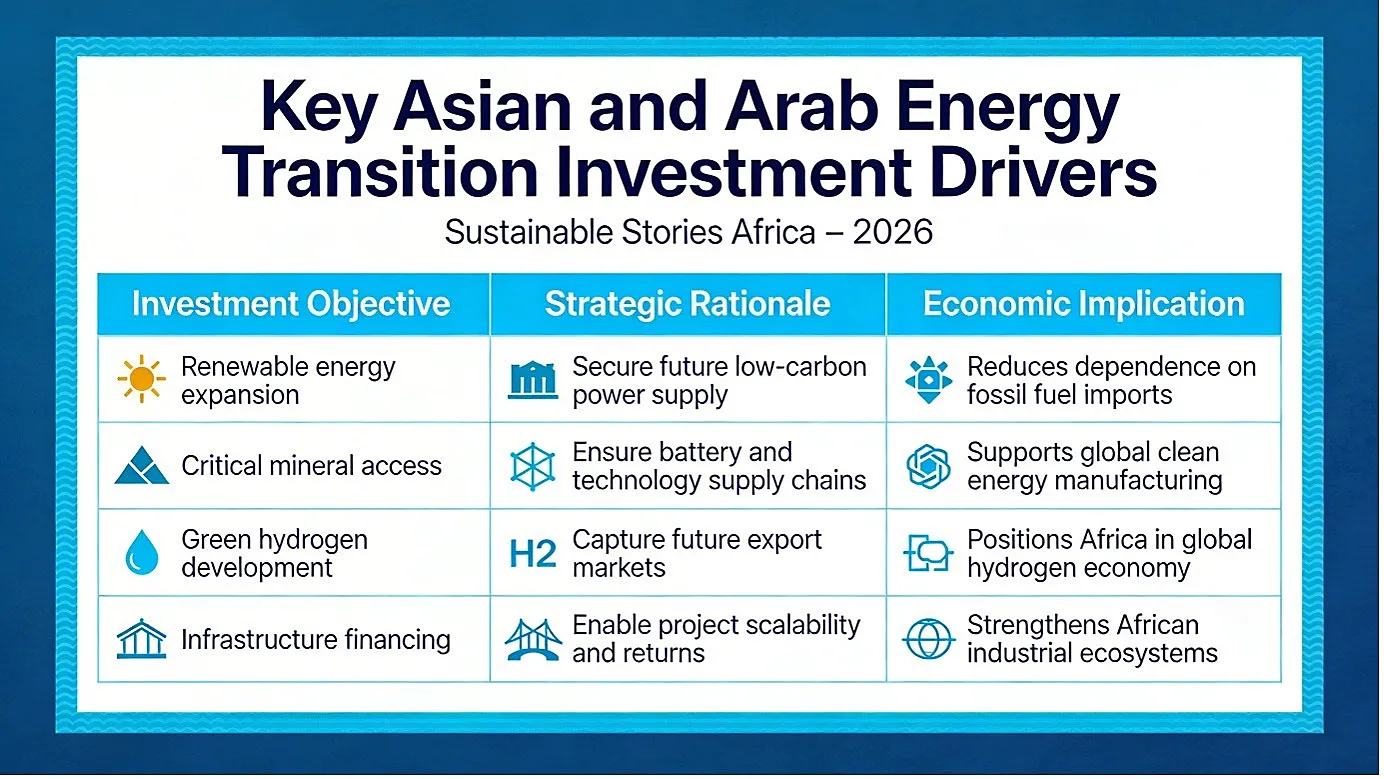
Key Asian and Arab Energy Transition Investment Drivers
Investment Objective | Strategic Rationale | Economic Implication |
|---|---|---|
Renewable energy expansion | Secure future low-carbon power supply | Reduces dependence on fossil fuel imports |
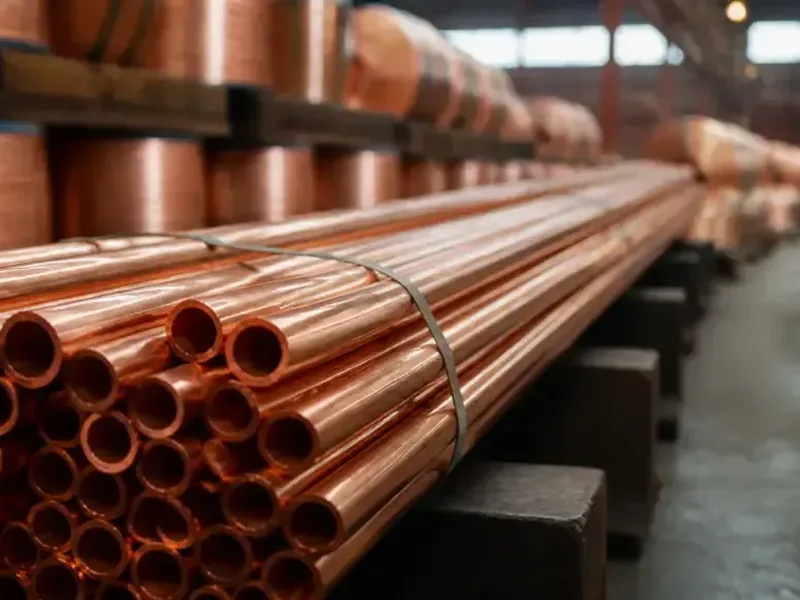
Critical mineral access | Ensure battery and technology supply chains | Supports global clean energy manufacturing |
Green hydrogen development | Capture future export markets | Positions Africa in global hydrogen economy |
Infrastructure financing | Enable project scalability and returns | Strengthens African industrial ecosystems |
These investments are structured through sovereign wealth funds, export credit agencies, development finance institutions, and corporate partnerships.
For example, Gulf investors are backing large-scale solar and hydrogen projects, while Asian investors are expanding mineral refining and manufacturing operations to integrate Africa into global clean technology supply chains.
Africa Gains Leverage In Energy Transformation
Africa stands to gain significant economic and structural benefits if these investments translate into local industrial capacity and employment growth.
Beyond energy generation, investments can catalyse domestic manufacturing, technology transfer, and infrastructure expansion.
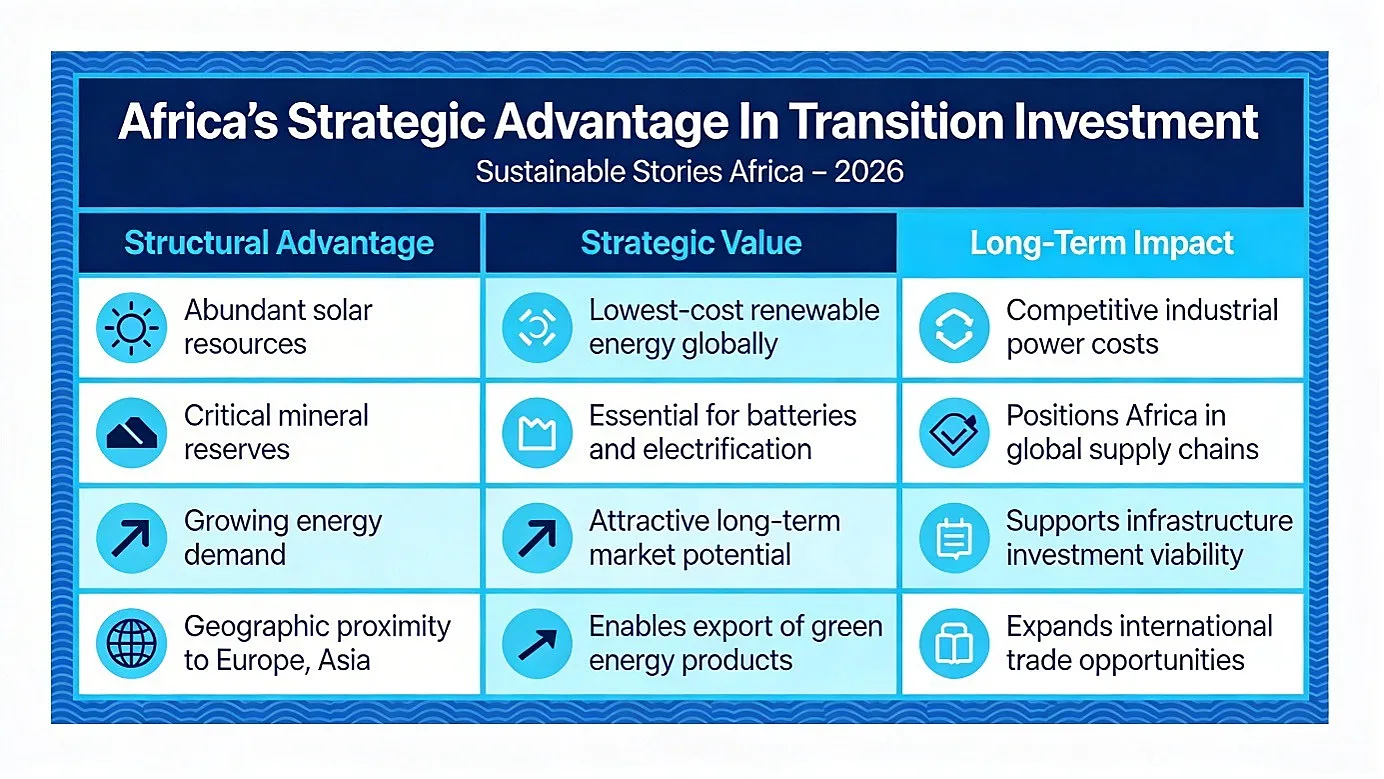
Africa’s Strategic Advantage In Transition Investment
Structural Advantage | Strategic Value | Long-Term Impact |
|---|---|---|
Abundant solar resources | Lowest-cost renewable energy globally | Competitive industrial power costs |
Critical mineral reserves | Essential for batteries and electrification | Positions Africa in global supply chains |
Growing energy demand | Attractive long-term market potential | Supports infrastructure investment viability |
Geographic proximity to Europe, Asia | Enables export of green energy products | Expands international trade opportunities |
This dynamic creates an opportunity for Africa to shift from raw material exporter to energy and industrial powerhouse.
Policy Alignment Determines Investment Transformation Outcomes
However, the scale and impact of these investments will depend heavily on Africa’s domestic policy and institutional environment.
Investors require stable regulatory frameworks, bankable power purchase agreements, and reliable grid infrastructure. Without these, projects risk delays, higher costs, or cancellation.
Governments must also ensure investments support domestic economic development, including local employment, industrialisation, and technology transfer.
Effective coordination between governments, investors, and development institutions will determine whether Africa captures the full economic benefits of this transition.
Path Forward – Strategic Partnerships Must Drive Industrialisation Outcomes
African governments must strengthen regulatory clarity, grid infrastructure, and investment frameworks to unlock the full value of Asian and Arab capital flows. Stable policies will accelerate project implementation and investor confidence.
Strategic partnerships must prioritise domestic industrial development, enabling Africa to move beyond resource extraction toward integrated energy and manufacturing leadership in the global transition economy.
Strategic Analysis – Why This Investment Shift Matters Now
The surge in Asian and Arab capital reflects a structural realignment of global energy investment patterns. As Europe and North America focus on domestic energy transitions, Asia and the Middle East are expanding their international partnerships to secure future supply chains.
For Africa, this represents a pivotal economic opportunity.
If managed strategically, these investments can transform Africa’s energy systems, strengthen industrial capacity, and position the continent as a central pillar of the global clean energy economy.
If mismanaged, Africa risks remaining a supplier of raw resources rather than capturing the full economic value of its energy transition potential.
Culled From: Asians & Arabs place big bets on African transition