Businesses are being urged to identify where nature-related risk matters most by linking ecosystem decline to operations, supply chains and communities.
The shift matters because nature loss is no longer only an environmental concern; it is becoming a financial, operational and governance risk.
For African markets, the message is practical: water, soil, forests and biodiversity are business infrastructure.
Nature Is Now A Business Risk
Businesses can no longer treat nature as background scenery. A World Economic Forum analysis says companies must identify where nature-related risk matters most by understanding how changes in ecosystems affect the services that keep operations, supply chains and communities functioning.
The message is clear: nature-related risk becomes material when ecosystem services weaken.
Water supply, soil stability, flood protection, pollination, climate regulation and coastal protection are not abstract environmental assets. They are business inputs.
When they fail, disruption follows.
- Farms lose yields.
- Factories face water shortages.
- Roads flood.
- Insurers reprice exposure.
- Lenders question asset quality.
- Communities absorb the first shock.
- Companies later feel the cost through procurement, logistics, regulation and reputation.
For Africa, where agriculture, mining, energy, construction and consumer markets remain deeply tied to land and water systems, nature risk is not a distant ESG issue.
It is a balance-sheet issue.
How Risk Moves Through Nature
The WEF analysis argues that companies need to go beyond simple biodiversity mapping.
They must connect the “state of nature” to the ecosystem services on which their business depends.
This means asking sharper questions: Where are our factories, farms, suppliers and customers located?
- What natural systems support them?
- Which ecosystems are already under pressure?
- How would degradation affect revenue, costs, safety, compliance or community relations?
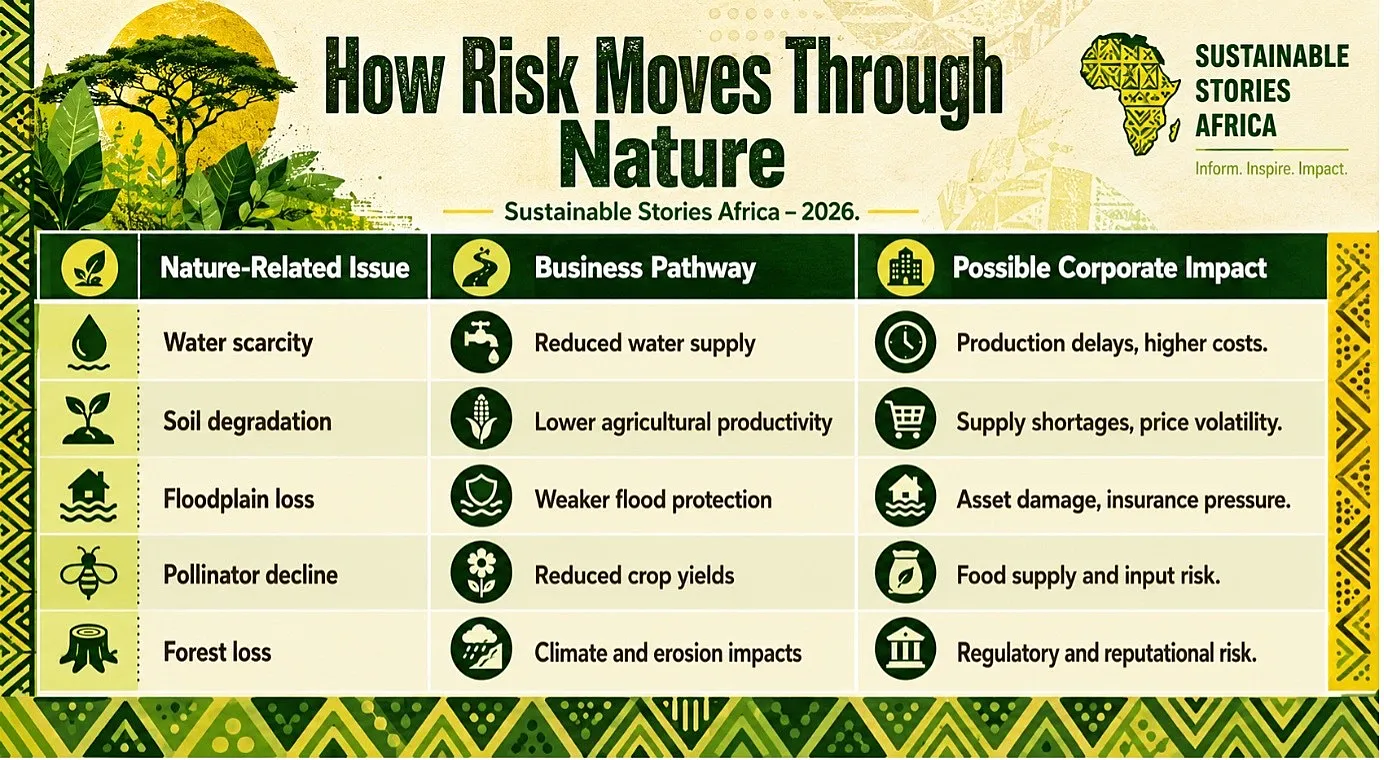
This is especially relevant for African companies and investors. A beverage manufacturer depends on clean water.
- A bank financing agribusiness depends on soil health and rainfall patterns.
- A mining firm depends on community trust, land stability and water stewardship.
- A city developer depends on drainage, wetlands and climate resilience.
Globally, the World Economic Forum has estimated that $44 trillion of economic value generation is moderately or highly dependent on nature and its services.
That figure explains why nature is entering boardrooms, loan committees and investor stewardship conversations.
The Taskforce on Nature-related Financial Disclosures offers a practical route through its LEAP approach: Locate, Evaluate, Assess and Prepare.
In simple terms, companies should locate their interface with nature, evaluate dependencies and impacts, assess material risks and opportunities, and prepare responses and disclosures.
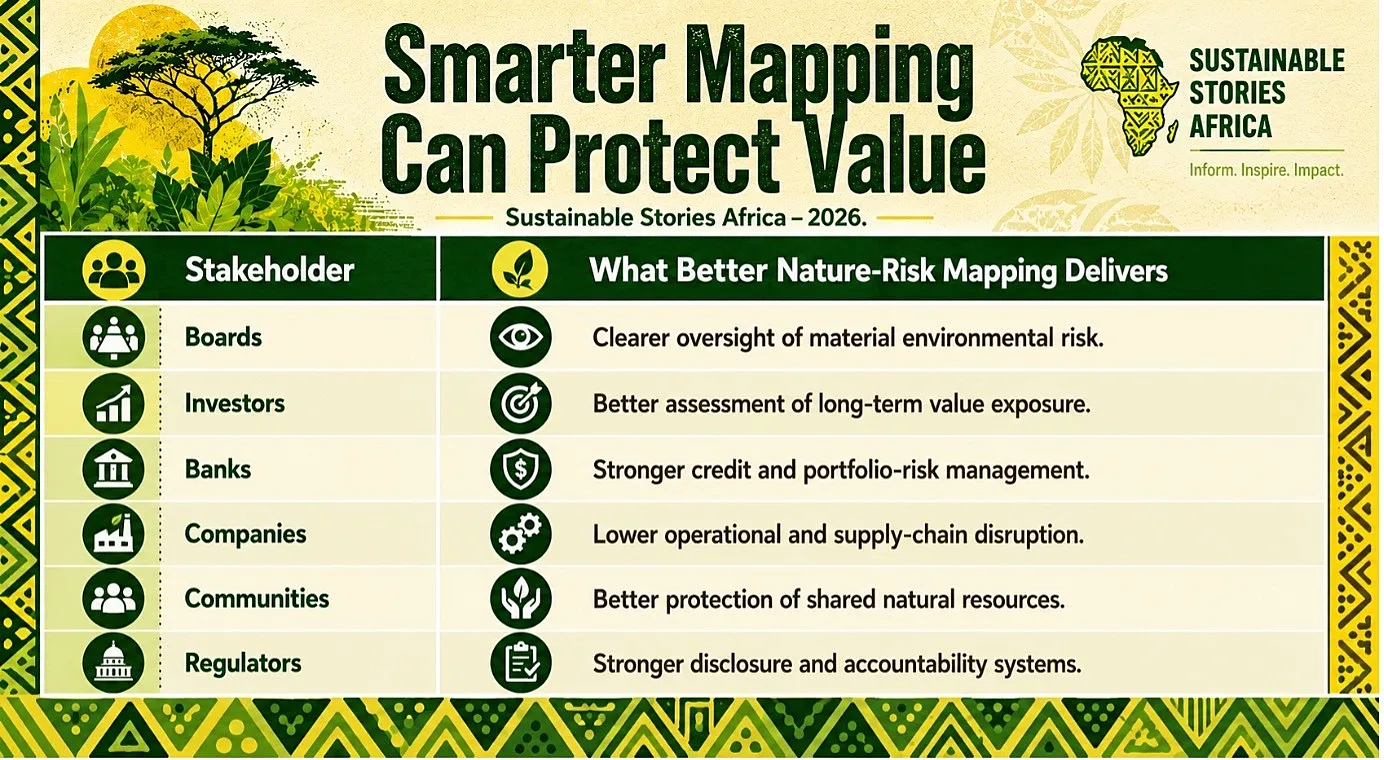
Smarter Mapping Can Protect Value
The business case for nature-risk mapping is not only defensive. Well done, it can unlock better strategy, stronger resilience and more credible ESG performance.
Companies that understand their nature dependencies can reduce exposure before disruption becomes expensive.
They can redesign sourcing, protect water catchments, restore degraded land, diversify suppliers, engage communities earlier and avoid stranded assets.
For financiers, nature-risk assessment can improve credit decisions.
It can reveal which borrowers are vulnerable to water stress, deforestation, biodiversity loss or social conflict linked to land use.
The upside is significant. Nature-positive business action can support food security, climate adaptation, water resilience, biodiversity protection and inclusive growth.
The cost of inaction is also clear.
Companies that ignore nature risk may face disrupted supply chains, community resistance, higher insurance costs, litigation, regulatory penalties and investor pressure.
Move Nature From Reports To Decisions
The next step is to move nature from sustainability language into business decision-making.
- Boards should require management to identify high-risk locations, priority ecosystem services and financially material dependencies.
- Chief financial officers should treat nature-related exposure as part of enterprise risk.
- Procurement teams should map supplier vulnerability.
- Banks should integrate nature risk into sector and borrower analysis.
For African markets, this requires better data, stronger disclosure systems and practical tools that work in local contexts.
- Companies should not wait for perfect datasets before acting.
They can begin with location mapping, supplier engagement, water-risk screening, land-use analysis and community consultation.
Nature risk should also be integrated into climate transition planning. The climate crisis and nature crisis reinforce each other.
A company that cuts emissions while destroying water systems or forests is not building true resilience.
Path Forward – For Nature-Smart Business
Businesses must identify where nature supports value, where ecosystems are weakening, and where risk could become financially material.
For Africa, a nature-smart strategy can strengthen ESG performance, protect communities and improve investment resilience.
The companies that act early will not only disclose better but also manage better.
Culled From: How businesses can identify where nature-related risk matters most | World Economic Forum