
Central banks and supervisors are increasingly treating transition plans as risk-management tools rather than voluntary climate promises.
The shift asks banks to highlight how strategy, lending and controls will respond to physical and transition risks over time.
For African regulators, proportionate requirements could expose concentration risks and financing gaps while avoiding a one-size-fits-all import of rules designed elsewhere.
Climate plans enter the supervisor’s office
Prudential transition plans are moving towards the centre of financial supervision as regulators seek forward-looking evidence that banks can manage climate risks without threatening their safety or the wider economy.
The emerging approach differs from a public net-zero pledge.
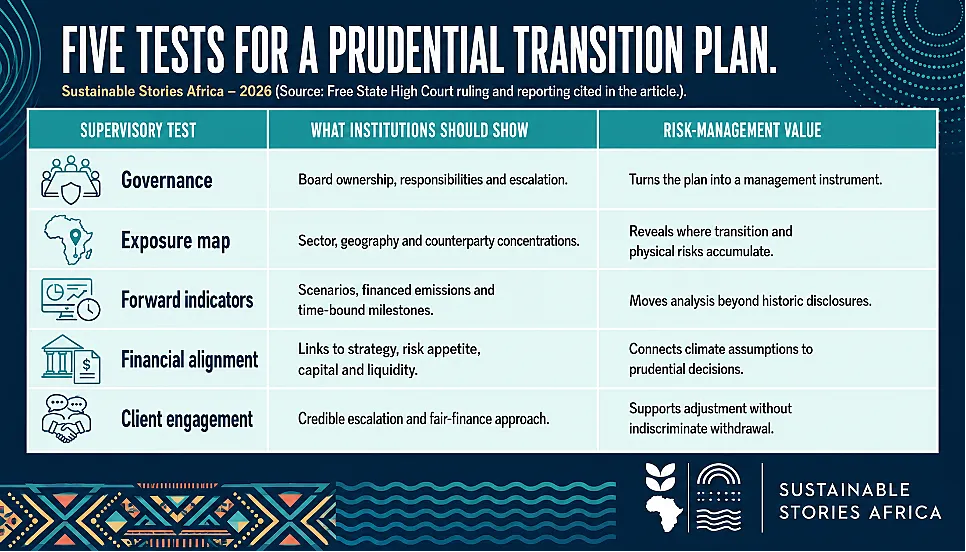
- A prudential plan links climate-related physical and transition risks to governance, business strategy, sector exposures, capital planning, client engagement and risk controls.
- Supervisors can then test whether a bank’s actions are credible under different economic pathways.
The momentum reflects a growing concern that traditional risk tools rely too heavily on historical data.
Floods, heat, drought, policy shifts and technological disruption can alter credit quality and asset values over periods that extend beyond normal planning horizons.
Europe has moved into implementation
The European Union has embedded climate and environmental risk management in revised capital rules.
From 2026, the European Banking Authority’s guidelines require institutions to identify and manage short- and long-term ESG risks using backwards- and forward-looking indicators, including financed emissions.
Banks are also expected to prepare prudential transition plans focused on risk management. These sit alongside, but are different from, corporate sustainability disclosures.
The distinction matters: disclosure tells markets what a bank reports, while supervision tests whether its strategy and controls protect safety and soundness.
The Network for Greening the Financial System has developed guidance on credible plans, climate targets, scenarios and adaptation.
Basel principles likewise recognise that physical and transition risks can affect individual banks and financial stability.
Plans can reveal hidden concentrations
A useful transition plan can show whether a lender is overly exposed to carbon-intensive borrowers, drought-sensitive agriculture, flood-prone property or infrastructure that may become uneconomic.
It can also identify opportunities in resilient housing, clean energy, water systems and climate-smart production.
However;
- Plans can become paperwork if supervisors focus on templates rather than decisions.
etrics must connect to credit policies, client assessments, pricing, limits and escalation.
Assumptions should be consistent with national transition pathways and tested against disorderly outcomes.
Adaptation deserves equal attention.
- In many African markets, immediate physical risk may be more financially material than distant emissions targets.
- Banks need to understand how heat, water stress and disaster recovery affect borrowers now.
African adoption should be proportionate
Regulators should begin with materiality, data readiness and supervisory capacity.
- Large, systemically important banks can face more requirements, while smaller institutions receive phased guidance and common tools.
Regional cooperation can reduce costs.
- Shared scenarios, taxonomies and sector data would help banks operating across borders.
- Supervisors should also guard against abrupt de-risking that cuts finance to transition-dependent sectors without supporting credible improvement.
Data remains a central constraint.
- Many banks lack granular information on borrower locations, energy use, insurance coverage and adaptation capacity.
- Supervisors should avoid false precision while insisting on steady improvement.
- Common data templates, geospatial risk layers and sector pathways can reduce duplication, especially for smaller institutions.
Client engagement is also essential:
- A plan that merely exits exposed sectors may lower one bank’s reported risk while shifting social and economic costs elsewhere.
- Credible planning should distinguish companies that refuse to adapt from those needing finance to make a feasible transition.
Path Forward – Make plans actionable, credible and fair
The path forward is to treat transition planning as continuous risk management.
Boards should own the plans, supervisors should challenge them, and banks should connect targets to real portfolio decisions.
African central banks can adapt global lessons to local priorities: resilience, energy access, food systems and orderly industrial transition.
The goal is not a perfect document, but a financial system better prepared for change.
Culled From: Climate risks push prudential transition plans to the top of central bank agendas - Green Central Banking