Africa is getting far more solar power for the same money as panel prices fall and Chinese exports reshape global clean-energy markets.
The shift matters now because electricity shortages, diesel dependence and high financing costs still hold back homes, hospitals, farms and factories across the continent.
If converted into installed capacity, cheaper imports could turn Africa’s energy deficit into an opportunity for resilience.
Cheaper Panels Are Changing Africa’s Equation
Africa’s solar market has reached a striking inflexion point: the continent now gets roughly three times as much solar capacity for every dollar spent as it did less than a decade ago.
The shift is being driven by falling solar panel prices, surging Chinese exports and rising demand from African economies under pressure from unreliable grids, costly diesel and climate-linked energy disruptions.
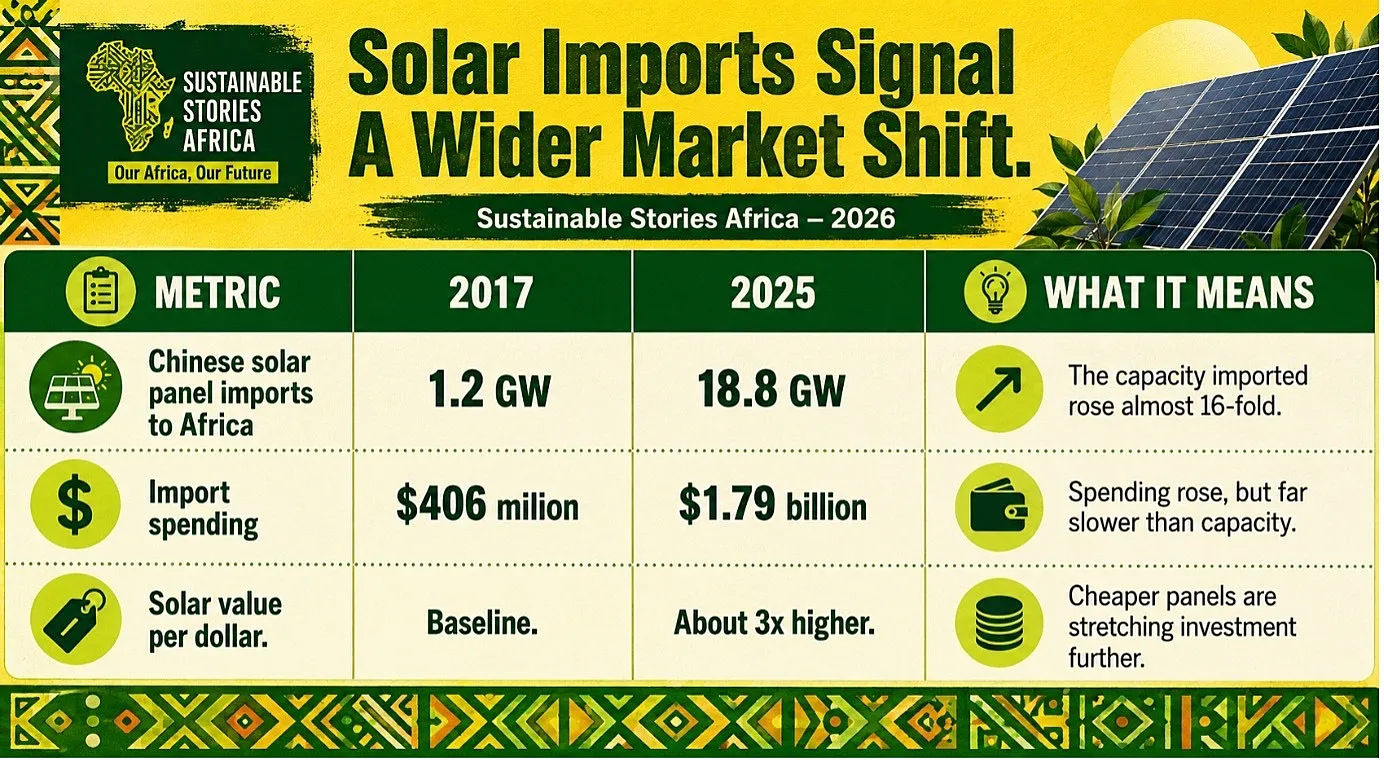
In 2017, African countries imported about 1.2 GW of solar panels from China at $406 million. By 2025, imports had climbed to 18.8GW, costing $1.79 billion.
That means spending rose about 4.4 times; however, imported capacity expanded nearly 15.7 times. In practical terms, cheaper technology, not only larger budgets, is doing much of the heavy lifting.
For a shop owner in Lagos, a clinic in rural Kenya or a cold-storage operator in Zambia, this is not just a procurement story.
It is about whether power becomes predictable enough to keep vaccines cold, food fresh, classrooms lit and small businesses open after sunset.
Solar Imports Signal A Wider Market Shift
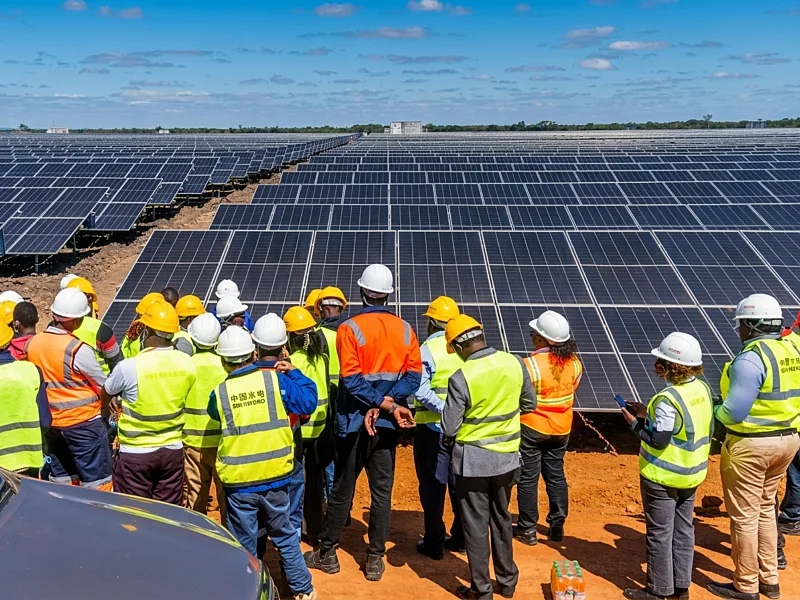
Africa is moving from solar promise to solar purchasing power. The continent imported a record 18.8 GW of Chinese solar panels in 2025, up from 12.7 GW in 2024.
Egypt, Algeria, South Africa, Nigeria and the DRC each crossed the 1 GW threshold, a sign that demand is spreading across markets, rather than being concentrated in one or two.
North Africa is driving utility-scale projects, while sub-Saharan Africa's growth spans businesses, households, mines, telecoms, farms and off-grid systems.
Where power cuts are routine, solar is increasingly treated as infrastructure.
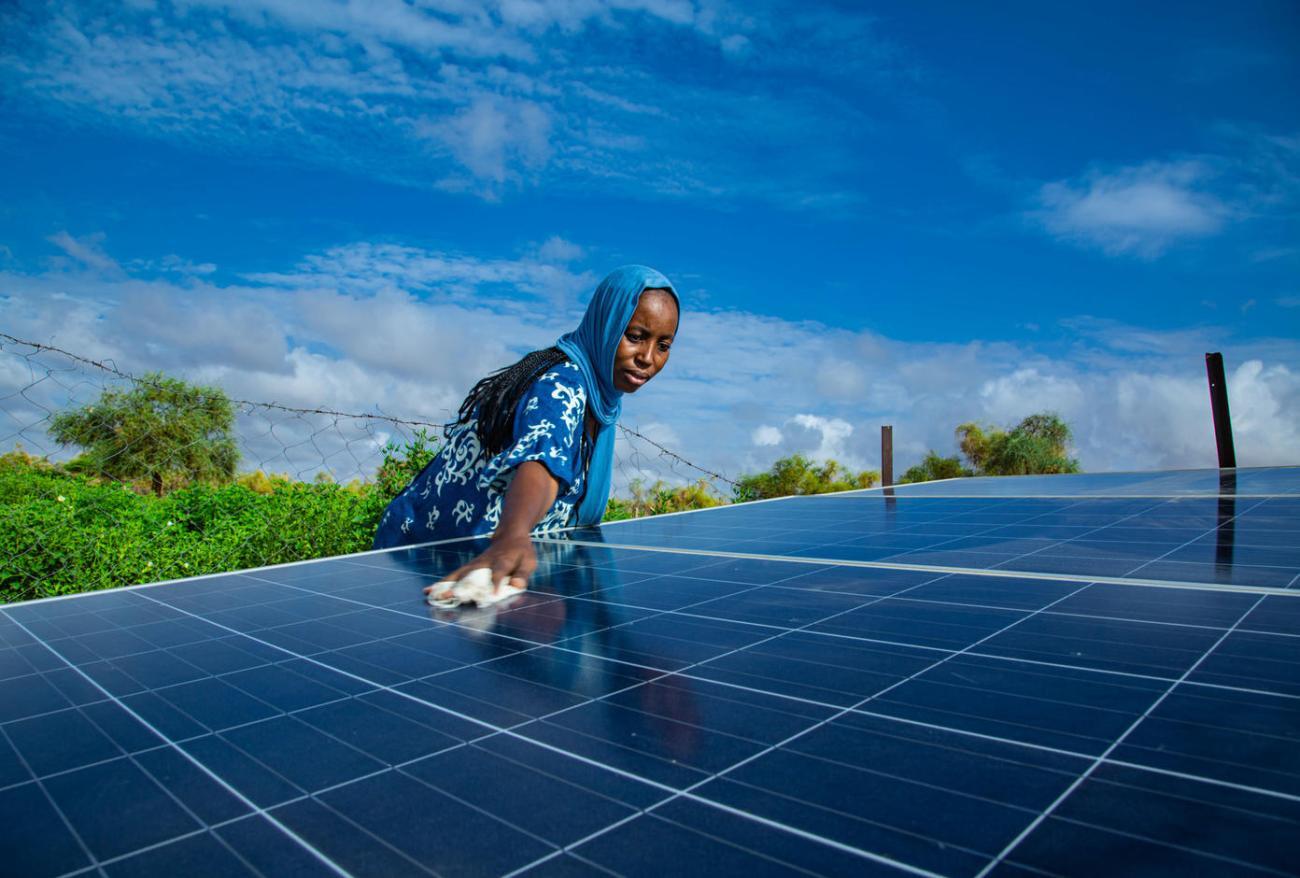
The context matters. Around 600 million Africans remain without electricity, and diesel generators, costly, volatile and polluting, still fill the gap for many.
Solar alone is not the complete answer; it still requires installation, financing, maintenance and storage. But the economics are shifting fast enough to change the conversation.
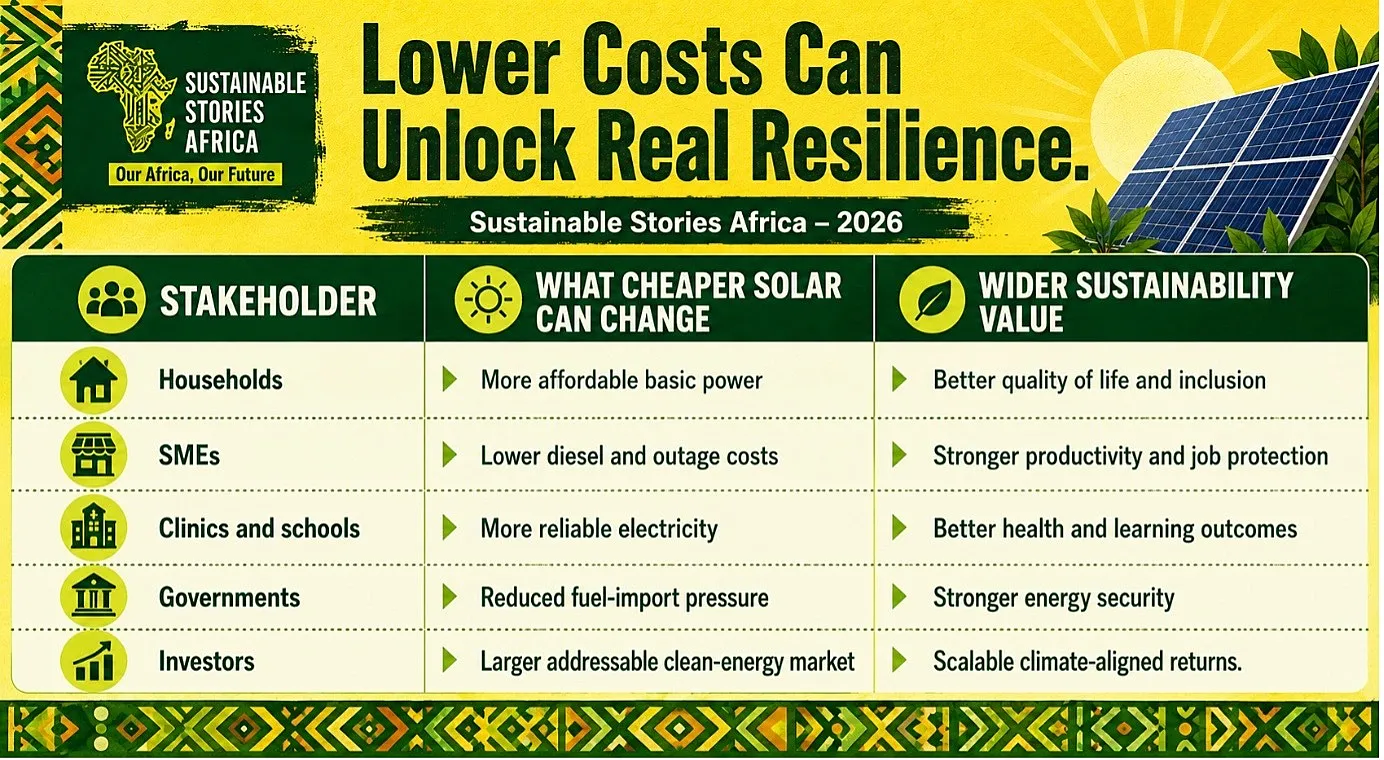
Lower Costs Can Unlock Real Resilience
If Africa converts cheaper imports into productive power, the benefits could cut across households, markets and public services.
- For families, solar can reduce dependence on candles, kerosene or noisy generators.
- For small businesses, it can protect margins by reducing diesel use.
- For clinics, it can support refrigeration, diagnostics and emergency care.
- For schools, it can extend learning hours and power digital tools.
The opportunity is also industrial. Cheaper solar can help African manufacturers lower energy costs, support agro-processing, strengthen cold chains and make export sectors more competitive.
It can also help countries reduce fuel imports, improve energy security and build cleaner growth pathways.
However, the risk is clear. If imports do not translate into installed, well-regulated and well-financed projects, Africa could end up with a supply boom that fails to solve access, reliability or affordability.
Cheap panels can start the transition; they cannot complete it without finance, storage, skills and policy discipline.
Finance And Grids Must Now Catch Up
The next stage of Africa’s solar story should be less about whether the technology is cheap enough and more about whether institutions can move quickly enough.
- Governments need faster permitting, clearer mini-grid rules, stronger standards for imported equipment and policies that encourage local installation, maintenance and component value chains.
- Utilities need grid investment, flexible planning and transparent procurement.
- Development finance institutions need to lower risk, support local-currency financing and crowd in private capital.
- Businesses also have a role.
- Commercial and industrial users can accelerate adoption through rooftop solar, storage systems and power-purchase agreements.
- Banks can build lending products for households, SMEs and energy-service companies.
- Regulators can protect consumers from poor-quality systems while encouraging innovation.
Africa’s solar opportunity is no longer theoretical. The continent is already buying the hardware.
The urgent task is to turn cheaper panels into dependable power, bankable projects and measurable social impact.
Path Forward – Turn Imports Into Installed Impact
Africa’s priority should be clear: convert record solar imports into reliable electricity access, productive use and lower-cost growth.
That requires grid upgrades, storage, quality standards, local skills and affordable finance.
The promise is bigger than cheaper panels. Well done, this shift can advance energy access, climate resilience, SME productivity, public-service delivery and cleaner industrialisation across African markets.
Culled From: Africa now gets 3X more solar for every $1 spent