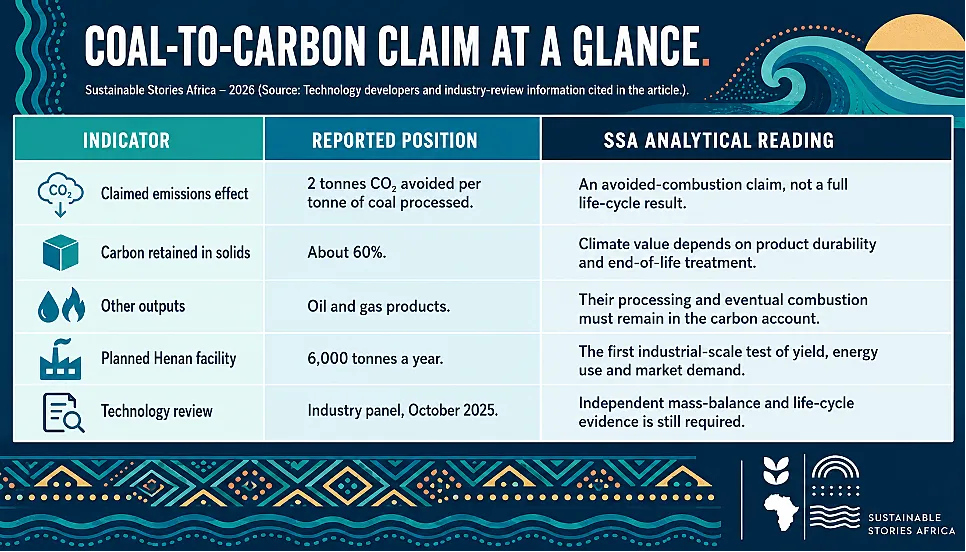
A Chinese-developed process claims it can avoid about 2 tonnes of carbon dioxide for every tonne of coal processed by locking much of the coal’s carbon into solid, high-value materials.
The distinction is crucial: the figure represents emissions avoided from combustion, not an independently verified reduction across the technology’s full life cycle.
Its climate value will depend on what it replaces, how the plants are powered and whether a new market expands coal extraction.
Coal moves beyond the furnace
A new Chinese coal-conversion technology seeks to reposition the fuel as an industrial feedstock rather than something to burn, with its developers claiming the process can avoid roughly 2 tonnes of carbon dioxide for every tonne of coal processed.
The process, presented at an industry conference in Taiyuan, Shanxi province, was developed by Zhaoqing Shunxin Coal Chemical Industry Technology and Guangdong Coal-based Carbon Materials Research.
The companies say that about 60% of the carbon in ordinary coal remains in solid carbon materials, while the remainder is converted into oil and gas products.
An expert panel organised by the China International Association for the Promotion of Science and Technology reviewed the technology in October 2025 and described it as internationally leading, recommending faster commercialisation.
That assessment is an industry review, however, and does not substitute for an independently published life-cycle assessment.
Molecules become higher-value products
The developers say the process separates molecular structures according to bond strength.
Lower-energy structures are converted into conventional oil and gas, while stronger aromatic structures are converted into a low-ash condensed-ring pitch.
That pitch can be used to produce carbon foams, carbon fibres, activated carbon, three-dimensional graphene and materials for supercapacitors.
The commercial proposition is as striking as the climate claim: coal bought for hundreds or thousands of yuan per tonne could be converted into products worth tens or hundreds of thousands of yuan.
A first industrial partnership is already planned. Zhaoqing Shunxin and state-owned China Pingmei Shenma intend to build a 6,000-tonne-a-year coal-based carbon materials facility in Henan province.
The companies say products from the process have completed tests with downstream users.
Avoided combustion is not zero carbon
The reported carbon benefit comes mainly from keeping part of coal’s carbon in solid products instead of oxidising it during combustion.
It is therefore better understood as an avoided-emissions claim against a specific counterfactual: that the same coal would otherwise have been burned.
A credible assessment must also account for methane from mining, land disturbance, energy used in processing, emissions from oil and gas co-products, transport, product durability and what happens at end of life
- If carbon materials remain stable for decades and displace more emissions-intensive alternatives, the benefit could be meaningful.
- If the process stimulates additional mining or uses carbon-intensive energy, the net gain could narrow.
This is especially relevant for coal-producing African economies considering industrial diversification.
Moving from raw extraction to advanced materials could increase local value, but investment decisions should not treat a headline emissions number as proof of alignment with national climate plans.
Commercialisation needs transparent carbon tests
Developers should publish mass-balance data, plant energy requirements, product yields and independently reviewed life-cycle results before policymakers attach green incentives to the technology.
Buyers also need traceability, showing how long the carbon remains stored and which conventional materials are displaced.
For governments, the opportunity lies in setting technology-neutral performance thresholds.
- Public support should reward verified emissions reductions, resource efficiency and safe waste management, rather than the continued use of any particular fossil feedstock.
There is also a circular-economy question.
- Carbon products can support batteries, insulation and advanced manufacturing, but climate value depends on durability and recovery.
- Standards should identify whether products are reused, recycled, oxidised or discarded.
Public agencies considering demonstration finance could require open performance data and third-party monitoring as conditions of support.
That would help distinguish a technically interesting conversion route from a genuinely scalable decarbonisation solution, while giving researchers and potential buyers evidence they can compare with bio-based, recycled or conventionally manufactured carbon materials.
Path Forward - Independent evidence must lead industrial transition
Coal-to-carbon materials may offer a higher-value, potentially lower-emissions use for part of an existing resource base, but their climate credentials remain conditional.
The path forward is independent verification, transparent accounting and demonstration at industrial scale.
Only then can investors judge whether the process displaces combustion and supports a genuine transition, or simply creates a profitable new market for coal.
Culled From: Chinese Coal-to-Carbon-Materials Technology Claims 2-Tonne CO2 Cut Per Tonne Processed