
Generative AI is entering a new phase where success depends less on writing clever prompts and more on managing high-quality context.
Researchers argue that "context-maxxing" could help users preserve critical thinking while producing more accurate, trustworthy AI outputs.
The shift may redefine how businesses, governments and professionals across Africa build AI capabilities without sacrificing human judgment or institutional knowledge.
The Next AI Race Is About Context
Artificial intelligence is no longer just a race to build larger models; it is becoming a race to preserve human intelligence.
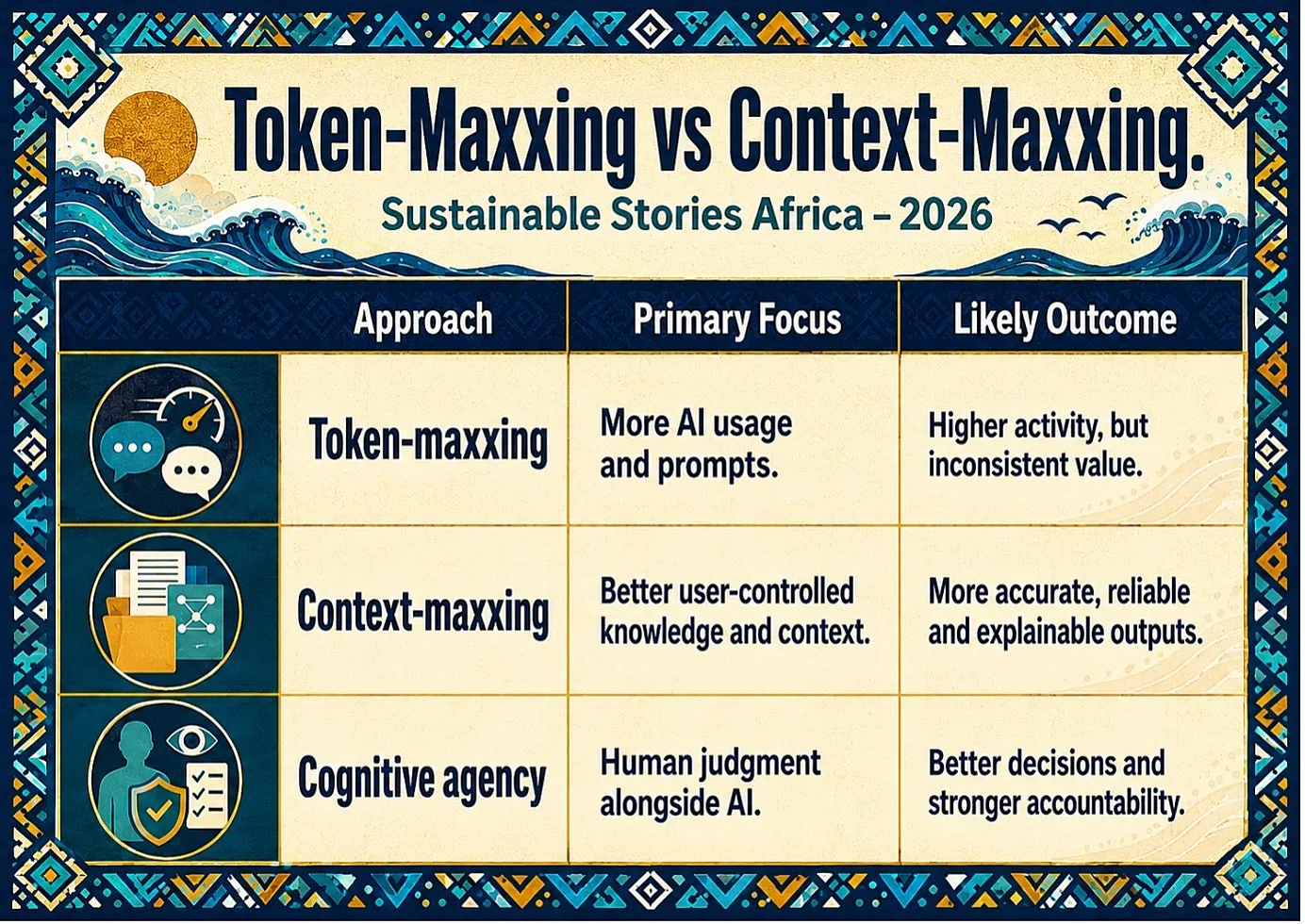
A growing body of research is shifting attention toward "context-maxxing," a concept that encourages users to maximise control over the knowledge, expertise, preferences and institutional information they provide to generative AI systems.
Rather than simply increasing AI usage, or "token-maxxing", the approach argues that better outcomes come from richer, more accurate and user-controlled context.
The idea arrives at a pivotal moment. As organisations increasingly rely on AI for writing, coding, analysis and strategic planning, researchers warn that poorly designed AI workflows risk eroding critical thinking, creativity and independent decision-making if people outsource too much cognitive work to machines.
For businesses across Africa, where institutional knowledge often resides in people rather than formal systems, the debate is becoming more than a technology conversation; it is an economic and governance issue.
Better Context Produces Better Decisions
The principle behind context-maxxing is straightforward: AI performs only as well as the information it receives.
Researchers at the Brookings Institution argue that users should treat context as a strategic asset rather than an afterthought.
Instead of repeatedly asking AI isolated questions, individuals and organisations should organise documents, decisions, workflows, preferences and domain expertise so AI can reason with richer, higher-quality information.
The approach also seeks to strengthen what researchers describe as "cognitive agency", the ability of people to think, evaluate and make decisions alongside AI rather than allowing the technology to replace human reasoning.
For African organisations, the implications are significant.
A renewable-energy developer in Kenya, for example, may possess years of community engagement records, environmental assessments and regulatory approvals.
If these knowledge assets are organised and securely integrated into AI workflows, project teams can generate faster, more accurate analyses while preserving institutional memory.
Conversely, fragmented documents, inconsistent data and poor governance may produce misleading recommendations regardless of how advanced the AI model becomes.
Human Intelligence Becomes Competitive Advantage
If adopted thoughtfully, context-maxxing offers benefits extending well beyond productivity.
- Businesses could build AI systems that preserve institutional knowledge rather than lose expertise when employees leave.
- Governments could improve policy analysis by integrating trusted datasets rather than relying on fragmented information.
- Universities could use AI to strengthen learning instead of encouraging passive dependence.
Researchers argue that humans gain the greatest value when AI encourages reflection, planning and evaluation rather than providing instant answers without engagement.
Under these conditions, AI becomes a collaborative partner instead of a substitute for thinking.
This matters particularly for emerging markets, where specialised expertise remains scarce and preserving local knowledge is essential for sustainable development.
Build AI Around Trusted Human Knowledge
The emergence of context-maxxing highlights an urgent governance priority.
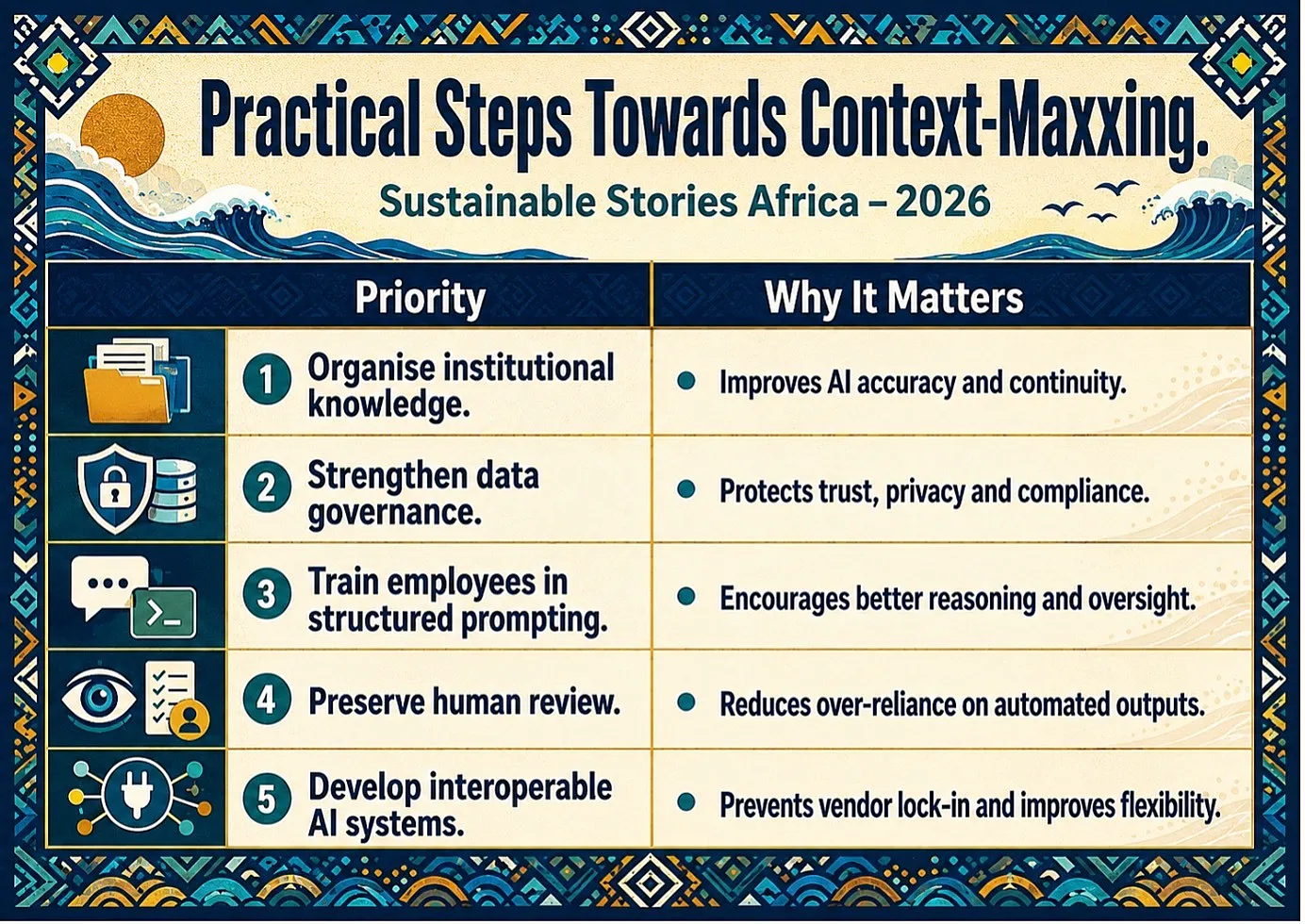
Organisations should invest not only in AI tools but also in structured knowledge management, secure data governance, interoperable systems and workforce training that enables employees to collaborate effectively with AI.
Rather than measuring AI success solely by speed or cost savings, leaders should evaluate whether AI improves decision quality, transparency and long-term organisational capability.
For policymakers, the challenge is equally important.
Future AI regulation may increasingly focus not only on algorithms but also on how organisations govern, protect and share the human context that makes AI valuable.
Path Forward – Building Human-Centred AI For Africa
Africa's AI future will depend as much on trusted knowledge systems as on computing power.
Organisations that preserve expertise, strengthen governance and keep humans firmly involved in decision-making will be better positioned to compete responsibly.
Context-maxxing offers a practical roadmap for aligning AI adoption with ESG principles, supporting transparency, accountability, digital resilience and sustainable innovation while ensuring technology amplifies, rather than diminishes, human intelligence.
Culled From: Context-maxxing: How to use generative AI without losing your mind