
The European Central Bank will apply climate-related value reductions to eligible corporate loans used as collateral in Eurosystem refinancing operations.
The extension, due no earlier than end-2027, adds transition exposure and loan maturity to existing risk controls, with a maximum additional reduction of 5%.
The decision makes climate uncertainty part of the financial plumbing connecting banks, companies and central bank liquidity.
Climate Risk Enters Loan Collateral
The European Central Bank is extending its climate factor beyond corporate bonds to certain eligible loans owed by non-financial companies and pledged by banks in Eurosystem refinancing operations.
The measure, announced on 24 July 2026, is expected to start no earlier than the end of 2027 and will reduce the value assigned to collateral that is more sensitive to climate-transition uncertainty.
This is not a green lending subsidy or a judgment on whether a borrower is sustainable.
- It is a balance-sheet protection measure.
- If a counterparty fails and the Eurosystem must sell pledged assets, sudden changes in climate policy, technology, consumer behaviour, litigation or the wider economy could reduce what those assets are worth.
A Score Will Adjust Value
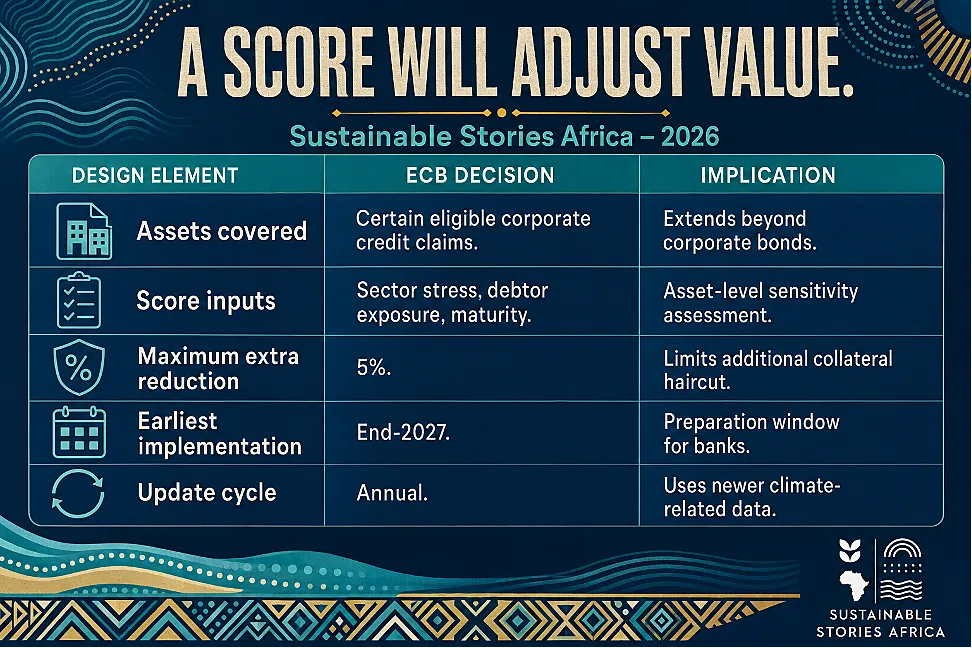
The ECB will calculate an asset-level uncertainty score using three elements: a sector stressor from the latest Eurosystem climate stress test, the debtor’s exposure to transition-related uncertainty and the loan maturity.
The more sensitive the collateral, the larger the reduction applied to its value.
The maximum additional reduction across covered bonds and credit claims will be 5%. Values will be updated annually to incorporate new climate data, while the factor assigned to individual loans will not be publicly disclosed.
The extension builds on the climate factor for marketable assets issued by non-financial corporations and affiliates, approved in July 2025 and effective from 15 June 2026.
Collateral frameworks sit behind monetary policy but influence real financing behaviour. A bank that can pledge an asset at a lower value receives less central bank liquidity against it.
Over time, that can strengthen incentives to gather credible transition information and understand the emissions, business model and maturity profile behind corporate credit.
Better Data Can Improve Resilience
The benefit is stronger risk recognition before a disorderly transition creates losses.
Banks that already assess how regulation, carbon costs, technology or customer demand may affect borrowers will be better prepared to manage the factor and explain exposures to supervisors, investors and clients.
For African companies and banks, the decision is geographically distant but commercially relevant.
European lenders finance trade, infrastructure and multinational operations across the continent.
Where African corporate exposures sit inside European banking groups or capital structures, credible transition plans and comparable data can increasingly affect financing discussions, even when the ECB factor does not directly apply to a local loan.
For borrowers, the signal is also about tenor. A longer-dated claim carries more time for transition assumptions to change, so maturity becomes part of the score.
Companies seeking long-term finance will increasingly need to demonstrate that assets, cash flows and capital plans remain credible using different policy and technology pathways, rather than relying on a distant net-zero pledge.
Prepare Evidence Before Implementation
Euro-area banks should map eligible credit claims, improve borrower-level transition data and test the liquidity impact under different collateral valuations.
Companies should connect emissions data to strategy, capital expenditure and revenue assumptions so lenders can distinguish managed transition from unmanaged exposure.
Regulators elsewhere should study the design without mechanically copying it. The important principle is that climate uncertainty can lead to financial loss; the calibration must still reflect local markets, data quality and development needs.
Transparent methodology and proportional implementation will be essential if climate pricing is to strengthen resilience without producing blunt exclusion.
Path Forward – Price Transition Risk Before Losses Arrive
Banks should map affected loans, improve debtor-level data and test liquidity consequences before implementation.
Borrowers need transition evidence tied to strategy and investment.
Other central banks should learn from the framework while calibrating local conditions.
Risk recognition works best when methodology is proportionate, data improves, and development finance remains available.
Culled From: ECB Extends Climate Risk Pricing to Corporate Loans Used as Collateral