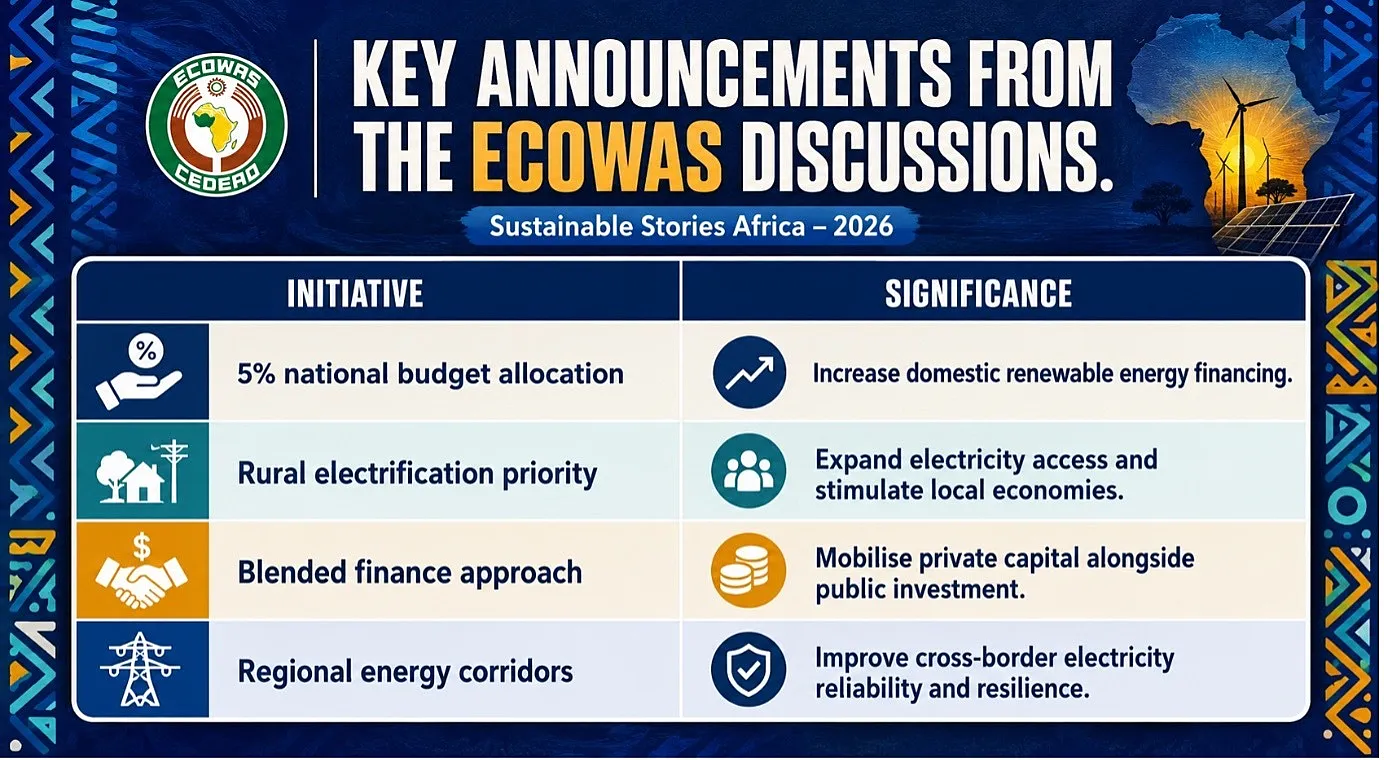
ECOWAS lawmakers have urged member states to dedicate at least 5% of annual national budgets to renewable energy and rural development, signalling a stronger regional commitment to domestic financing for the energy transition.
The recommendation comes as governments confront rising electricity demand, unreliable grids, climate risks and tightening public finances while pursuing economic growth.
If translated into national policy, the proposal could improve energy security, expand rural electrification, stimulate local industries and reduce dependence on imported fossil fuels across West Africa.
Domestic Funding Takes Centre Stage
West Africa's energy transition may no longer depend primarily on international donors.
The Parliament of the Economic Community of West African States (ECOWAS) has called on its member states to allocate at least 5% of their annual national budgets to renewable energy and rural development, describing sustained domestic investment as essential to improving energy security, expanding electricity access and accelerating economic transformation.
The recommendation emerged from the ECOWAS Parliament's Joint Committee meeting in Dakar, Senegal, where parliamentarians, development finance institutions and energy experts examined financing models capable of addressing one of the region's most persistent development challenges: reliable electricity for households, businesses and rural communities.
While the proposal is advisory rather than legally binding, it represents one of the bloc's strongest regional calls for governments to finance their own clean energy ambitions.
Energy Access Remains Development's Missing Link
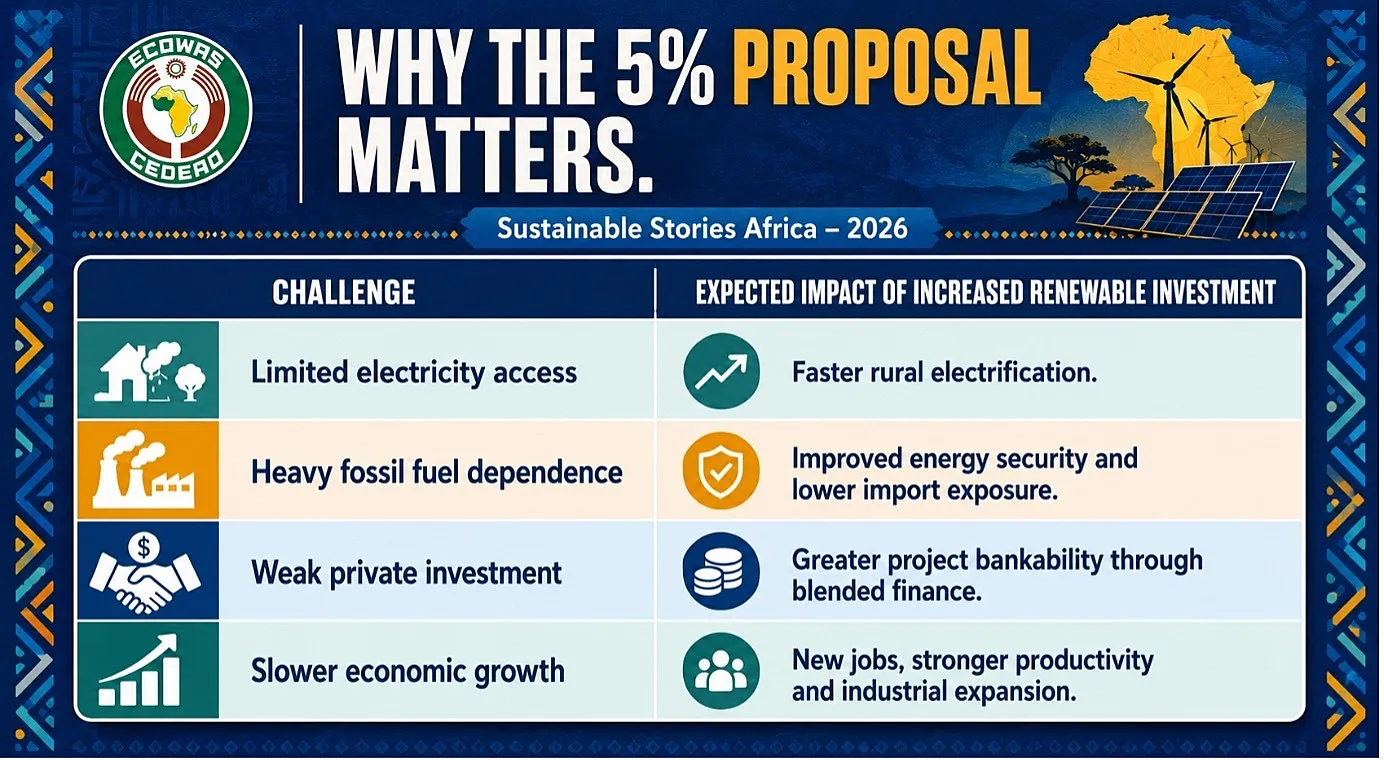
For millions of West Africans, unreliable electricity remains more than an infrastructure problem; it is an economic constraint affecting healthcare, education, agriculture and industrial productivity.
ECOWAS estimates that more than half of the region's population continues to experience unreliable or no access to electricity, with rural communities disproportionately affected.
Energy poverty continues to limit agricultural processing, healthcare delivery, education outcomes and small-business growth.
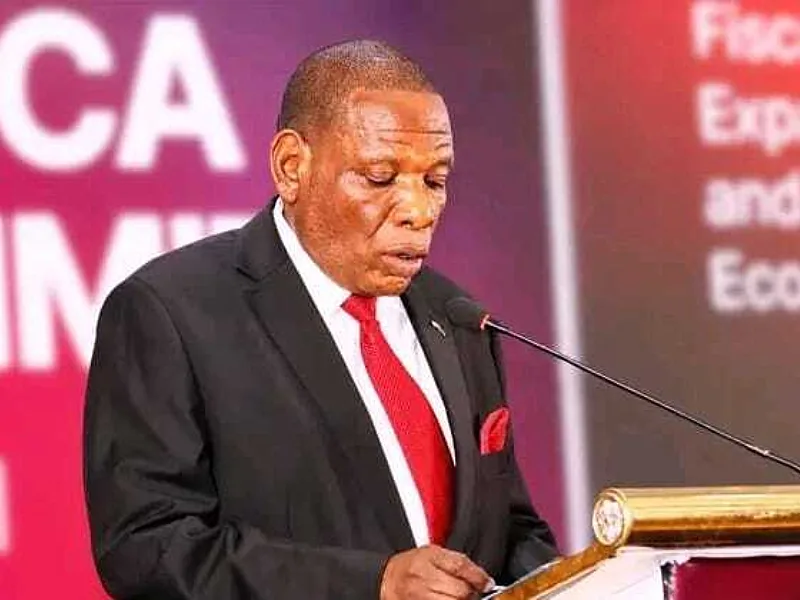
During the Dakar discussions, Nigerian lawmaker Senator Ali Ndume argued that dedicating 5% of national budgets to renewable energy is financially achievable and could transform rural economies.
"For less than one million dollars, you can modernise a rural community," he said, linking rural electrification to stronger agriculture, improved security and reduced rural-to-urban migration.
Development finance experts also highlighted financing gaps. The ECOWAS Bank for Investment and Development (EBID) revealed that renewable energy currently accounts for only about 4% of its energy financing portfolio despite growing demand for decentralised power solutions.
Officials cited weak project preparation, regulatory bottlenecks and limited project bankability as key barriers preventing greater private investment.
Meanwhile, Senegal showcased a potential pathway forward. Officials outlined plans to achieve 40% renewable electricity generation by 2030, supported by a €2.5 billion Just Energy Transition Partnership while advocating blended finance structures that combine grants, concessional finance, commercial lending and private equity.
Turning Energy Security Into Economic Opportunity
The proposal reaches beyond climate policy.
Greater investment in renewable energy could reduce dependence on imported fossil fuels, improve energy resilience, lower long-term electricity costs and create new employment opportunities across clean energy value chains.
For farmers, dependable electricity could enable irrigation, food processing and cold-chain storage.
Rural clinics could preserve vaccines and operate critical medical equipment. Schools could extend digital learning, while small businesses would spend less on diesel generators and more on productive investments.
The initiative also aligns with ECOWAS' broader regional energy strategy, which prioritises universal electricity access, stronger regional interconnections, renewable energy expansion and improved energy security as foundations for sustainable economic development.
Political Commitment Must Become Financial Commitment
Regional ambition alone will not electrify West Africa.
The ECOWAS Parliament's recommendation now places responsibility on national governments to translate political commitments into annual budget decisions.
Doing so will require stronger policy coordination, bankable renewable energy projects, regulatory reforms and closer collaboration among governments, development finance institutions and private investors.
Equally important is ensuring that renewable energy investments reach underserved rural communities where economic returns extend far beyond electricity generation, improving livelihoods, strengthening resilience and supporting inclusive growth.
Path Forward – Regional Commitments Must Become National Investments
The next phase of West Africa's energy transition depends on converting regional recommendations into measurable national spending commitments, stronger institutions and investment-ready renewable projects.
If governments align public budgets with regional ambitions while expanding blended finance and cross-border cooperation, renewable energy could become a cornerstone of stronger energy security, economic resilience and sustainable development across the ECOWAS region.