
EFRAG has opened a 100-day consultation on ESRS‑40a, a draft sustainability reporting standard for large non-EU groups with significant European activity.
The proposal focuses on impacts on people and the environment, removing risks, opportunities, resilience and dependencies from the reporting architecture.
African multinationals in scope have until 31 October 2026 to influence a standard expected to govern 2028 reporting.
Europe Redraws Foreign Reporting Rules
Large non-European companies operating in the European Union could face a narrower, impacts-focused sustainability reporting standard from the 2028 financial year.
EFRAG opened consultation on its ESRS‑40a exposure draft on 23 July 2026, giving companies, investors and civil society 100 days to respond before the advisory body finalises technical advice for the European Commission.
The draft addresses undertakings outside the EU that have substantial business transactions with Europe.
Following the Omnibus amendments, Article 40a applies where a non-EU group generates more than €450 million in EU net turnover in each of two consecutive years and has either an EU branch generating more than €200 million or EU subsidiaries under the same ultimate parent generating more than €200 million.
Impacts Replace Double Materiality
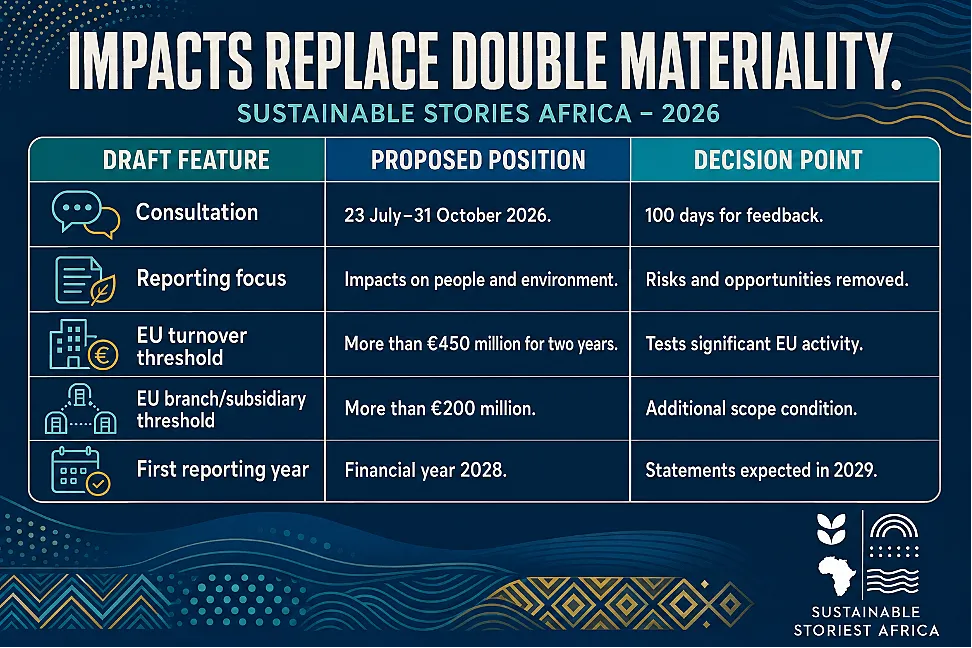
Unlike the broader European Sustainability Reporting Standards for EU companies, the draft removes the reporting on sustainability-related risks, opportunities, resilience and dependencies.
Its stated purpose is transparency about how the largest non-EU groups affect people and the environment while maintaining a level playing field for operators in the EU market.
EFRAG is asking whether it has processed that narrowing correctly and whether companies should be allowed a mixed approach.
Under the proposal, certain impacts could be reported globally or limited to EU-related activity, while climate treatment is more constrained.
The consultation also asks how non-EU groups should interpret references to EU law and how ESRS‑40a can interoperate with jurisdictional standards based on the IFRS Sustainability Disclosure Standards.
Reporting would become mandatory for financial years beginning on or after 1 January 2028, with the first statements expected in 2029. EFRAG plans a separate cost-benefit analysis effective mid-August.
The current document is an exposure draft, not a final legal standard, and the European Commission remains responsible for adoption.
Early Alignment Can Reduce Duplication
For African groups with significant European turnover, early engagement offers two gains.
- First, they can demonstrate whether global systems already used for IFRS S1, IFRS S2, GRI or national requirements can supply the proposed impact data.
- Second, they can explain where EU concepts create practical difficulties across countries with different laws, value chains and information systems.
Good interoperability could prevent sustainability teams from creating parallel databases for every jurisdiction.
It could also improve accountability to workers, communities and customers whose experiences sit outside Europe but remain connected to goods and services sold there
Poorly designed boundaries, by contrast, could obscure important impacts or make reports difficult to compare.
The impacts-only model also changes who needs to be heard during preparation.
Investor relations remains relevant, but human rights teams, environmental specialists, procurement functions, unions and affected communities become central sources of evidence.
Companies that treat the exercise as a finance-only compliance project may miss the very impacts the draft is designed to expose.
African Companies Should Enter Consultation
Potentially affected groups should run a scope assessment now, map entities and EU turnover, compare the draft data points with existing disclosures and document gaps in value chain information.
Boards should decide who owns the response across finance, legal, sustainability, risk and internal audit.
African business associations, regulators and professional bodies should also participate before the 31 October deadline.
The consultation is the point at which technical evidence can shape proportionality, global-versus-EU boundaries and interoperability.
Waiting for final rules would leave companies with less influence and a shorter implementation runway.
Path Forward – Shape The Standard Before Reporting Begins
African groups should test scope, map data gaps and submit evidence on interoperability and cross-border implementation before 31 October. Boards need clear ownership now.
EFRAG and the European Commission should preserve impact transparency while avoiding duplicated systems.
A workable final standard must reflect global value chains without weakening accountability to people and the environment.
Calle From: EFRAG Proposes Impacts-Only CSRD Standard for Non-EU Companies