Egypt has launched the $15 billion New Delta agricultural project to reclaim desert land for farming.
The plan comes as population growth, food imports and water pressure reshape national food security.
Its promise is bold: more wheat, jobs and production, if water governance holds.
Egypt Looks West For Farmland
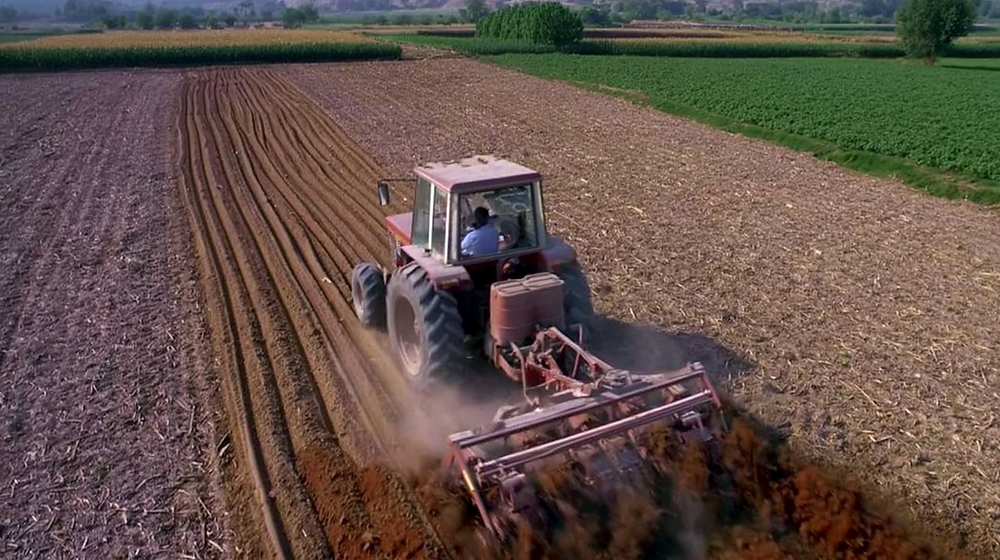
Egypt has launched the New Delta agricultural development project, a roughly $15 billion desert reclamation programme aimed at converting nearly 924,000 hectares of land into productive farmland west of the Nile Delta.
The project is designed to expand the country’s cultivated land by almost 15%, according to the Ecofin Agency and other project reporting.
President Abdel Fattah el-Sisi inaugurated the project in northwestern Egypt, with total investments estimated at 800 billion Egyptian pounds, or around $15 billion.
The project stretches across desert hinterlands linking Beheira, Giza and Matrouh, and is framed by the government as a national food-security intervention.
Why The Desert Project Matters
Egypt is one of Africa’s most populous countries and a major food importer. That makes agricultural land, irrigation and grain production central to economic stability.
The New Delta project is expected to focus on strategic crops including wheat, maize, sunflowers, fruits and vegetables, with some reports also highlighting olives and figs.
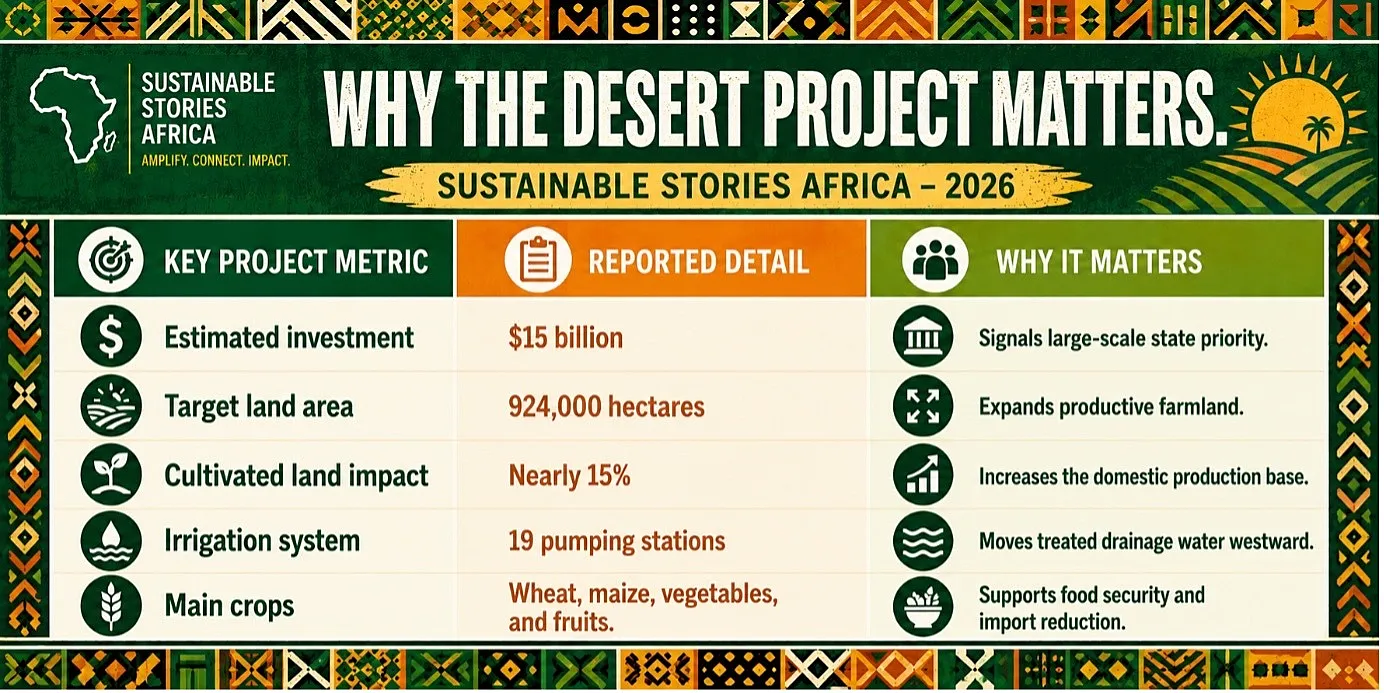
The project relies on an irrigation system designed to transport treated drainage water from the Delta region through canals and pumping stations.
That engineering ambition is central to the project; however, it also raises its biggest sustainability question: how Egypt balances food production with water scarcity.
What Egypt Hopes To Gain
For Egyptian families, food security is not an abstract policy goal. It is the price of bread, the availability of vegetables, and the stability of household budgets.
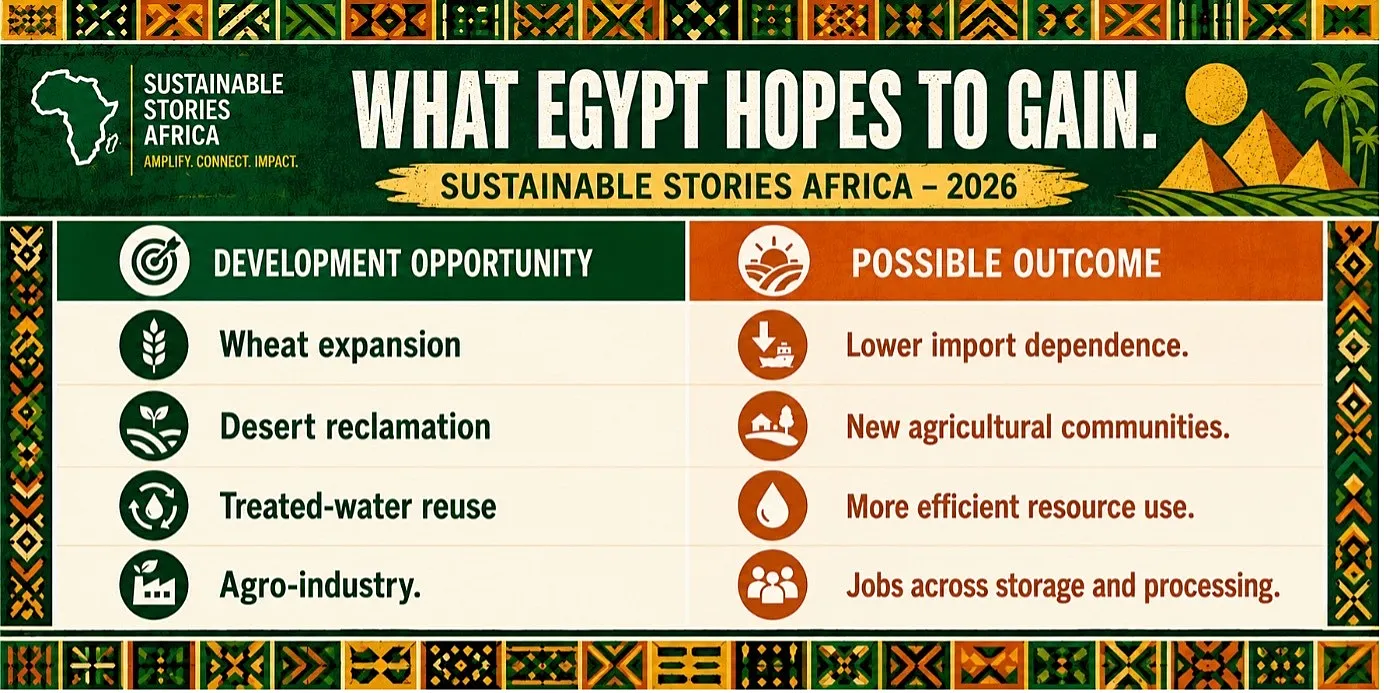
If the project succeeds, it could reduce pressure on imports, support rural jobs, expand agro-processing and improve the domestic supply of strategic crops.
For farmers, logistics firms, millers and food processors, the New Delta could become a new production corridor.
However, the opportunity comes with hard questions. Desert agriculture is expensive, water-intensive and dependent on strong maintenance.
If water systems fail or costs rise, the gains could narrow quickly.
Sustainability Must Match Scale
Egypt’s next task is to prove that the New Delta can deliver food security without deepening water stress.
That means transparent water accounting, efficient irrigation, soil monitoring, crop planning and clear reporting on yields, costs and environmental impacts.
The project also needs an inclusive economic design. New farms should support local employment, skills development and small producers' participation, not only large-scale state-linked operators.
Food security becomes stronger when infrastructure connects to livelihoods.
For African markets, Egypt’s move carries a wider lesson: food systems are becoming infrastructure systems.
Land, water, energy, transport, storage and finance now determine whether countries can protect citizens from global food shocks.
Path Forward – Grow Food Without Wasting Water
Egypt’s New Delta project should prioritise water efficiency, crop suitability, transparent reporting and inclusive jobs.
If managed well, it can strengthen food security and climate resilience. If poorly governed, it could expose the limits of desert farming in a water-stressed region.
Culled From: Egypt Expands Desert Agriculture With $15 Billion New Delta Project - Ecofin Agency