New GlobeScan and Ashoka research shows that the biggest barrier to employee participation is not apathy, but lack of decision-making power.
The finding matters as companies ask workers to support sustainability, innovation and social impact while keeping authority concentrated at the top.
For African and Global South workplaces, the lesson is clear: participation cannot grow where employees are invited to care but not empowered to act.
Participation Needs Power, Not Posters
The biggest obstacle hindering employees from helping their companies improve social and environmental impact is a lack of decision-making power, according to new research by GlobeScan and Ashoka.
The study, based on 8,865 corporate employees across 33 countries, found that 47% of employees who feel unable to contribute to a positive impact at work cited lack of decision-making power as the main barrier.
This placed power ahead of limited resources or budget, weak sustainability prioritisation, and a lack of leadership guidance.
For employers, the message is direct: employee participation is not mainly a communications problem. It is an organisational design problem.
Across African offices, factories, banks, telecom firms, media houses and development organisations, workers are increasingly asked to “own” purpose, ESG, innovation and customer trust.
However, many remain far from the rooms where budgets are approved, suppliers are selected, risks are escalated, and sustainability commitments become operational choices.
That gap is where participation breaks down.
Workers Want Impact, Systems Block Them
A familiar management assumption holds that employees disengage from sustainability initiatives due to a lack of awareness or motivation.
New research challenges this directly. Many workers already believe they can contribute; however, they are constrained by hierarchy, limited budgets, and unclear mandates.
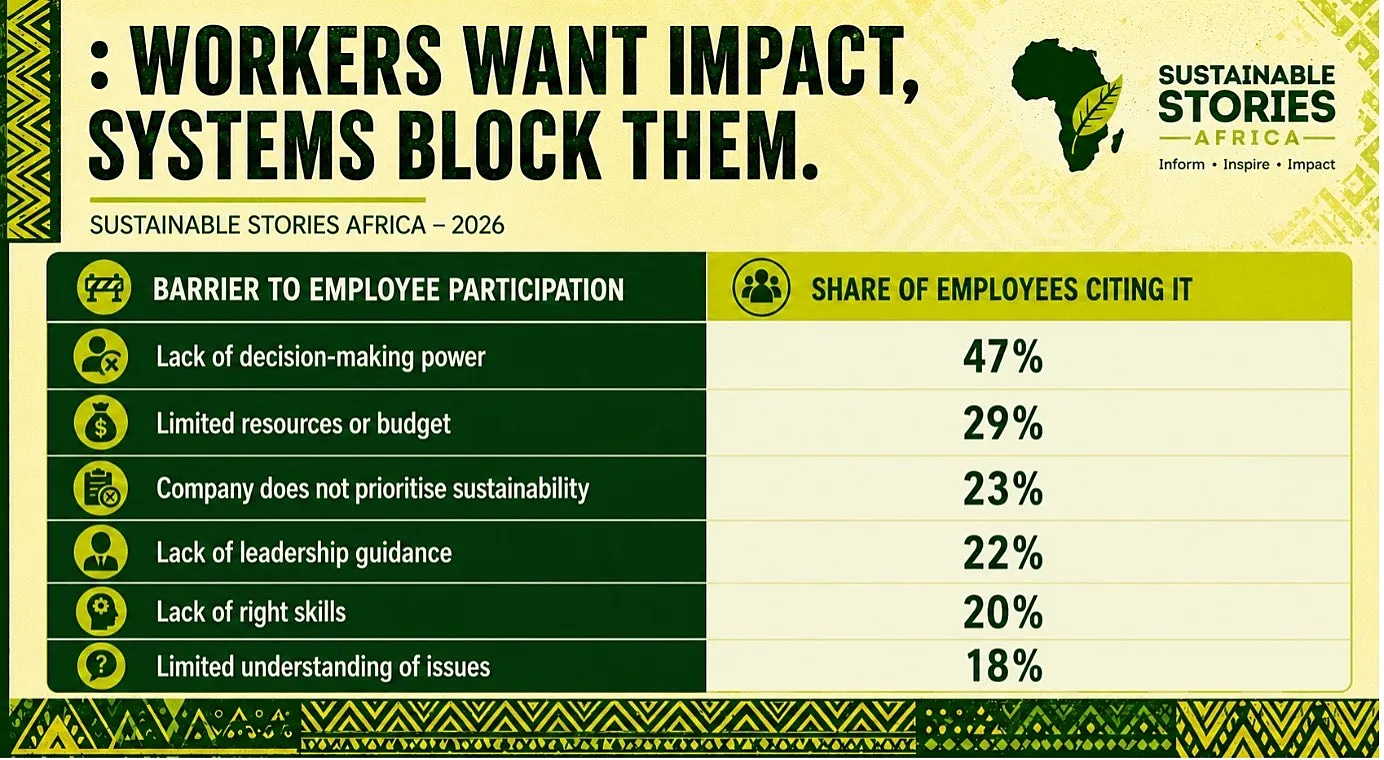
The data reveals a structural problem. Skills and awareness rank below power, money, priority, and leadership as barriers to participation. Employees are not refusing to engage. They are being asked to contribute without the authority to change outcomes.
- In a Lagos bank branch, customer-facing staff see financial inclusion gaps daily but have no route to redesign products.
- In manufacturing plants, technicians spot energy waste but lack approval to act.
- In newsrooms, junior reporters identify community-level climate stories but cannot influence commissioning budgets.
These are not isolated frustrations; they are lost sources of innovation.
For companies under ESG performance pressure, employee agency is becoming a strategic asset.
- Those closest to customers, communities, and operations often see risks before senior leadership does.
- Confining their participation to surveys and town halls means losing the practical intelligence required to act.
Shared Authority Can Build Better Companies
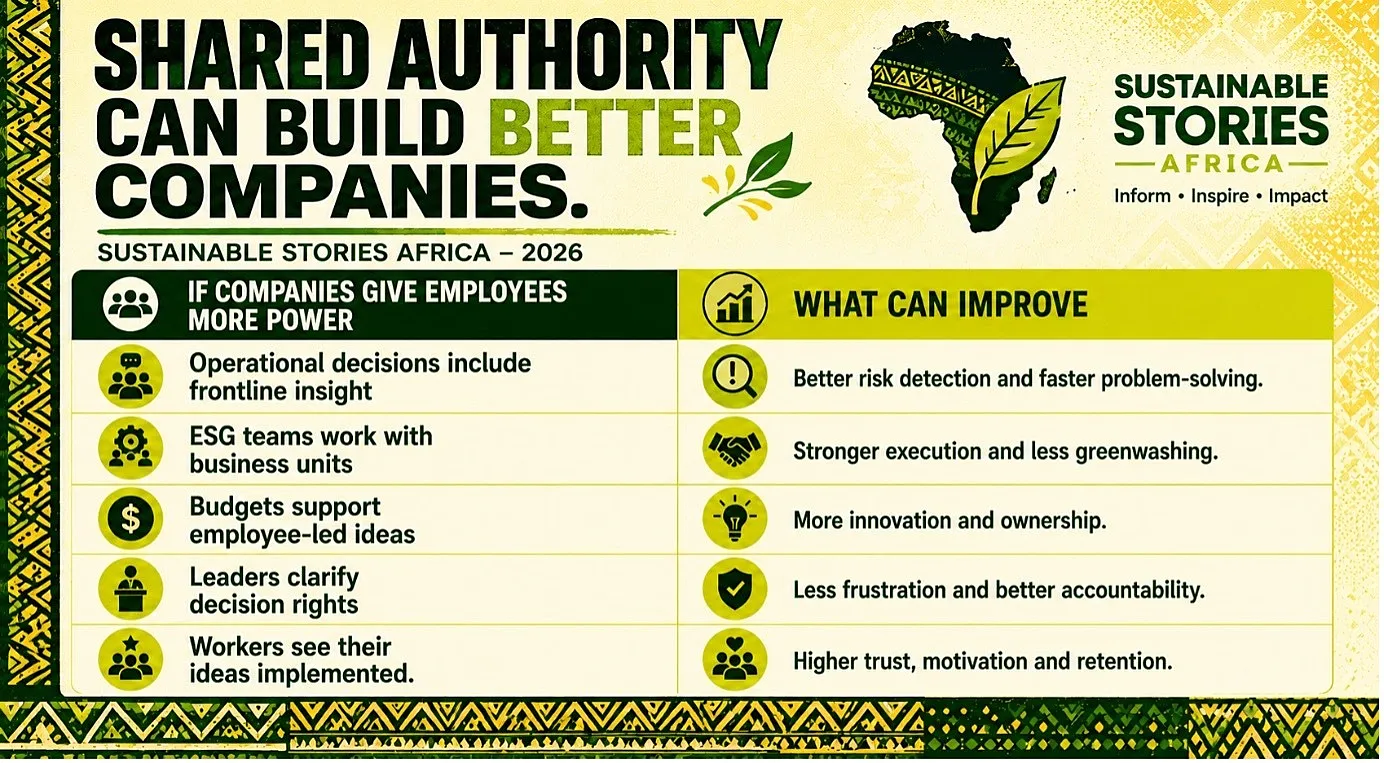
The upside is significant. When employees have real participation, organisations can become more adaptive, trusted and resilient.
Participation with power can improve morale, deepen loyalty and strengthen purpose. It can also help companies identify social and environmental risks early, design more practical solutions and build cultures where accountability moves beyond boardrooms.
For African markets, this matters deeply.
Many businesses operate in environments shaped by infrastructure gaps, inflationary pressure, youth unemployment, climate exposure and trust deficits.
Employees often understand these pressures at ground level because they live close to them.
- A field officer knows why a rural customer cannot access a product.
- A call-centre agent hears the same complaint before it becomes a reputational crisis.
- A procurement officer sees where local supplier inclusion is possible.
- A plant worker knows where waste can be reduced.
When such workers are empowered, companies move from performative participation to practical transformation.
Leaders Must Redesign Participation
The call to action is not more engagement sessions. It is embedding participation into the mechanics of work itself.
- Companies must define where employees can make decisions, rather than merely where they can offer feedback.
- They should create dedicated budgets for employee-led sustainability and innovation projects, connect staff ideas to measurable business outcomes, and train managers to share authority without surrendering accountability.
Boards and ESG committees;
- Must treat employee participation as a governance matter, rather than an HR side project, asking directly whether staff have channels to influence decisions on energy use, procurement, inclusion, and community impact.
For investors and regulators, the issue is material.
- A company that cannot listen internally will struggle to respond externally. Weak employee voice becomes weak risk management.
The future of work will not be built by motivational campaigns. It will be built by organisations willing to trust workers with responsibility, resources, and real influence.
Path Forward – Give Workers Power To Act
Companies should shift from asking employees to support impact to enabling them to shape it.
That means clearer decision rights, dedicated resources, leadership backing and stronger links between participation and ESG performance.
The next phase of workplace sustainability must be practical. Employee voice should move from suggestion boxes to strategy, budgets and operational decisions.
Culled From: The Biggest Barrier to Employee Participation Is a Lack of Decision-making Power