Energy-as-a-Service (EaaS) is rapidly changing how businesses and communities access renewable power by removing the need for large upfront investments.
As energy costs rise and grid reliability challenges persist, subscription-based clean energy solutions are attracting growing interest across Africa and other emerging markets.
The shift could accelerate decarbonisation, improve energy access, and unlock new investment opportunities while helping organisations focus on growth rather than infrastructure ownership.
A New Model Changes Energy Access
For decades, the biggest barrier to renewable energy adoption was not technology. It was capital.
Today, a growing number of businesses, industrial facilities, schools, hospitals, and communities are bypassing that challenge through Energy-as-a-Service (EaaS).
This model allows customers to access renewable energy systems without owning the assets themselves.
Under EaaS arrangements, developers, utilities, or private investors finance, install, operate, and maintain energy infrastructure while customers pay predictable service fees over time.
The approach is gaining traction globally as organisations seek lower energy costs, improved reliability, and faster pathways to decarbonisation.
The model is emerging as a powerful enabler of renewable energy deployment across Africa, where financing constraints have historically slowed clean energy investment despite abundant solar, wind, and hydro resources.
Industry observers increasingly view EaaS as one of the most important innovations bridging the gap between sustainability ambitions and practical implementation.
Removing Capital Barriers To Clean Power
The appeal of Energy-as-a-Service lies in its simplicity.
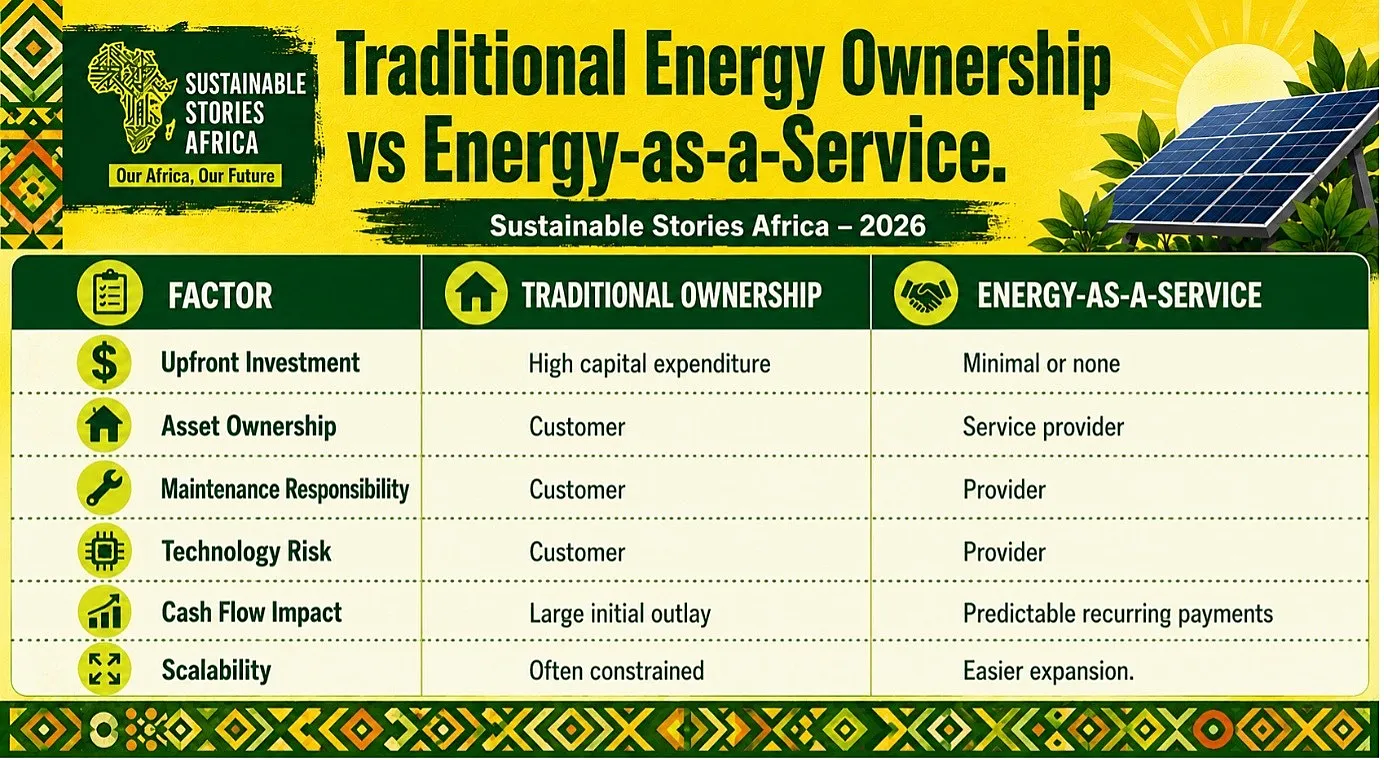
Rather than investing millions of dollars in solar installations, battery storage systems, microgrids, or energy-efficiency upgrades, customers pay for the energy service delivered.
This shifts financial and operational risks away from the user and onto specialised providers.
- For manufacturers facing rising electricity costs, the model can improve cash flow while enhancing energy security.
- For hospitals and schools, it can provide reliable power without diverting scarce capital away from core services.
Across many African economies, where grid instability and financing costs remain significant challenges, EaaS is becoming increasingly attractive.
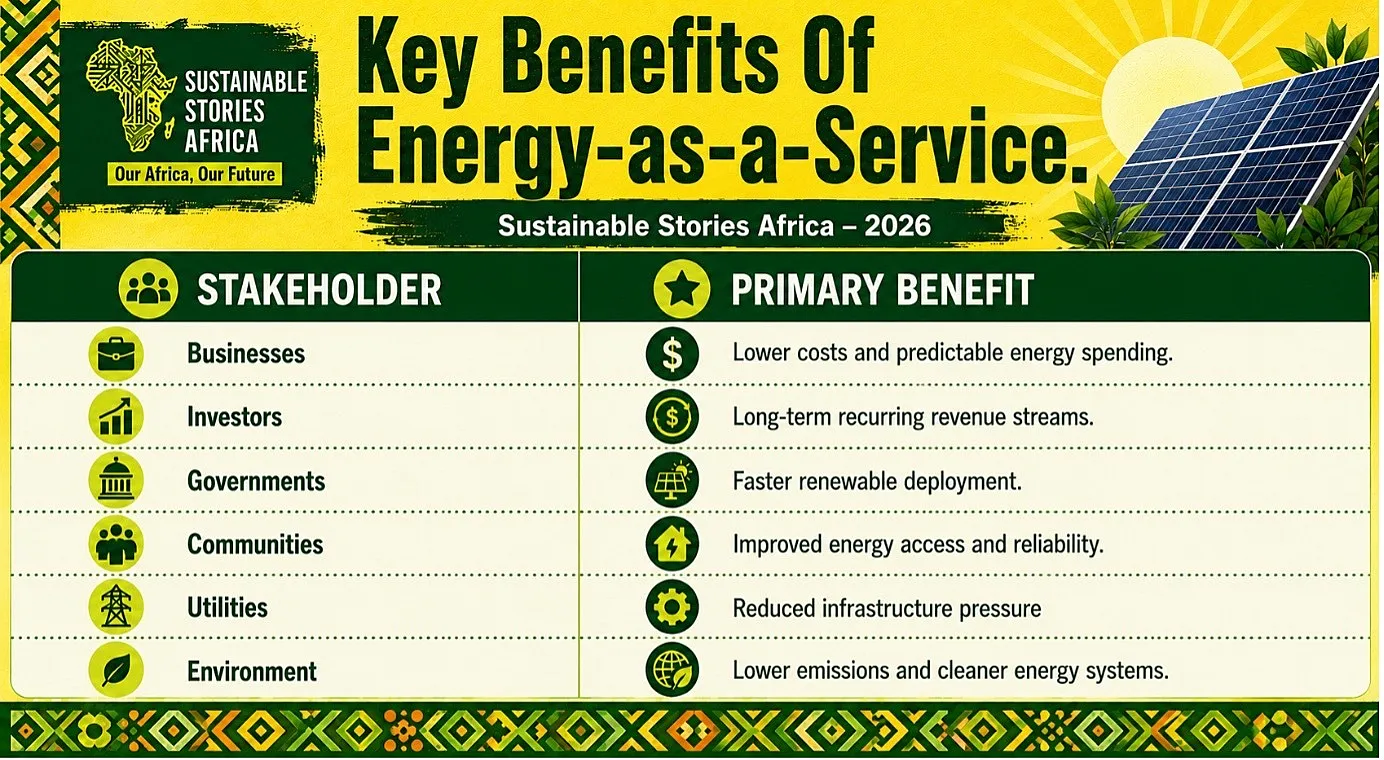
The model is also attracting investors seeking long-term, stable returns linked to infrastructure and sustainability outcomes.
As renewable technologies continue to decline in cost while battery performance improves, EaaS providers are increasingly able to offer competitive pricing that rivals or outperforms conventional energy sources.
For many organisations, the conversation is no longer whether renewable energy makes sense. It is whether they can access it quickly enough.
Building Cleaner And More Resilient Economies
The broader implications extend far beyond electricity supply.
By lowering barriers to adoption, Energy-as-a-Service can accelerate progress toward climate targets while supporting economic development goals.
- For businesses, the benefits include reduced operational costs, greater energy resilience, and improved ESG performance.
- For governments, wider renewable deployment can ease pressure on national grids, reduce fossil fuel dependence, and support energy-transition objectives.
Communities can also benefit from improved reliability, particularly in underserved areas where decentralised renewable systems can provide access to power more efficiently than traditional grid expansion.
Without innovative financing models such as EaaS, many renewable projects could remain stalled despite strong demand and favourable economics.
The risk is not a lack of technology. The persistence of financial barriers prevents deployment at scale.
Financing Innovation Must Match Climate Ambition
The growth of Energy-as-a-Service demonstrates that financing innovation can be just as important as technological innovation.
- Policymakers, financiers, development institutions, and private investors now have an opportunity to accelerate adoption by creating supportive regulatory frameworks, expanding blended-finance mechanisms, and encouraging private-sector participation.
- Businesses must also evaluate energy procurement differently. Instead of viewing energy infrastructure as an asset they must own, many organisations may achieve greater value by treating energy as a managed service.
As Africa seeks to expand energy access while advancing sustainability goals, scalable models that combine affordability, reliability, and environmental performance will become increasingly important.
The challenge now is to move from pilot projects to widespread deployment.
Path Forward – Scaling Service-Based Renewable Energy Models
Energy-as-a-Service is demonstrating that access can sometimes matter more than ownership.
By removing capital constraints, the model is helping renewable energy reach organisations that previously could not participate in the transition.
The next phase will require stronger policy support, innovative financing partnerships, and greater investor confidence.
If these elements align, EaaS could become a major catalyst for cleaner, more resilient, and more inclusive energy systems across African markets.
Culled From: Energy-as-a-Service accelerates renewables growth