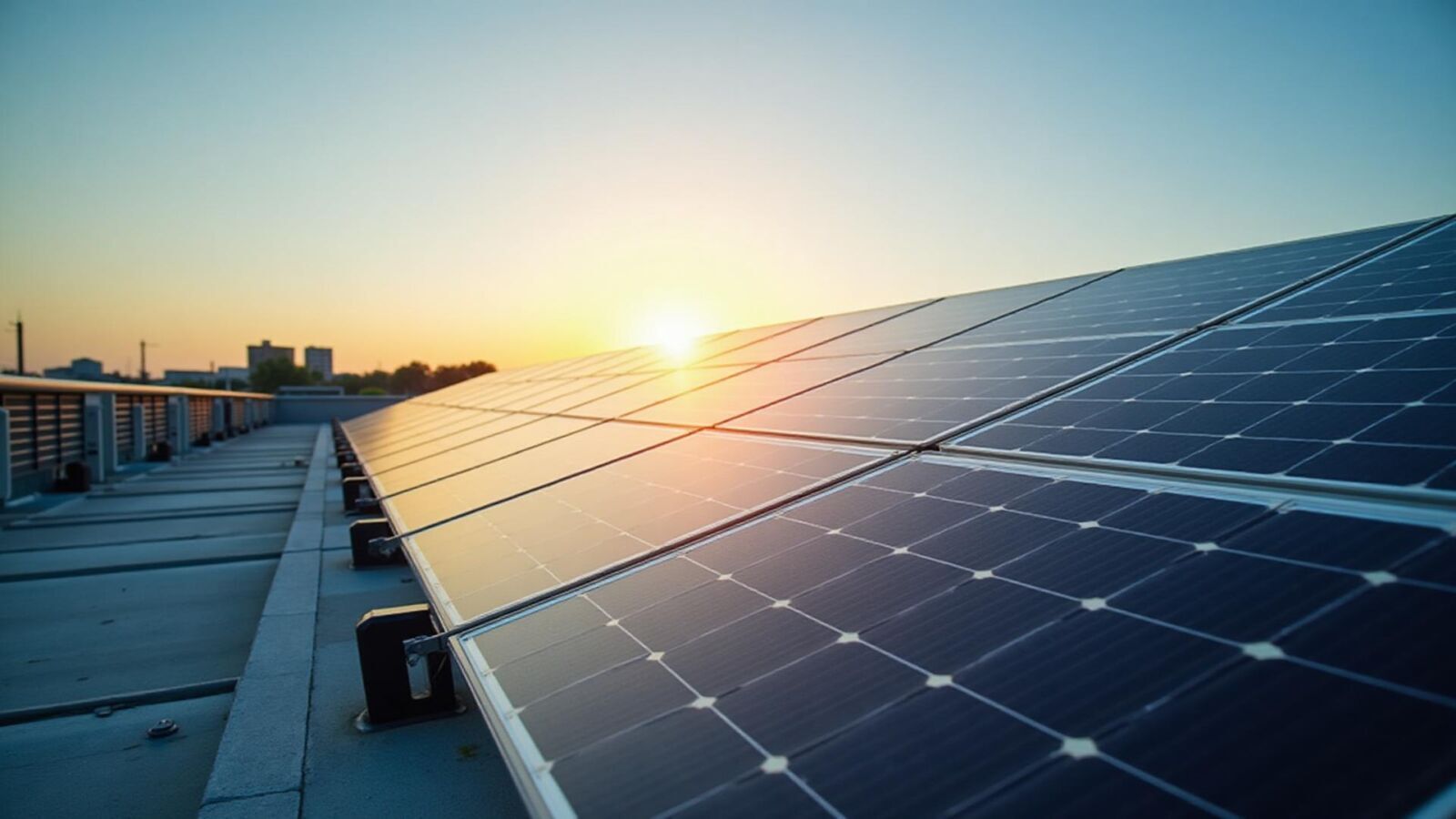
The global energy sector, which is responsible for 31% of reported emissions, continues to show the widest gap between sustainability rhetoric and actionable transparency.
Energy Reporting Rises, Transparency Still Trails
The Global Corporate Sustainability Report 2025 reveals that, although disclosure across energy companies now encompasses 94% of their global market capitalisation, key gaps in emissions reporting, transition strategies, and political lobbying threaten to undermine global climate goals and investor confidence.
Energy companies have among the highest reporting rates for Scope 1 and 2 emissions, with 92% disclosing operational carbon data. However, Scope 3 emissions, the largest driver of climate impact for oil, gas, and power companies, remain inconsistently reported across most regions outside Europe.
Only 58% of global energy firms disclose any Scope 3 categories at all, leaving investors and regulators with limited visibility into supply chain emissions and broader climate exposure.
A major concern highlighted in the report is the sector's disproportionate influence on global climate outcomes. Energy firms account for 31% of all emissions disclosed globally, the highest share of any industry. Yet the data most essential for assessing long-term climate risk, full value chain emissions, transition-aligned capital expenditure, and R&D investment in clean technologies, remains patchy or absent.
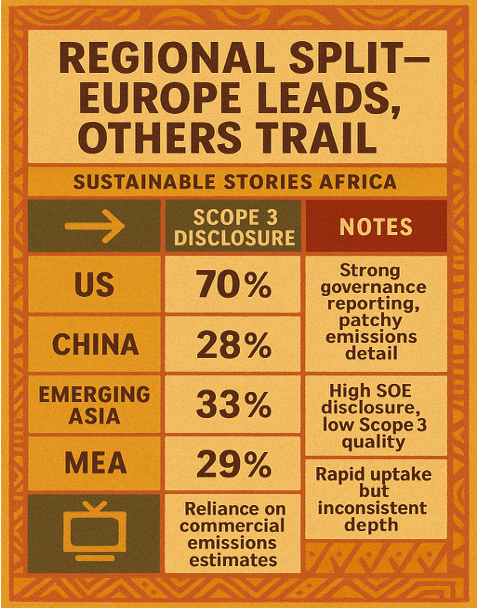
Regional Split – Europe Leads, Others Trail
Europe is the only region where Scope 3 disclosure approaches completeness, driven by mandatory ESRS standards requiring detailed value-chain transparency.
The report shows that 97% of European energy companies disclose Scope 3 emissions, while other regions fall far behind:
| Region | Scope 3 Disclosure | Notes |
|---|---|---|
| US | 70% | Strong governance reporting, patchy emissions detail |
| China | 28% | High SOE disclosure, low Scope 3 quality |
| Emerging Asia | 33% | Rapid uptake but inconsistent depth |
| MEA | 29% | Reliance on commercial emissions estimates |
In China and the Middle East, where state-owned energy enterprises account for a large share of national output, disclosure is improving but remains inconsistent. The report notes that while 95% of SOEs publish sustainability reports, only 52% disclose Scope 3 emissions in a meaningful way.
CapEx and R&D – Signals Still Weak
Beyond emissions data, the report identifies weak transparency in spending on low-carbon innovation, arguably the clearest indicator of corporate commitment to a transition strategy.
Only 33% of energy firms disclose transition-aligned capital expenditure, while just 19% report R&D spending on clean technologies such as carbon capture, renewable fuels, or electrification.
The limited visibility into long-term investments weakens market confidence. Without consistent CapEx disclosure, investors cannot assess whether companies' transition plans are supported by real financial commitments or merely aspirational targets.
The report warns that despite the industry's heavy climate footprint, its innovation footprint remains modest. "R&D disclosure in the energy sector is not keeping pace with the scale of transition challenges," it notes, citing the need for more transparent metrics tied to technology readiness and deployment timelines.
Lobbying Misalignment Undermines Credibility
One of the most striking findings concerns political lobbying. Only 14% of energy companies disclose their climate-related lobbying positions or the activities of trade associations they support.
This lack of visibility raises red flags for regulators who must weigh corporate sustainability commitments against potential behind-the-scenes efforts to delay or dilute climate policy. The report emphasises that transparent lobbying is integral to building trust, noting that public sustainability targets lose credibility when companies quietly undermine climate regulations.
Assurance Gaps Add to the Challenge
While overall sustainability disclosure continues to expand globally, the reliability of energy-sector reporting varies widely. Only 17% of companies obtain reasonable assurance for their emissions data; most rely on limited assurance that provides weaker validation.
The report highlights ISSA 5000, the new global standard for sustainability assurance, as a critical tool for improving data quality. But adoption remains slow, leaving investors to navigate uneven verification standards across markets.
Why the Energy Sector Matters Most
The report underscores that no sector has as much influence on global climate objectives. Energy companies set the pace for emissions reductions across industrial supply chains, determine the scale of fossil fuel phase-outs, and shape the cost trajectories of emerging clean technologies.
However, the sector's slow progress on disclosure creates systemic blind spots:
- Climate models rely on corporate emissions data that is incomplete.
- Investors lack clarity to shift portfolios toward true transition leaders.
- Governments face uncertainty in designing national decarbonisation policies.
- Stakeholders cannot evaluate whether public climate commitments match private financial decisions.
What Needs to Change
The report outlines several priority actions:
- Mandate Scope 3 emissions disclosure globally, especially for energy firms.
- Require transition-aligned CapEx reporting tied to verifiable milestones.
- Expand reasonable assurance under ISSA 5000 to improve data reliability.
- Standardise lobbying transparency, ensuring companies disclose policy positions.
- Strengthen SOE frameworks, given their outsized emissions impact.
These measures, the report says, would significantly reduce information asymmetry and support more effective climate policymaking.
The global energy sector may be disclosing more than ever, but the quality and completeness of its reporting still fall short of what the world needs. With emissions rising and climate deadlines tightening, investors, regulators, and governments require clearer insight into how energy companies are managing climate risk and preparing for the future.
Until the gaps in Scope 3 disclosure, CapEx transparency, and lobbying alignment are addressed, the world's most consequential sector will remain its most opaque, limiting the credibility of global sustainability progress at the very moment clarity is most needed.