
ESG Management Services says it has been selected for a UK Financial Conduct Authority pilot testing future reporting requirements for ESG ratings providers.
The exercise comes as Britain prepares to regulate a market increasingly used to guide capital allocation, risk management and investment products.
For African institutions, participation could help ensure emerging global rules reflect developing-market realities, not only the operating models of larger financial centres.
African Expertise Enters Britain’s Regulatory Room
A Nigerian-led sustainability advisory firm has entered a UK regulatory exercise that could influence how ESG ratings providers report information to supervisors, giving African market experience a place in a process expected to shape confidence in sustainable finance.
ESG Management Services, a UK-headquartered firm founded by Lagos-born ESG specialist Toju Francisco Da-Silva, said it was selected for the Financial Conduct Authority’s voluntary ESG ratings regulatory reporting pilot.
The FCA launched the pilot on April 28, 2026, inviting ESG ratings providers expecting to fall within the future UK regulatory regime to express interest by May 13.
Participation is voluntary, and the regulator said it could select a representative sample depending on the number and range of applications received.
Why ESG Ratings Rules Now Matter
ESG ratings increasingly shape investor decisions on capital allocation, portfolio construction, and regulatory reporting.
However, the market has faced persistent concerns over opaque methodologies, inconsistent assessments, and conflicts of interest, prompting the FCA to push for greater transparency, reliability, and comparability as ratings gain influence over financial markets.
Global spending on ESG data was projected to reach $2.2 billion in 2025. FCA research found 55% of surveyed users concerned about how ratings were constructed, and 48% about transparency; the regulator estimates its proposed framework could deliver roughly £500 million in net benefits over ten years.
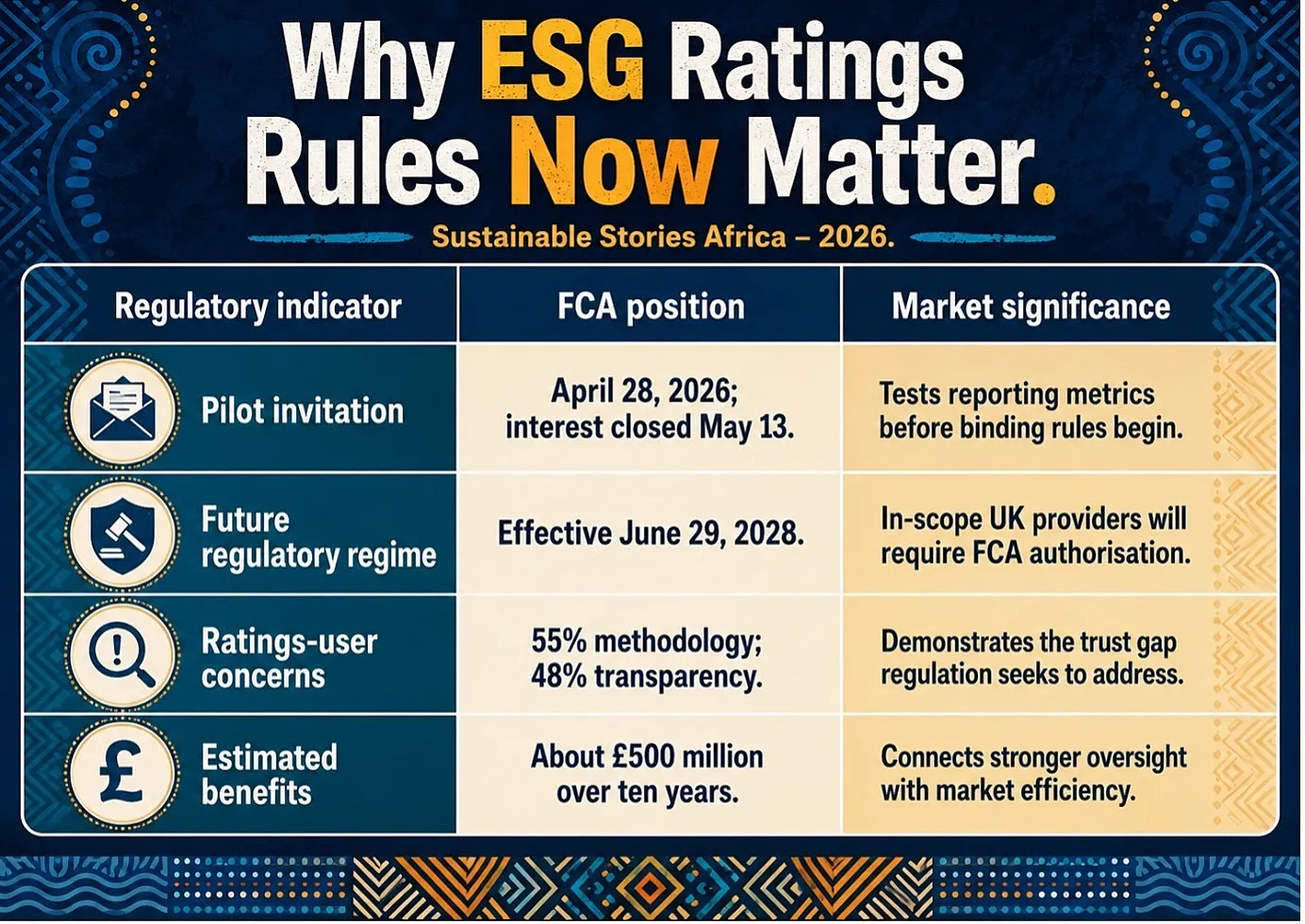
The new regime takes effect on June 29, 2028, and requires FCA authorisation for firms providing specified ESG ratings in the UK.
A pilot will test whether the proposed metrics are clear, feasible, and useful for supervision, with revisions possible following feedback from providers.
For African markets, the practical question remains: frameworks built around mature disclosure systems may not translate neatly to smaller companies and infrastructure projects operating with fragmented data.
Better Rules Could Unlock Trusted Capital
ESGMS work covers governance, risk and compliance, sustainable finance, investment readiness and institutional strengthening.
The firm works with governments, companies, investors, financial institutions and development partners across African markets.
Participation allows the company to explain where international reporting expectations may impose unintended burdens or overlook the operating conditions of developing markets.
Da-Silva said African institutions must become “active contributors to the development of international standards rather than passive adopters.”
Such participation could produce two outcomes.
- Regulators would receive feedback representing a wider range of provider sizes and operating models
- African institutions could gain a clearer understanding of the governance, evidence and internal controls increasingly expected by international investors.
Clearer and more comparable ratings could also reduce frictions relating to due diligence, strengthen investor confidence and help credible businesses distinguish themselves from organisations relying on weak or unsupported sustainability claims.
However, participation in the pilot does not mean an express FCA authorisation, regulatory approval or an endorsement of a provider’s ratings.
The FCA has stated that information submitted during the pilot will not be used to determine future authorisation applications.
African Institutions Must Shape Standards Early
African financial institutions, advisers and ESG ratings providers should treat the UK process as a signal to improve methodology disclosure, data quality, conflicts management, complaints procedures and governance controls before major international regimes take effect.
ESGMS will also need to translate its participation into measurable outcomes by demonstrating how its feedback applies to African market realities and showing clients how stronger reporting can improve investment readiness rather than merely increasing compliance costs.
Path Forward – Building Credible Rules Through Market Participation
The immediate priority is to develop a reporting framework that strengthens transparency without imposing one-size-fits-all requirements.
Effective participation should test whether the proposed metrics are workable for smaller providers and institutions operating in data-constrained markets.
For Africa, the bigger opportunity is to move from receiving global ESG rules to helping design them, thereby strengthening the governance, data and assurance systems required to compete credibly for sustainable capital.