
The European Banking Authority has finalised expanded Pillar 3 ESG disclosure rules that will extend climate and sustainability-risk transparency beyond large listed banks.
The rules begin from the 31 December 2026 reference date for most institutions, with smaller banks given extra time.
For African markets linked to European finance, the message is clear: ESG data quality is becoming a capital-access issue.
Bank Transparency Enters New Phase
Europe’s banking regulator has sent a clear signal to financial markets: ESG risk is no longer a side note in bank reporting.
The European Banking Authority has finalised draft Implementing Technical Standards to update Pillar 3 disclosure requirements on environmental, social and governance risks, equity exposures and shadow banking exposures.
The rules are expected to apply from the 31 December 2026 reference date for most EU banks, while small and non-complex institutions will begin from 31 December 2027.
The move expands ESG disclosure obligations from mainly large listed banks to all EU institutions, using a proportional framework that adjusts reporting depth by size and complexity.
For African banks, companies and governments that depend on European lenders, investors and development finance, the change matters. What EU banks must disclose about climate transition risk, physical risk, fossil-fuel exposure and counterparties could shape how capital is priced, allocated and monitored across emerging markets.
Climate Risk Moves Into Bank Data
Pillar 3 disclosures are the public-facing part of banking regulation. They help investors, regulators, analysts and the wider market understand where risks sit inside banks’ balance sheets.
Under the new EBA framework, banks will publish more structured information on exposures linked to climate transition risks, physical risks, fossil-fuel sectors, equity holdings and shadow banking entities.
This includes information on sectors that contribute significantly to climate change, financed emissions where available, and exposures vulnerable to climate hazards such as floods, droughts, storms and heatwaves.
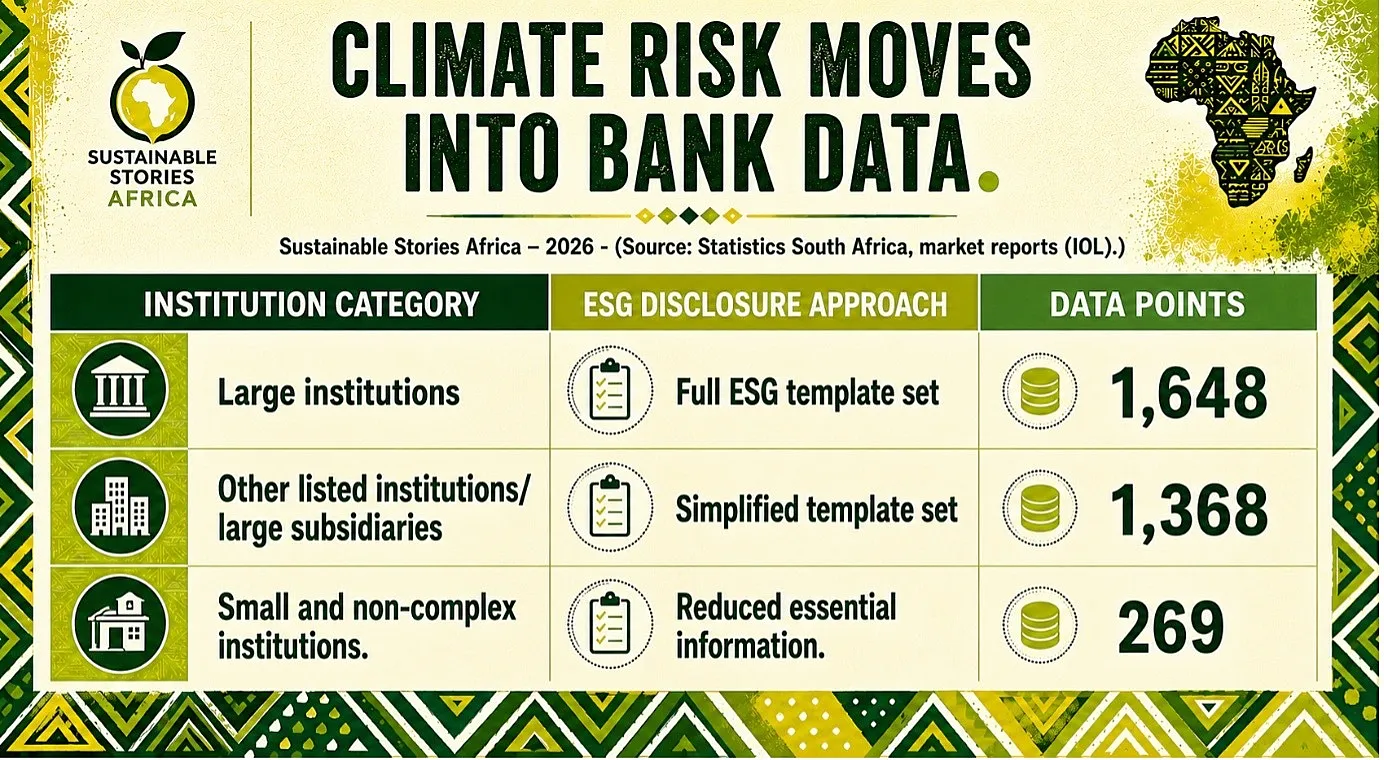
The EBA is also simplifying the existing regime. For large institutions, ESG-related data points will fall by about 37%, from 2,614 to 1,648.
Other listed institutions and large subsidiaries will report 1,368 data points, while small and non-complex institutions will report 269.
It matters because banks sit at the centre of the real economy. A loan to a coal-linked company, a mortgage portfolio exposed to flood zones, or credit exposure to energy-intensive infrastructure can become a financial stability issue when climate policy, technology or physical hazards change quickly.
For African borrowers, the signal is practical. A European bank financing energy, infrastructure, transport, mining or agribusiness projects may increasingly ask for clearer emissions data, transition plans, location-based climate risk information and evidence of governance before lending.
Better Data Can Unlock Better Capital
The positive opportunity is that clearer ESG risk disclosure can improve capital discipline.
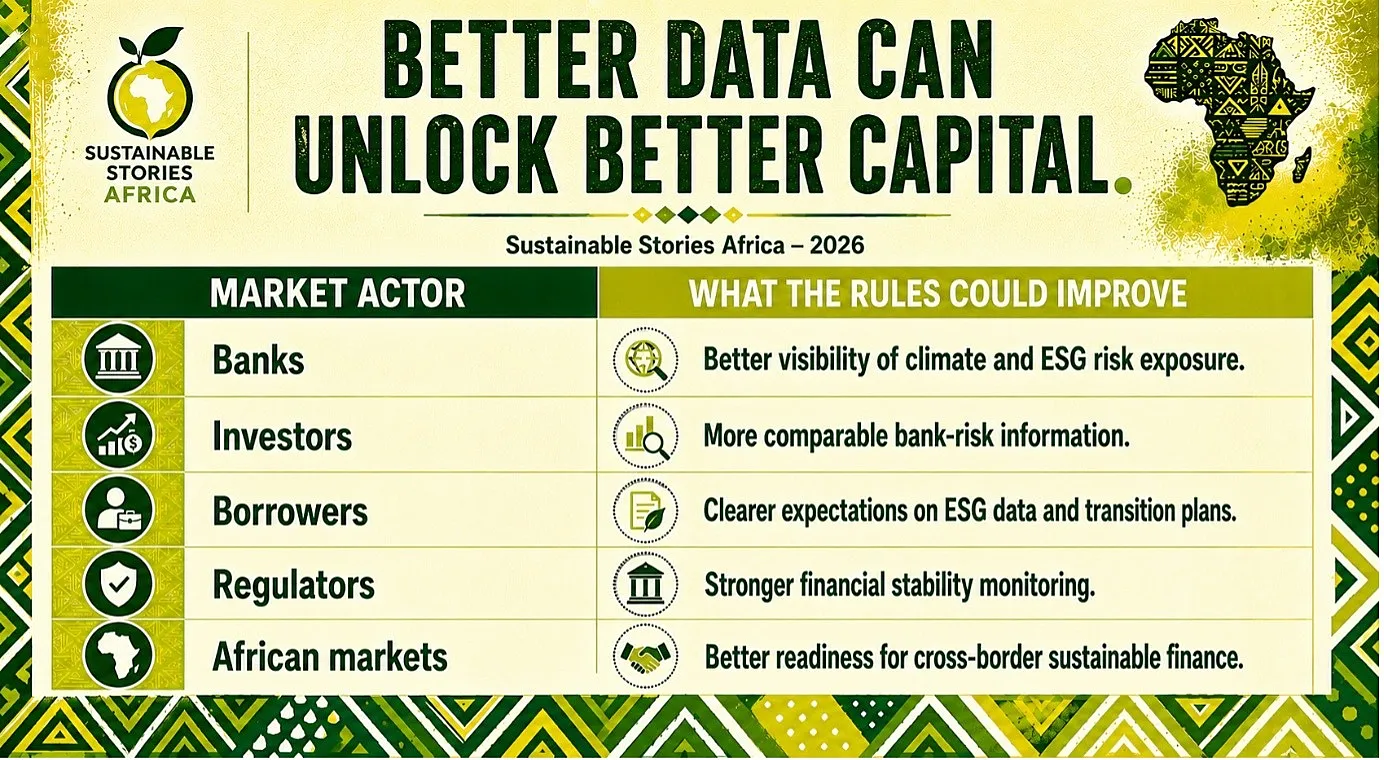
- For banks, stronger transparency can help identify vulnerable portfolios earlier. For investors, it improves comparability.
- For regulators, it supports financial stability.
- For companies, it creates a clearer market expectation: sustainability claims must be backed by usable data.
For African economies, this could support better project preparation. Renewable energy, resilient infrastructure, sustainable agriculture and green transport projects may become more bankable if sponsors can provide credible data on emissions, risk management and social safeguards.
However, there is also a risk. Companies without strong disclosure systems may face higher scrutiny, slower approvals or more expensive financing.
The gap will not only be between green and brown assets. It may also be between well-documented and poorly documented businesses.
African Borrowers Must Prepare Early
The EBA’s rules should be read as an early warning for institutions outside Europe.
African banks, exporters, infrastructure sponsors and public-sector borrowers need to strengthen ESG data systems before disclosure expectations become financing bottlenecks.
That means improving climate-risk mapping, emissions measurement, board oversight, transition planning and sector-level risk reporting.
Regulators across African markets can also use the moment to deepen alignment for local sustainability reporting.
Where domestic frameworks are credible, banks and companies will be better positioned to respond to European lender questions without reinventing compliance systems for every transaction.
The real work is not paperwork. It is building financial systems that can see risk before it becomes loss.
Path Forward – Disclosure Must Support Resilient Finance
The EBA’s expanded rules show where global banking regulation is heading: simpler reporting, wider coverage and sharper climate-risk transparency.
For African markets, the priority is readiness. Banks, borrowers and regulators must turn ESG reporting into practical risk management, so sustainable finance becomes more accessible, credible and resilient.
Culled From: EBA Finalises Expanded ESG Disclosure Rules for All EU Banks from December 2026