The European Union has agreed on a negotiating position to overhaul its Sustainable Finance Disclosure Regulation (SFDR), replacing today's complex investment classifications with three clearer sustainability categories.
The move comes as regulators seek to reduce compliance burdens while restoring investor confidence after years of confusion and greenwashing concerns.
For global capital markets, including Africa's emerging sustainable finance ecosystem, the reforms could reshape how investors evaluate responsible investment opportunities and channel climate finance.
Europe Moves to Rewrite Sustainable Finance Rules
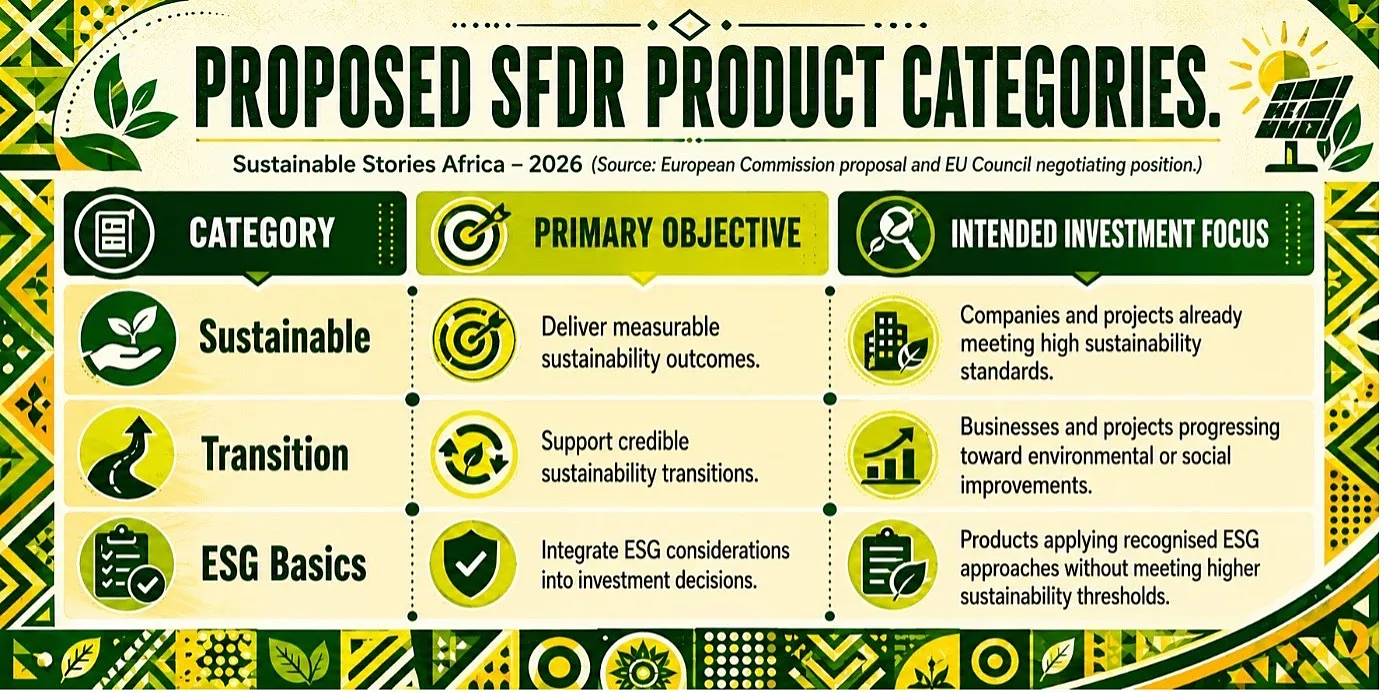
The European Council has agreed its negotiating position on one of the bloc's most significant sustainable finance reforms, paving the way for a simpler Sustainable Finance Disclosure Regulation (SFDR) that introduces three new sustainability product categories designed to improve transparency, reduce administrative burdens and rebuild investor trust.
The agreement, reached on 24 June, forms the Council's mandate for negotiations with the European Parliament.
While the legislation is not yet final, it marks a major milestone in the EU's effort to modernise sustainable investing after widespread criticism that existing disclosure rules had become overly complex, expensive and vulnerable to inconsistent interpretation.
Under the proposed framework, investment products would be classified into Sustainable, Transition, and ESG Basics, replacing the market's heavy reliance on Article 8 and Article 9 labels that many investors found difficult to understand.
Making Sustainable Investing Easier To Understand
Since its introduction in 2021, the SFDR has become one of the world's most influential sustainable finance regulations.
However, many asset managers, institutional investors and retail clients argued that disclosures were becoming longer rather than clearer, while differing interpretations increased compliance costs and uncertainty.
The Council's proposal aims to simplify sustainability disclosures without weakening market integrity.
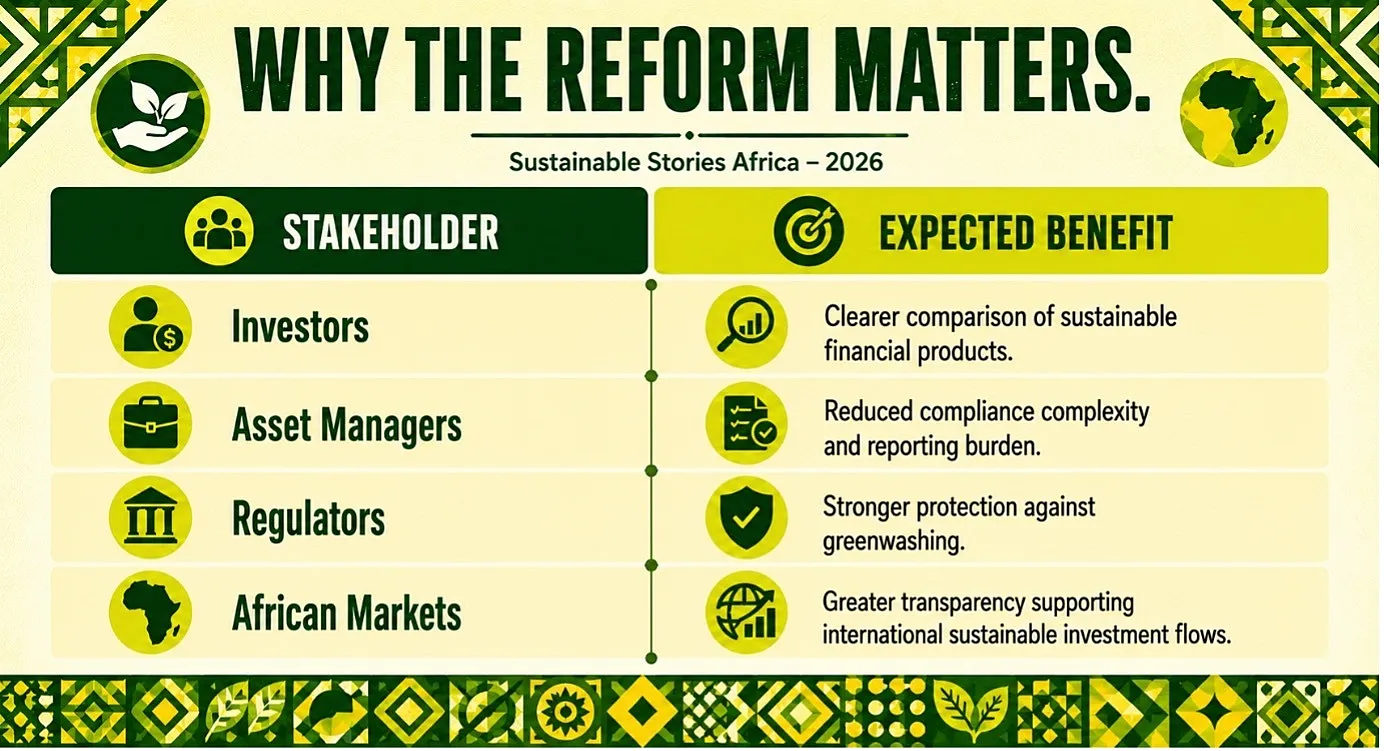
Investors would receive clearer information on what each investment product is designed to achieve, while financial institutions would face fewer reporting obligations and more consistent disclosure standards.
For Africa, the implications extend beyond Europe.
European investors remain among the continent's largest providers of climate finance, infrastructure funding and ESG-focused investment.
Simpler classification rules could make it easier for international asset managers to explain African sustainable investment opportunities to global investors, particularly in renewable energy, resilient infrastructure and transition finance.
The proposal also strengthens safeguards against misleading sustainability claims by tying product categories to clearer eligibility criteria, an increasingly important issue as regulators worldwide intensify scrutiny of greenwashing.
Why The Reform Matters Beyond Europe
If successfully implemented, the revised framework could strengthen confidence across global sustainable finance markets by making ESG investment products easier to compare.
That matters because sustainable investing increasingly depends on credibility as much as capital.
African governments seeking investment to renewable energy, climate adaptation, biodiversity, resilient agriculture and social infrastructure benefit when international investors can confidently distinguish between genuinely sustainable funds, transition-focused portfolios and broader ESG integration strategies.
The reforms could also encourage greater alignment between European capital markets and emerging disclosure frameworks being developed across Africa, where regulators are progressively adopting internationally recognised sustainability reporting standards.
Conversely, maintaining today's fragmented disclosure system risks prolonging investor confusion, increasing compliance costs and slowing capital flows needed to finance climate resilience and inclusive economic growth.
Building Trust Before Capital Flows
Although the Council has established its negotiating position, the reform still requires agreement with the European Parliament before becoming law.
Trilateral negotiations will determine the final architecture of the revised framework.
For African policymakers, regulators and financial institutions, the negotiations offer an opportunity to prepare for a market increasingly shaped by transparent sustainability classifications and internationally comparable ESG disclosures.
As sustainable finance continues to evolve from voluntary commitments to measurable investment standards, credibility will increasingly determine where global capital flows.
Path Forward – Building Transparent Markets Through Shared Standards
The Council's agreement signals Europe's intention to simplify sustainable finance while preserving investor confidence and strengthening market integrity.
Final negotiations will determine how these categories operate across financial markets.
For Africa, the lesson is equally important: transparent sustainability classifications, credible disclosures and internationally comparable reporting standards will become increasingly essential for attracting long-term climate and development finance while supporting resilient economic growth.
Culled From: EU Council Agrees SFDR Reform with Three New Sustainable Product Categories