The European Commission says its EUDR simplification package will cut annual compliance costs by about 75%.
The move comes before the law applies from December 30, 2026, for large and medium-sized companies.
For African cocoa, coffee, timber, rubber and palm oil suppliers, the relief is real, but traceability remains the new price of market access.
Relief Arrives, But Scrutiny Remains High
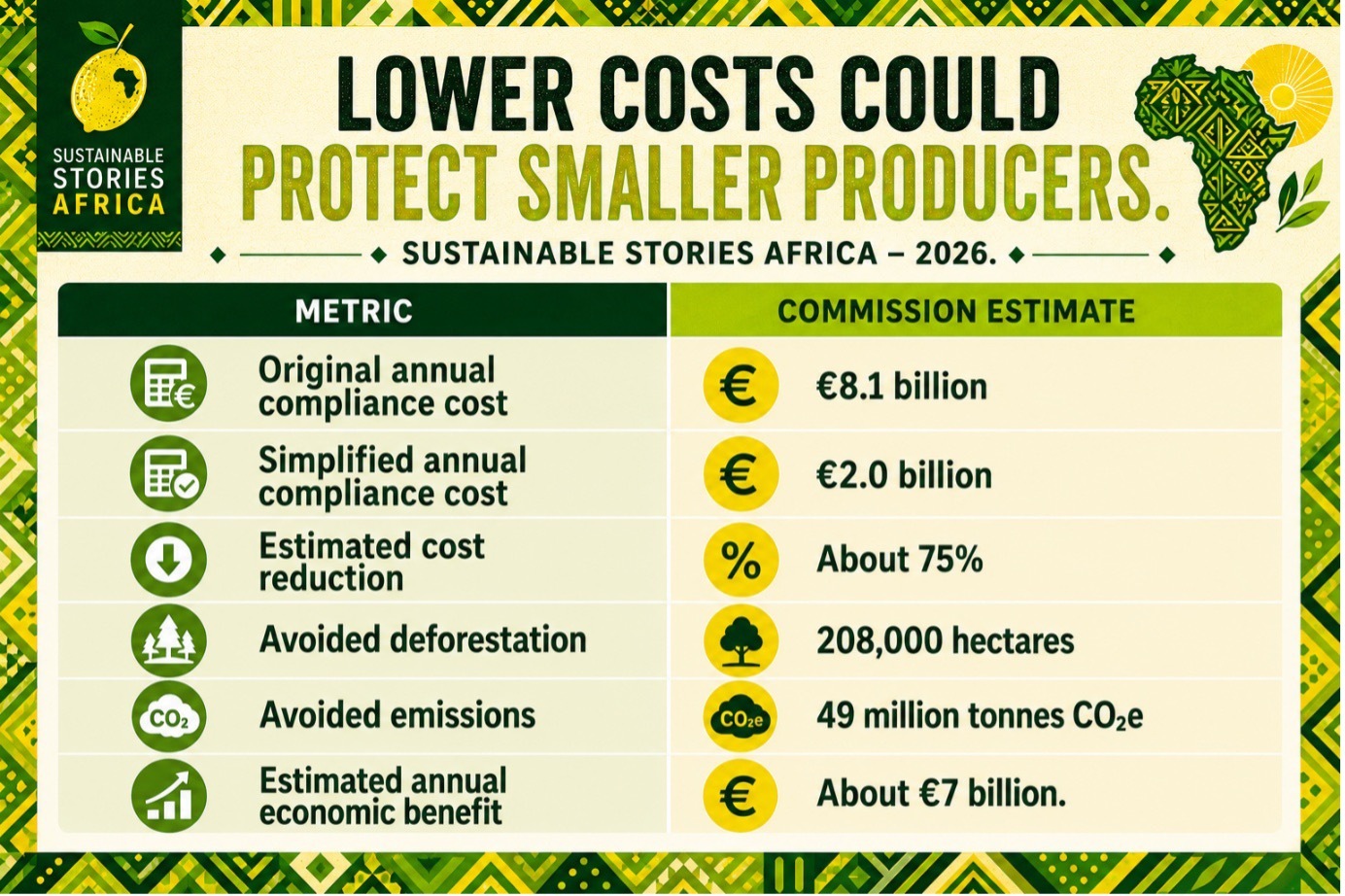
The European Commission has moved to simplify the EU Deforestation Regulation, saying combined changes will reduce annual compliance costs for affected companies by about 75%, from an estimated €8.1 billion to €2.0 billion.
The package, published in May 2026, does not scrap the law. It keeps the core demand: companies placing covered commodities on the EU market must prove they are not linked to deforestation or forest degradation.
The regulation still covers key products such as cocoa, coffee, cattle, soy, palm oil, rubber and wood, as well as selected derived products.
For African exporters, the message is direct: Brussels may be cutting paperwork, but it is not cutting expectations.
What Changed Inside The Package
The simplification package updates guidance, FAQs, product scope and the EU’s Information System.
It clarifies that multiple shipments can be covered by a single due diligence statement, offers lighter obligations for some downstream actors, and introduces simplified declarations for micro and small primary operators.
The Commission also proposed product-scope changes, including adding selected downstream products such as soluble coffee and palm oil derivatives, while excluding leather, samples and retreaded tyres.
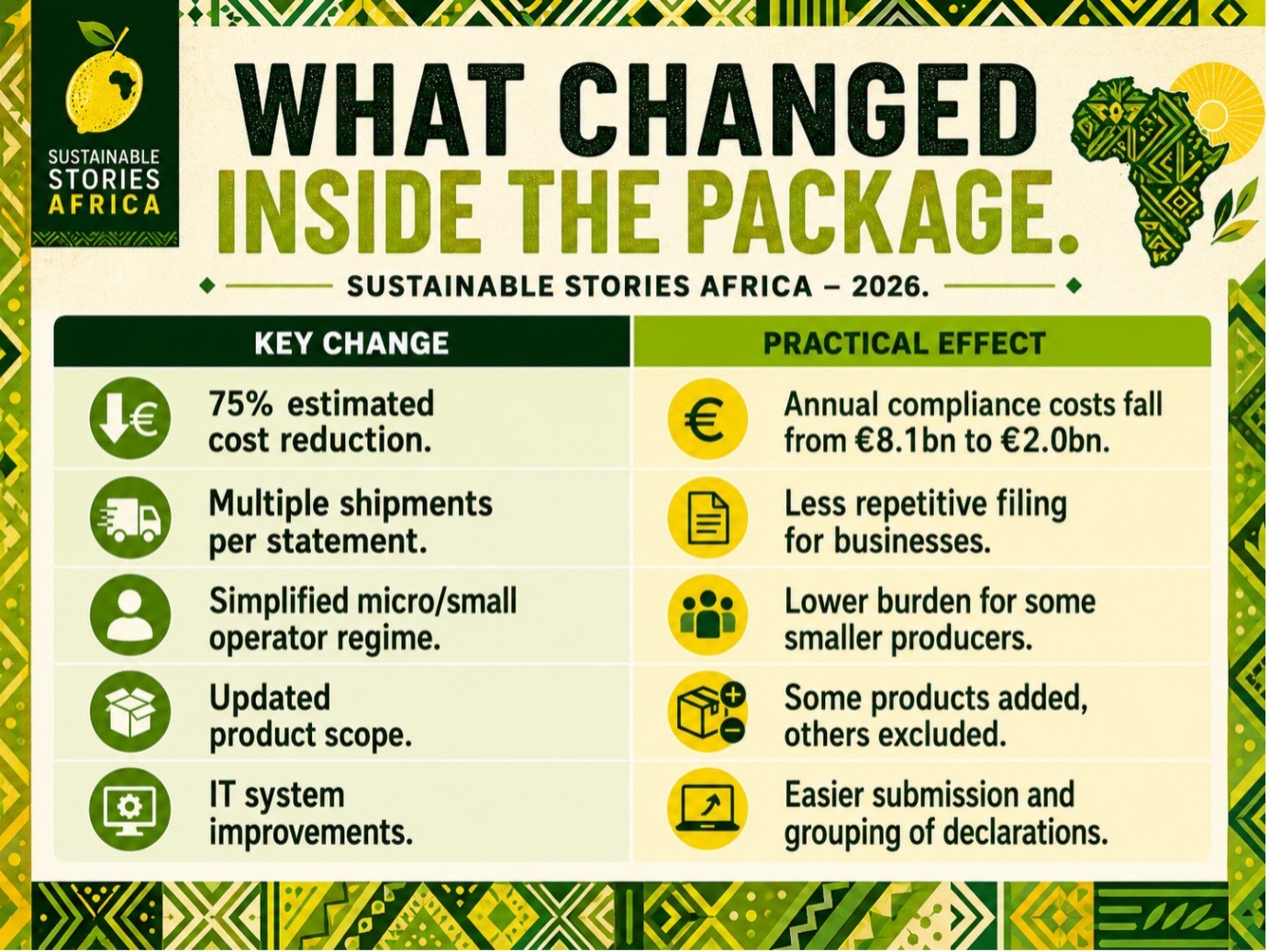
The regulation is expected to apply from December 30, 2026, for large and medium companies, and from June 30, 2027, for many micro and small enterprises.
Africa’s Exporters Face A New Market Reality
For a cocoa cooperative in Ghana, a coffee trader in Ethiopia or a rubber processor in Côte d’Ivoire, the EUDR is not a distant European rule. It is becoming a commercial test.
Exporters will need stronger farm mapping, geolocation records, supplier documentation and legality checks.
Buyers will ask not only whether a product is high quality, but whether its origin can be proven.
Several African countries, including Ghana, Gabon, Congo, South Africa, Tunisia and Madagascar, have been classified as low-risk, while countries such as Cameroon, the Democratic Republic of Congo and Côte d’Ivoire remain standard-risk, according to Ecofin Agency’s summary of the revised rules.
That risk classification matters. Low-risk status can reduce inspection pressure and compliance friction.
Standard-risk suppliers may face more scrutiny, more documentation demands and higher costs.
Lower Costs Could Protect Smaller Producers
The positive case is clear: if simplification works, smallholders and exporters could spend less time fighting paperwork and more time building credible, traceable supply chains.
The Commission says the EUDR could generate about €7 billion in annual economic benefits by monetising 208,000 hectares of avoided deforestation and 49 million tonnes of avoided greenhouse gas emissions.
For African markets, the opportunity is bigger than avoiding penalties. EUDR readiness could support better land governance, cleaner commodity data, stronger ESG reporting and more trusted export relationships.
However, the risk is equally sharp. Producers without digital records, land documentation or cooperative-level support could be excluded from premium supply chains, even if they are not causing deforestation.
Compliance Must Become Development Infrastructure
African governments, commodity boards, banks and exporters should treat EUDR compliance as trade infrastructure, not just a legal burden.
That means investing in land-use mapping, farmer registries, affordable satellite tools, cooperative training and shared traceability platforms.
It also means ensuring small producers are not forced to carry the cost of compliance alone.
That matters here because the EUDR story is not only about Brussels. It is about who gets to remain inside global green supply chains.
Path Forward – Build Traceability Before Deadlines Arrive
The path forward is practical: African exporters should audit supply chains now, map farms, digitise supplier records and engage EU buyers before enforcement begins.
Governments should support shared compliance systems so smallholders are not priced out.
Well done, EUDR simplification can reduce cost, protect forests and keep African producers connected to Europe’s sustainability-driven markets.
Culled From: European Commission Cuts EUDR Compliance Costs by 75% in Deforestation Regulation Simplification Package