The European Union is renewing its push to expand renewable power across Africa through Global Gateway and Team Europe investments.
The renewed focus comes as energy access, green industry and geopolitical supply chains become increasingly connected.
For African households, businesses and manufacturers, the test is whether new funding delivers reliable electricity, jobs and local value.
Europe Returns To Africa’s Power Question
The European Union is reviving its push for renewable power, placing clean energy at the centre of a wider strategy linking development finance, industrialisation and geopolitical influence.
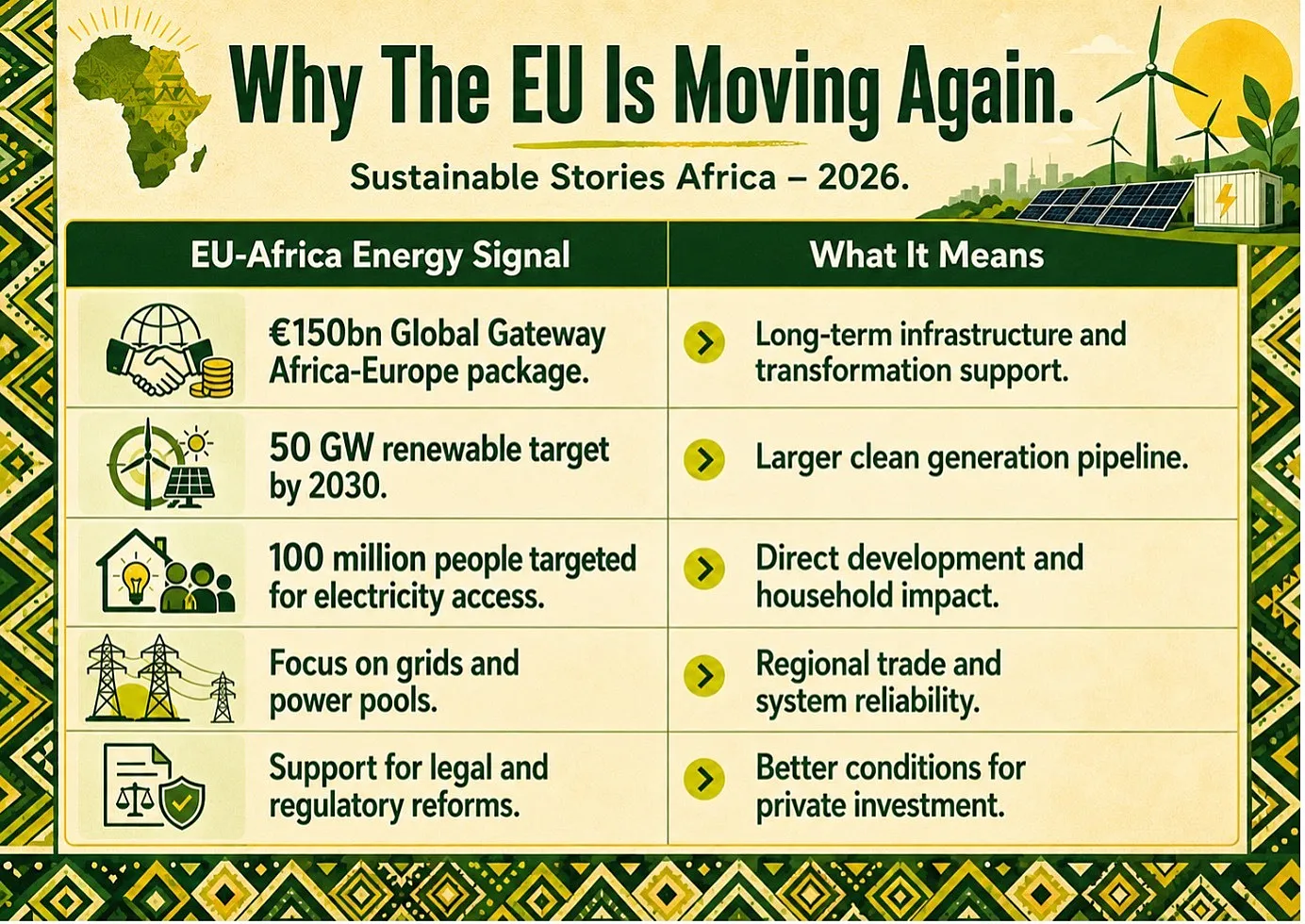
Through the EU-Africa Global Gateway Investment Package, the bloc says it is supporting Africa’s green and digital transformation, with up to €150 billion in planned investments across priority sectors.
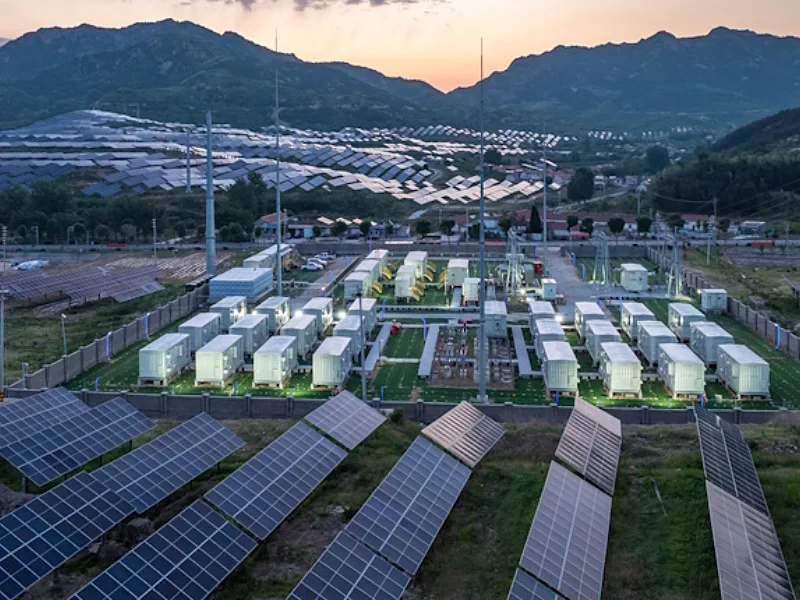
Energy is one of the most visible pillars, covering renewable generation, transmission, distribution, grid integration and access to modern electricity.
The timing matters. Africa still carries one of the world’s deepest electricity access gaps, even as it holds some of the strongest solar, wind, hydro and geothermal potential.
For families, unreliable power means children studying by poor light.
For factories, it means higher diesel costs.
For governments, it means industrial ambition constrained by an energy system that has not grown fast enough.
Why The EU Is Moving Again
The EU’s renewed energy push is not only climate diplomacy. It is also an economic strategy.
The Africa-EU Green Energy Initiative aims to support at least 50 gigawatts of additional renewable energy generation capacity by 2030 and provide at least 100 million people with access to electricity.
Its priorities include clean generation, transmission infrastructure, decentralised energy solutions and regulatory reforms that can attract private capital.
Recent EU-backed announcements have also highlighted funding for electrification, grid modernisation and renewable deployment across the continent.
A reported €545 million package under the Scaling Up Renewables in Africa campaign included support for clean energy access, transmission and rural electrification projects.
The push is unfolding in a more competitive global environment. China remains a major supplier of solar and wind technologies to Africa, while development banks and other partners are also scaling commitments to electrification.
The wider Mission 300 effort, backed by the World Bank and African Development Bank, aims to connect 300 million Africans to electricity by 2030, with financing commitments from several institutions.
What Africa Could Gain
If the EU’s renewed push delivers, the gains could extend beyond electricity access.
More renewable power can reduce dependence on costly diesel generation, improve reliability for small businesses, support cold storage for farmers, power hospitals, and make African manufacturing more competitive.
For industrial parks, mining corridors and agro-processing clusters, cleaner electricity can be the foundation for export growth.
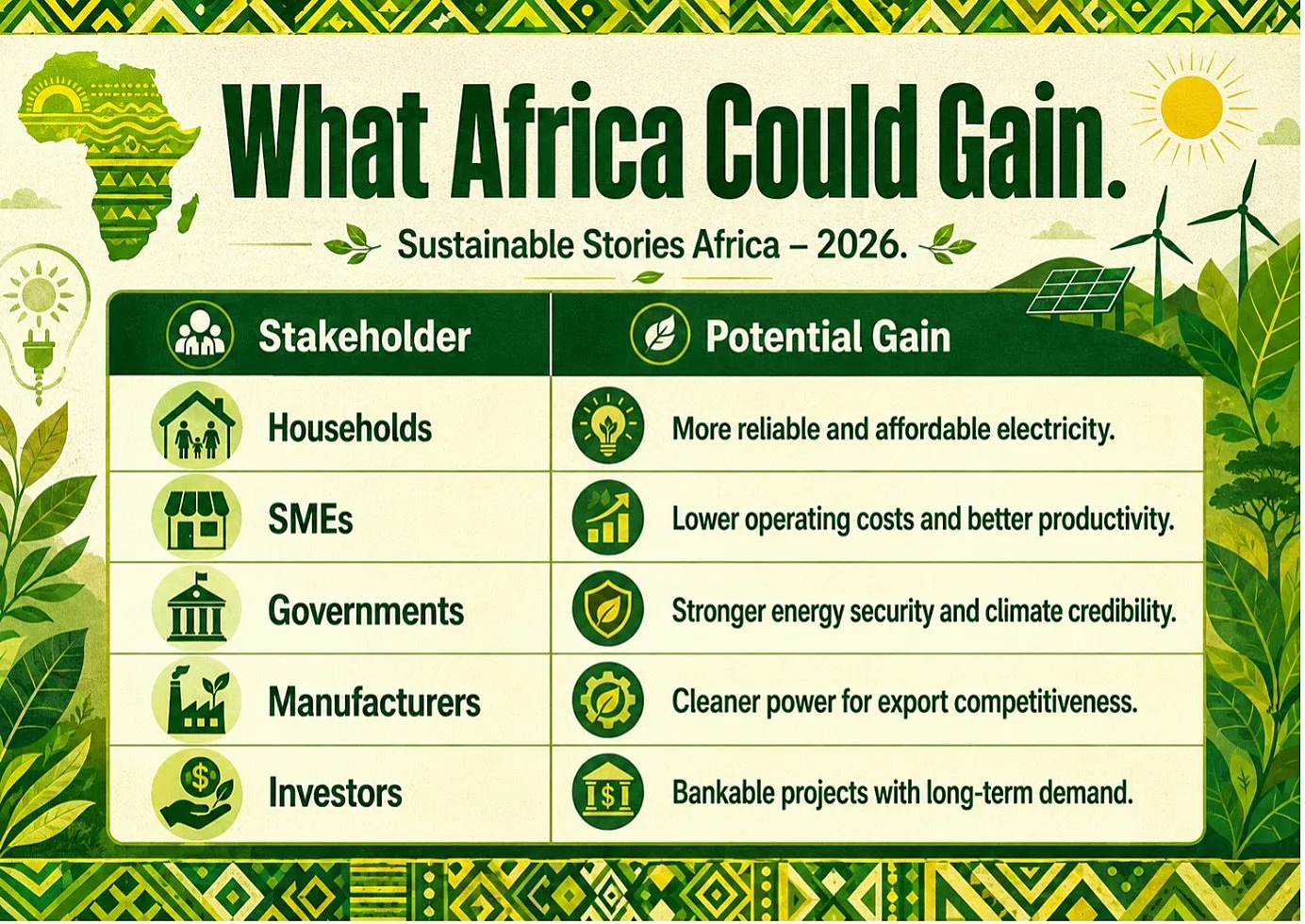
There is also a strategic industrial opportunity. If African countries use renewable energy investments to build local skills, assembly, maintenance, battery services and grid expertise, the continent can move beyond being a market for imported equipment.
However, the risk is equally clear. If projects are designed mainly around external financing priorities, Africa may gain infrastructure without enough local ownership, jobs or industrial depth.
Make Clean Power Locally Transformative
The next phase must focus on execution, not announcements.
African governments should prioritise bankable power-sector reforms, clear procurement rules, stronger utilities and transparent tariffs that protect vulnerable users while attracting investment.
The EU and its partners should align financing with African industrial plans, not only climate targets.
That means funding transmission lines, power pools, mini-grids, storage systems and productive-use energy for agriculture, manufacturing and digital services.
It also means supporting local companies that can install, maintain and operate clean-energy assets long after the ribbon-cutting ceremony.
- For financiers, the priority is to reduce project risk without weakening public accountability.
- For communities, the measure of success will be simple: does the power arrive, stay on and improve livelihoods?
Path Forward – Turn Energy Finance Into Development
Africa’s renewable future needs partnerships, but the partnership must deliver local value.
EU-backed projects should strengthen grids, expand access, build skills and support African industrial priorities.
The opportunity is to turn clean power into development infrastructure: electricity for homes, factories, farms and future industries.
If done well, Europe’s renewed push can support ESG goals while helping African economies grow with cleaner, more reliable energy.
Culled From: EU revives push for African renewable power