The European Commission has awarded €400 million to 65 industrial heat projects.
The first-ever Innovation Fund Heat Auction targets factories still dependent on fossil-fuel heat.
For African markets, the model shows how carbon revenues can finance a cleaner industry, competitiveness and energy security.
Europe Targets Factory Heat Emissions
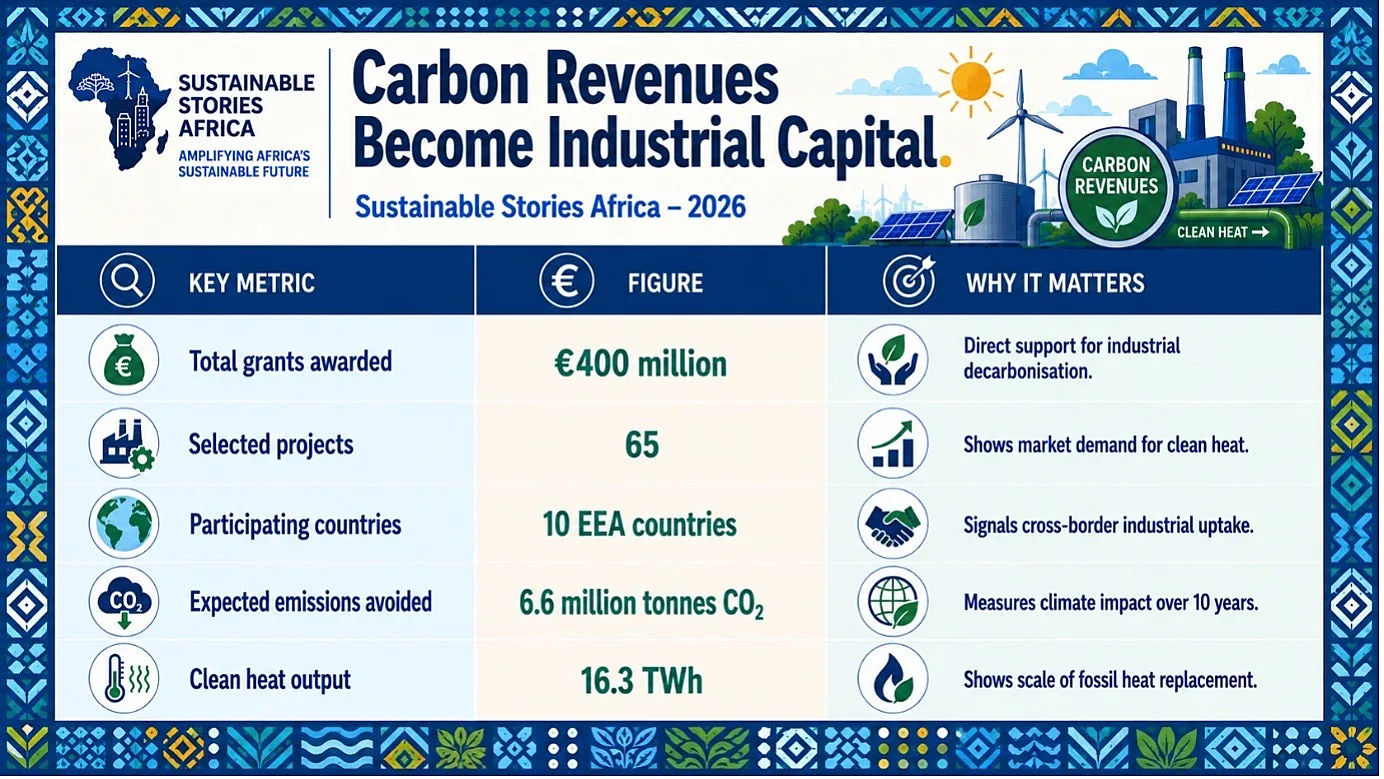
The European Commission has awarded €400 million in grants to 65 projects under its first Innovation Fund Heat Auction, marking a new attempt to cut one of industry’s most stubborn sources of emissions: fossil-fuel heat.
The projects, spread across 10 European Economic Area countries, will deploy technologies including heat pumps, resistance heating, solar thermal systems, electromagnetic heating and hybrid clean-heat solutions
Together, they are expected to avoid more than 6.6 million tonnes of carbon dioxide over 10 years and generate around 16.3 terawatt-hours of decarbonised heat in their first five years.
For factories that rely on natural gas to make paper, glass, ceramics, food, textiles, steel and pharmaceuticals, the auction offers a financial bridge between today’s fossil systems and tomorrow’s cleaner production lines.
Carbon Revenues Become Industrial Capital
The auction is funded through the EU Emissions Trading System, which turns carbon pricing revenue into grants for climate technology.
That design matters: it uses money raised from emissions to finance the technologies meant to reduce them.
The selected projects will replace natural gas-based heat production, equivalent to more than 1.5 billion cubic metres of natural gas.
The Commission said the expected clean heat output is roughly comparable to the annual consumption of 4 million EU households.
For Africa and the wider Global South, the lesson is not only technical. It is financial. As countries consider carbon markets, climate funds and industrial policy, Europe’s model shows how climate revenue can be recycled into productive sectors rather than an abstract environmental levy.
Cleaner Heat Can Protect Competitiveness
Industrial heat is difficult to decarbonise because many factories need high and constant temperatures. Replacing fossil-fuel boilers is not as simple as installing rooftop solar panels. It requires process redesign, capital investment, grid readiness and confidence that clean technologies can perform reliably.
If the heat auction succeeds, it could lower emissions while helping European manufacturers stay competitive under tighter climate rules. It could also create market demand for clean-heat equipment, engineering services and industrial electrification supply chains.
The same logic matters for African industrialisation. As export markets tighten climate standards, manufacturers that depend on carbon-intensive energy may face rising costs, weaker market access and future compliance pressure. Cleaner industrial heat could become part of export competitiveness, especially for food processing, textiles, cement inputs, mining value chains and agro-industrial parks.
Make Clean Industry Financeable
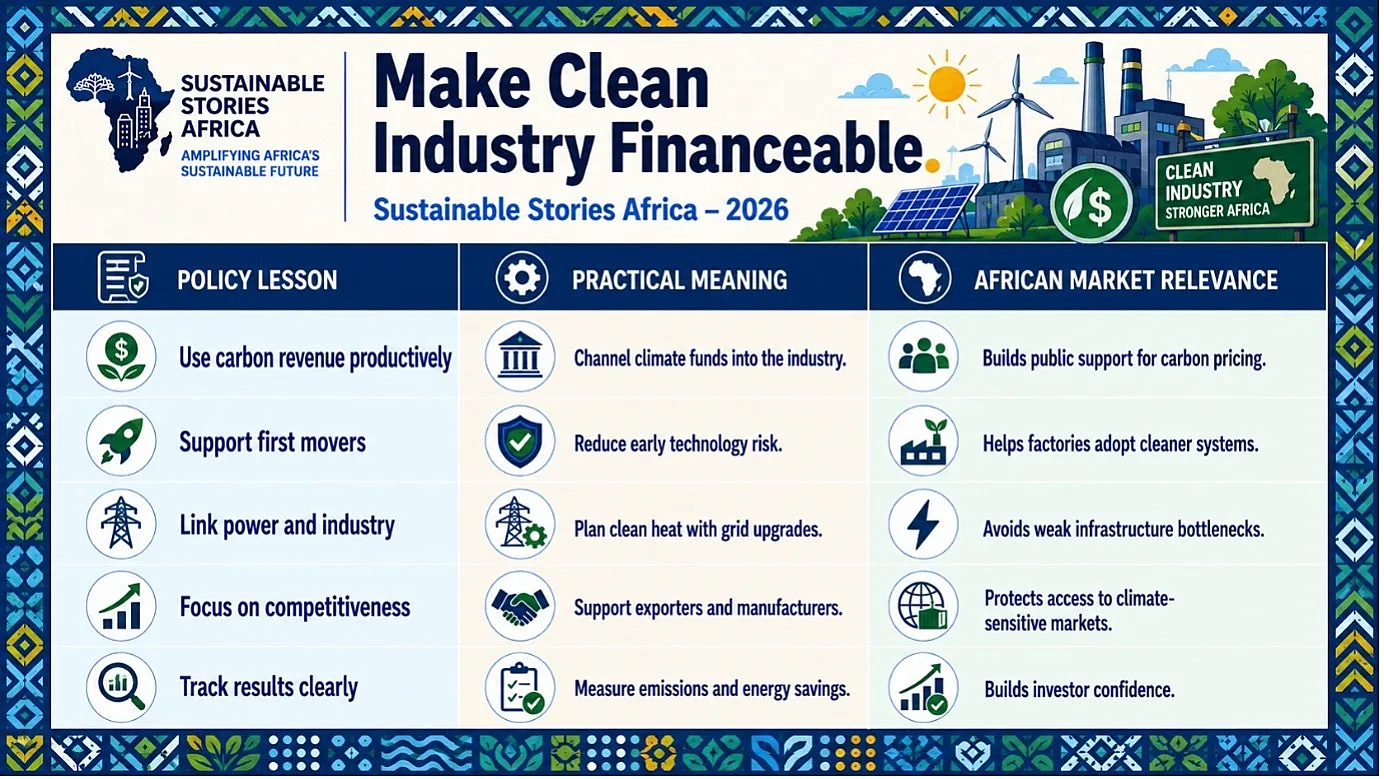
The EU’s auction model points to a broader policy challenge: clean industry needs bankable finance, not only climate ambition.
Governments must design funding tools that reduce the cost gap between fossil systems and clean alternatives.
African policymakers can draw three lessons.
- First, climate finance should be linked to productive sectors.
- Second, grant and guarantee mechanisms can crowd in private capital where technology risk remains high.
- Third, industrial decarbonisation should be planned alongside power-sector reform, because clean heat often depends on reliable and affordable electricity.
Path Forward – Finance Cleaner Factories, Build Resilience
Europe’s heat auction shows that industrial decarbonisation is moving from policy language to targeted finance.
The model rewards projects that can turn climate ambition into measurable emissions cuts.
For African markets, the priority is adaptation with purpose: build clean-power systems, create industrial finance tools, support local manufacturers and ensure climate policy strengthens jobs, exports and long-term resilience.
Culled From: EU Awards €400 Million to 65 Projects in First-Ever Innovation Fund Heat Auction to Decarbonise Industrial Heat