Brookings researchers warn that export restrictions imposed during supply shocks do not remove scarcity; they push more of it onto countries dependent on global markets.
Recent controls on energy, fertiliser and industrial inputs illustrate how defensive policies can intensify prices and volatility.
For African economies, resilience requires strategic reserves and domestic capacity; however, it also requires stronger commitments to keep essential trade flowing.
National protection creates global pressure
Governments trying to shield domestic consumers during a supply crisis may worsen conditions elsewhere, especially in poorer countries with limited production and small fiscal buffers, according to a new Brookings policy brief.
Kari Heerman and David Wessel argue that export bans, quotas, licensing rules and taxes can reserve goods for home markets; however, they do not increase supply.
By removing products from international trade, the measures redistribute scarcity and weaken one of the fastest ways economies adjust to shocks.
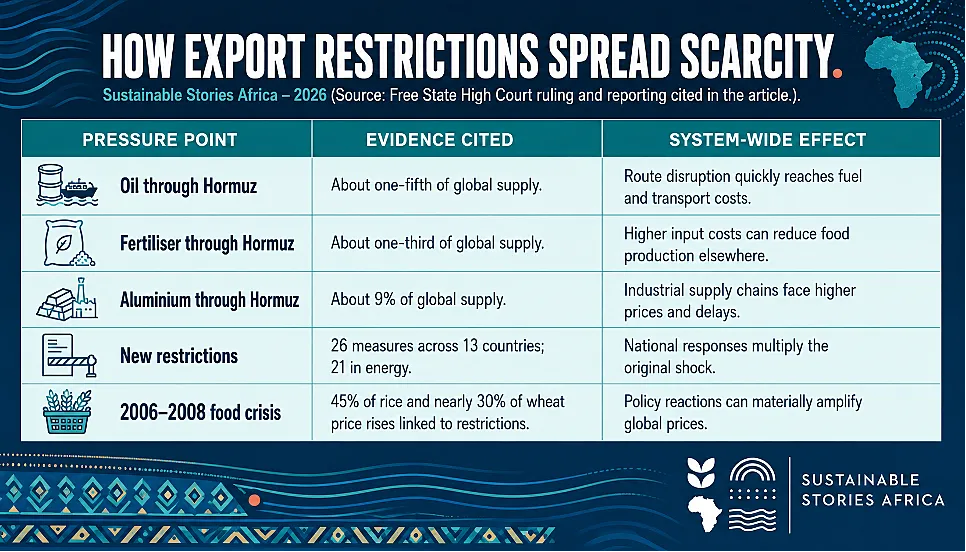
Their analysis follows the 2026 closure of the Strait of Hormuz, which disrupted the sale of crude oil, liquefied natural gas, fertiliser, petrochemicals and industrial commodities.
One-fifth of global oil, one-third of fertiliser and 9% of aluminium normally transit the route, according to figures cited in the brief.
Restrictions multiply during a crisis
Brookings said 13 countries announced 26 agriculture and energy export restrictions linked to the conflict, including 21 in energy.
Governments acted under intense pressure to control prices and reassure citizens that essential supplies would remain available.
The logic is politically understandable but economically contagious.
- When one exporter closes its market, importers scramble for alternatives and other producers may impose their own controls.
- Supply falls, price signals become less effective at encouraging production, and volatility increases.
History offers a warning.
- Export restrictions and related supply-limiting policies were estimated to account for about 45% of the global rice-price increase and nearly 30% of the wheat-price increase during the 2006-2008 food crisis.
- Similar behaviour aggravated shortages of protective equipment during the COVID-19 pandemic.
Africa carries an unequal burden
Import-dependent African economies are exposed, as witnessed in fuel, fertiliser, food and industrial inputs.
- Higher fertiliser prices arrive directly in planting decisions, harvest expectations and food inflation.
- Governments then face pressure to subsidise imports at the same time that foreign-exchange and budget constraints tighten.
A retreat from trade is not a cost-free solution.
- Stockpiles, redundant production and preferential supply agreements can improve security, but they require money, governance and maintenance.
- Countries with the weakest balance sheets are least able to replace market access with publicly financed resilience.
The policy goal should therefore be diversification rather than isolation: expand local and regional capacity where viable while preserving access to multiple international suppliers.
Trust can become economic infrastructure
Brookings recommends greater transparency on inventories, alternative suppliers and market capacity so governments can distinguish genuine shortages from panic.
The Agricultural Market Information System offers one model for shared monitoring and early warning.
The authors also favour advance commitments among trusted partners to keep essential goods moving during crises.
- Such agreements need credible incentives, rapid information sharing and practical arrangements for customs, logistics and payments.
Regional trade can provide an additional layer of insurance.
- The African Continental Free Trade Area (AfCFTA) can help countries diversify routes and suppliers; however, only if customs systems, transport corridors and emergency coordination continue functioning during stress.
- Exporting hardship to a neighbour undermines the trust needed for future cooperation.
Governments can pre-agree notification periods, humanitarian exemptions and consultation mechanisms for essential goods.
Such rules will not eliminate domestic political pressure, but they can slow panic-driven restrictions and give importers time to adjust before shortages become crises.
Path Forward – Build resilience without exporting hardship abroad
The path forward combines strategic reserves, efficient domestic production, diversified suppliers and regional trade corridors.
African institutions can use shared procurement and market intelligence to increase bargaining power.
Exporting countries should keep restrictions targeted, temporary and transparent.
Resilience is strongest when governments protect vulnerable citizens without undermining the international markets that other vulnerable citizens depend upon.
Culled From: Export restrictions don’t solve scarcity; they redistribute it | Brookings