The UK Financial Conduct Authority has proposed replacing detailed TCFD-based product reports with simpler climate disclosures for investment firms.
The regulator says the move could save firms about £20 million annually while giving investors clearer information.
For African and Global South markets, the shift matters because climate disclosure rules increasingly shape capital flows, investment trust, and ESG reporting expectations.
A Climate Rulebook Enters Its Leaner Era
The UK’s Financial Conduct Authority is proposing a major simplification of climate reporting rules for investment products, replacing detailed TCFD-based product reports with more targeted disclosures designed to help investors understand how climate risks could affect financial performance.
Announced on 5 June 2026, the proposal applies to asset managers, life insurers, and FCA-regulated pension providers. It would remove the need for full product-level TCFD reports and replace them with clearer information for retail investors, while allowing institutional clients to request key emissions data directly from firms.
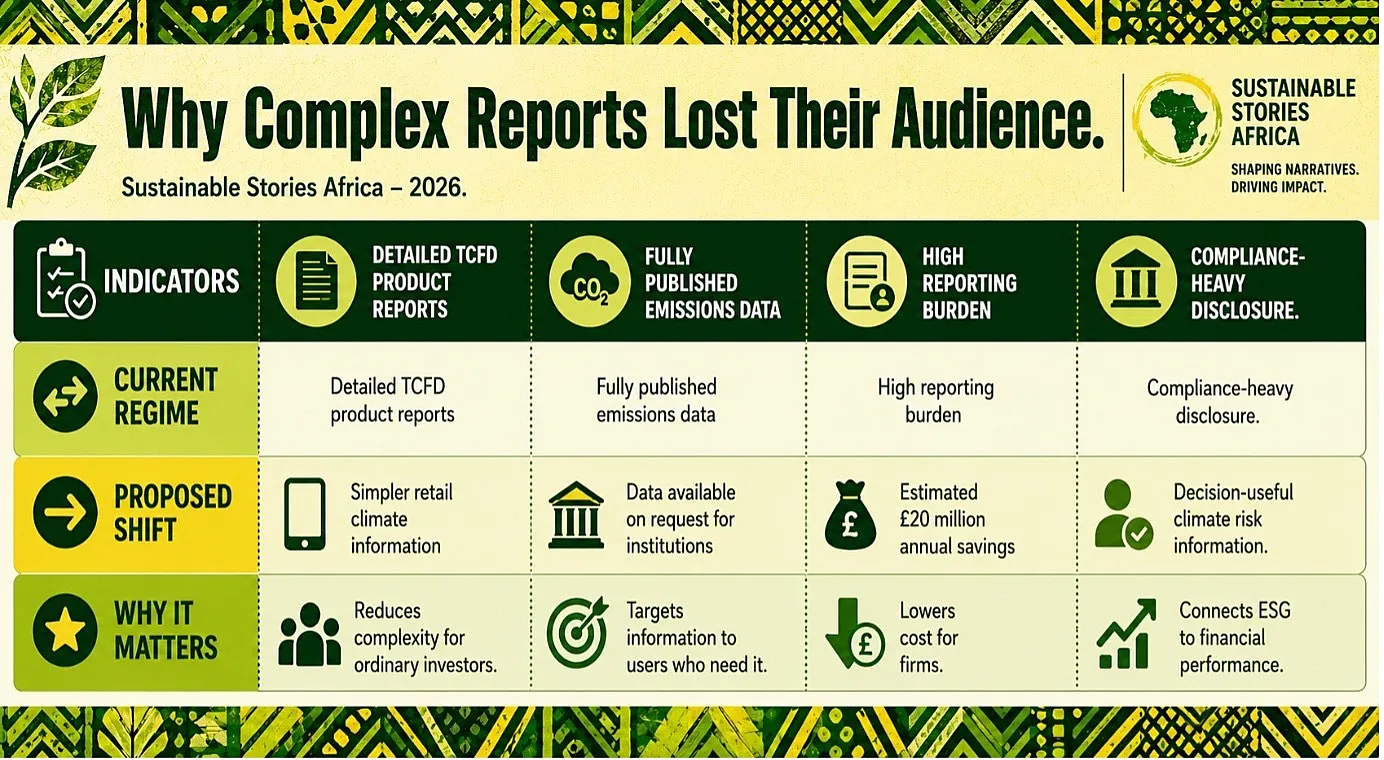
The FCA estimates the change could save investment firms about £20 million a year. But the deeper story is not just about cost. It is about whether climate disclosure can move from compliance paperwork to decision-useful information.
For investors in London, Lagos, Nairobi, Johannesburg, and Accra, that question is increasingly central. Climate risk is no longer a specialist ESG concern. It is becoming part of how portfolios are valued, how infrastructure is financed, and how fiduciary responsibility is interpreted.
Why Complex Reports Lost Their Audience
The UK Financial Conduct Authority's review surfaces a persistent tension in sustainable finance: more disclosure does not guarantee better decisions.
Product-level climate reports improved firms' awareness but left investors overwhelmed, too long, too technical, too opaque to use.
The proposed reform redistributes complexity by function. Retail investors receive targeted information on how material climate risks, flooding, heat stress, transition policy, and stranded assets may affect financial performance.
Institutional clients, with stronger analytical capacity and direct engagement channels, can request key emissions data without requiring firms to publish full product-level reports.
The FCA anchors this in Consumer Duty: disclosures must not merely exist; they must be understandable, relevant, and usable.
For African markets building sustainability reporting infrastructure, the design challenge is identical.
Disclosure frameworks must be credible enough to satisfy global investors and simple enough to serve real users.
Credibility and accessibility are not competing goals; they are the same requirement.
Better Disclosure Can Build Better Markets
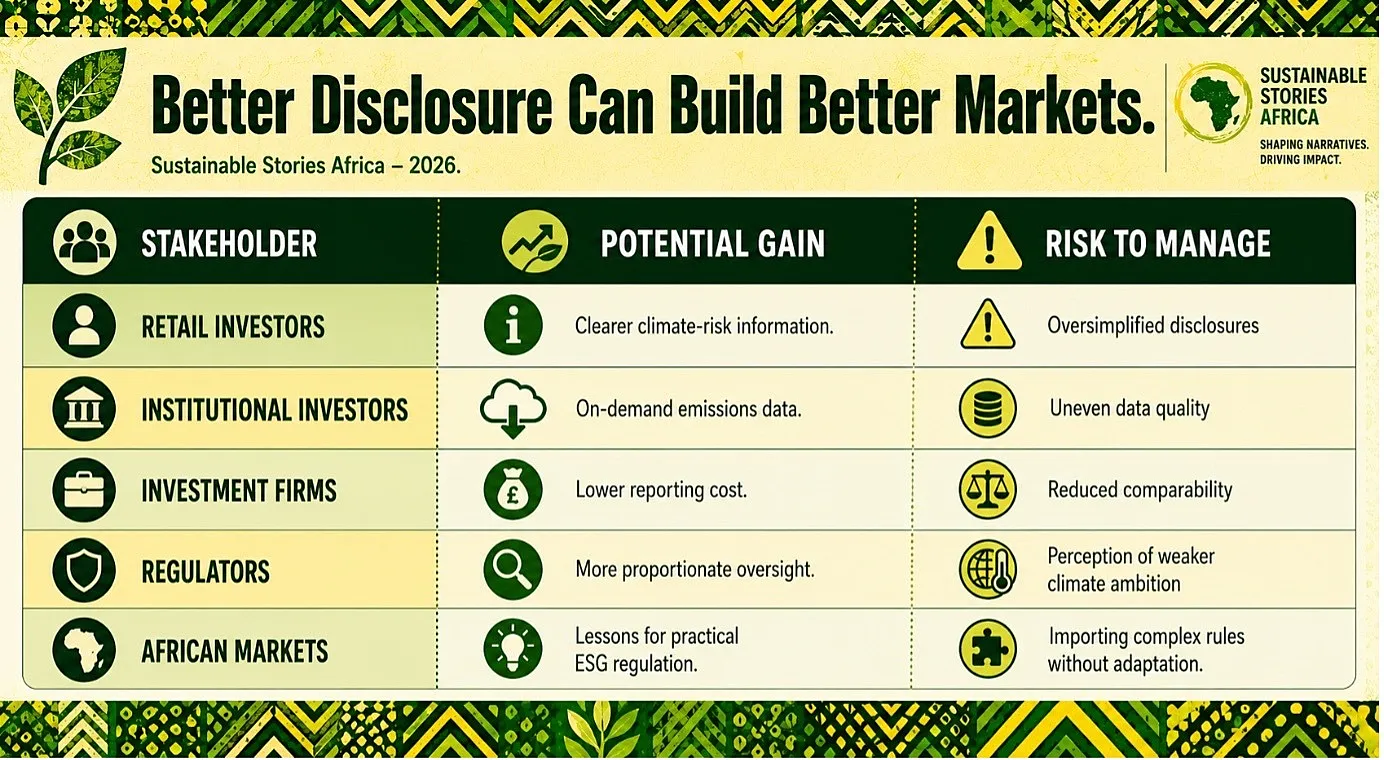
If done well, simpler climate reporting could strengthen sustainable finance rather than weaken it.
The opportunity is to shift disclosure away from box-ticking and toward clearer risk communication.
- For a pension saver, that means understanding whether a fund is exposed to sectors vulnerable to climate regulation or extreme weather.
- For an asset owner, it means accessing emissions data when needed for stewardship, portfolio alignment, or net-zero analysis.
- For firms, it means spending less time producing unread reports and more time integrating climate risk into investment decisions.
The risk, however, is that simplification becomes dilution. If fewer reports lead to weaker transparency, the market could lose confidence.
That would be damaging at a time when greenwashing concerns remain high, and climate finance needs are rising across emerging economies.
The stronger outcome is a middle path: leaner disclosures, sharper metrics, and better accountability.
This is where the UK proposal carries wider significance.
It signals that the next phase of sustainability reporting may not be about producing more documents. It may be about producing better decisions.
Regulators Must Protect Clarity and Credibility
The FCA consultation is open until 13 July 2026, with final implementation targeted for autumn.
The next few weeks will test whether firms, asset owners, consumer groups, and civil society can shape a framework that is both efficient and trustworthy.
For African regulators, the proposal should not be read as a retreat from climate disclosure.
It should be read as a warning against designing ESG rules that are too technical for the users they are meant to serve.
Markets need disclosure systems that answer three questions clearly: What is the climate risk?
How could it affect financial performance? What data supports the claim?
If those answers are missing, disclosure becomes theatre. If they are present, climate reporting becomes market infrastructure.
Path Forward – Simpler Rules, Stronger Market Trust
The priority now is proportionate climate disclosure that protects investors while reducing unnecessary reporting costs.
The FCA’s proposal shows that sustainable finance rules must evolve as markets learn what works.
African markets should draw the practical lesson: ESG regulation must be credible, comparable, and usable.
The future belongs to disclosure systems that inform capital, protect consumers, and turn climate risk into better financial decision-making.
Culled From: UK FCA Proposes Replacing TCFD Product Reporting with Simplified Climate Disclosure for Investment Firms