
Nigeria has announced a sweeping overhaul of its national curriculum, reducing subject overload while strengthening digital skills, vocational learning and national history.
The reforms will take effect from the 2025/2026 academic year following consultations with key education and examination bodies.
For millions of students, teachers and parents, the changes could reshape how learning prepares young Nigerians for work, citizenship and a rapidly changing economy.
Nigeria Bets On Smarter Learning
Nigeria's Federal Government has announced one of the country's most significant curriculum reforms in years, cutting the number of subjects taught across primary and secondary schools while introducing a stronger emphasis on practical skills, digital literacy and national identity.
The reform, announced by the Honourable Minister of Education, Dr Maruf Tunji Alausa, alongside the Honourable Minister of State for Education, Professor Suwaiba Sa'id Ahmad, is expected to take effect from the 2025/26 academic session.
According to the Ministry, the review followed consultations with the Nigerian Educational Research and Development Council (NERDC), WAEC, NECO, NBTE, NABTEB and other stakeholders responsible for curriculum development and assessment.
The government says the objective is straightforward: reduce classroom overload, simplify teaching, strengthen skills development and better align Nigerian education with global standards.
Rather than increasing classroom content, the policy seeks to improve learning quality by allowing students to focus on fewer, more relevant subjects.
Fewer Subjects, Stronger Practical Skills
The curriculum review changes both what students learn and how learning is organised.
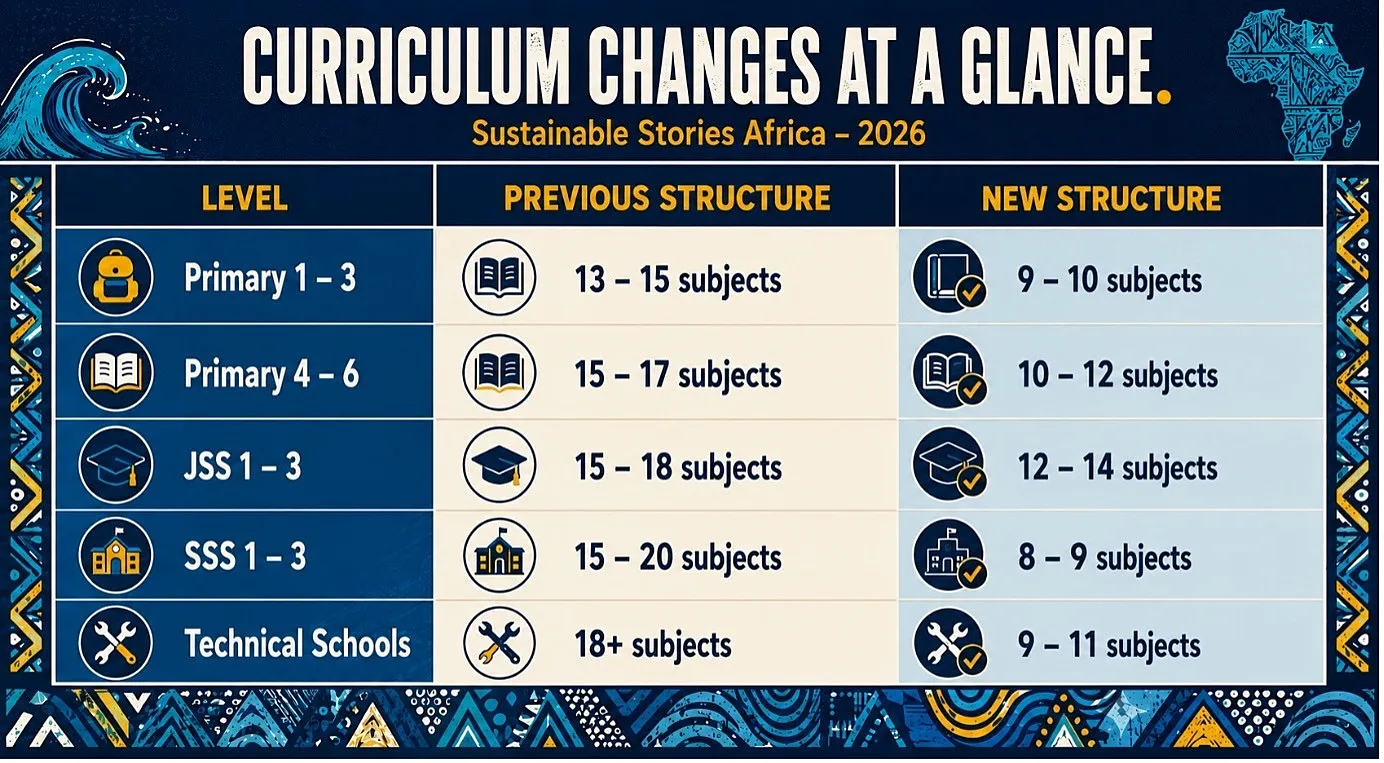
Under the revised structure, pupils in
- Primary 1 – 3 will study between 9 and 10 subjects, compared with the previous 13 – 15.
- Primary 4 – 6 students will study 10 – 12 subjects
- Junior Secondary students 12 – 14
- Senior Secondary students will focus on 8 – 9 subjects instead of as many as 20 previously.
Technical schools will also see subject loads reduced significantly.
Beyond reducing the number of subjects, the reform also changes curriculum priorities.
- Nigerian History returns as a compulsory subject from Primary 1 through Junior Secondary School
- Citizenship and Heritage Studies will replace separate Civic Education, Social Studies and History at the senior secondary level.
Trade education has also been streamlined into six practical disciplines for non-technical schools:
- Solar PV Installation and Maintenance
- Fashion Design and Garment Making
- Livestock Farming
- Beauty and Cosmetology
- Computer Hardware and GSM Repairs
- Horticulture and Crop Production
Meanwhile, NABTEB will administer 28 revised trade subjects for technical colleges, while WAEC and NECO examinations will align with the revised curriculum.
The Ministry also streamlined Nigerian language instruction to Hausa, Igbo and Yoruba, with each learner selecting one language.
According to Dr Alausa, the revised curriculum will enable children to learn "in a more focused and functional way" while allowing government resources to be directed more efficiently toward improving the delivery of education.
Preparing Learners For Tomorrow's Economy
Education systems increasingly face pressure to prepare students not only for examinations but also for rapidly evolving labour markets shaped by technology, renewable energy and entrepreneurship.
The inclusion of Digital Technologies, practical vocational pathways and Solar PV Installation and Maintenance reflects growing recognition that future employment opportunities will increasingly demand technical and transferable skills.
At the same time, restoring Nigerian History and introducing Citizenship and Heritage Studies may strengthen civic understanding, helping students better appreciate the country's institutions, culture and democratic development.
If effectively implemented, with trained teachers, updated learning materials and adequate classroom resources, the reforms could reduce learning fatigue, improve classroom engagement and better connect education with Nigeria's long-term economic ambitions.
However, curriculum redesign alone will not determine outcomes. Teacher preparedness, examination reforms, school infrastructure and consistent implementation across states will ultimately shape whether the intended benefits are realised.
Implementation Will Define Success
Curriculum reform marks only the beginning of a much larger transformation.
For the policy to deliver measurable improvements, stakeholders across the education system, including federal and state governments, school administrators, examination bodies, teachers, publishers and development partners, will need to coordinate implementation carefully.
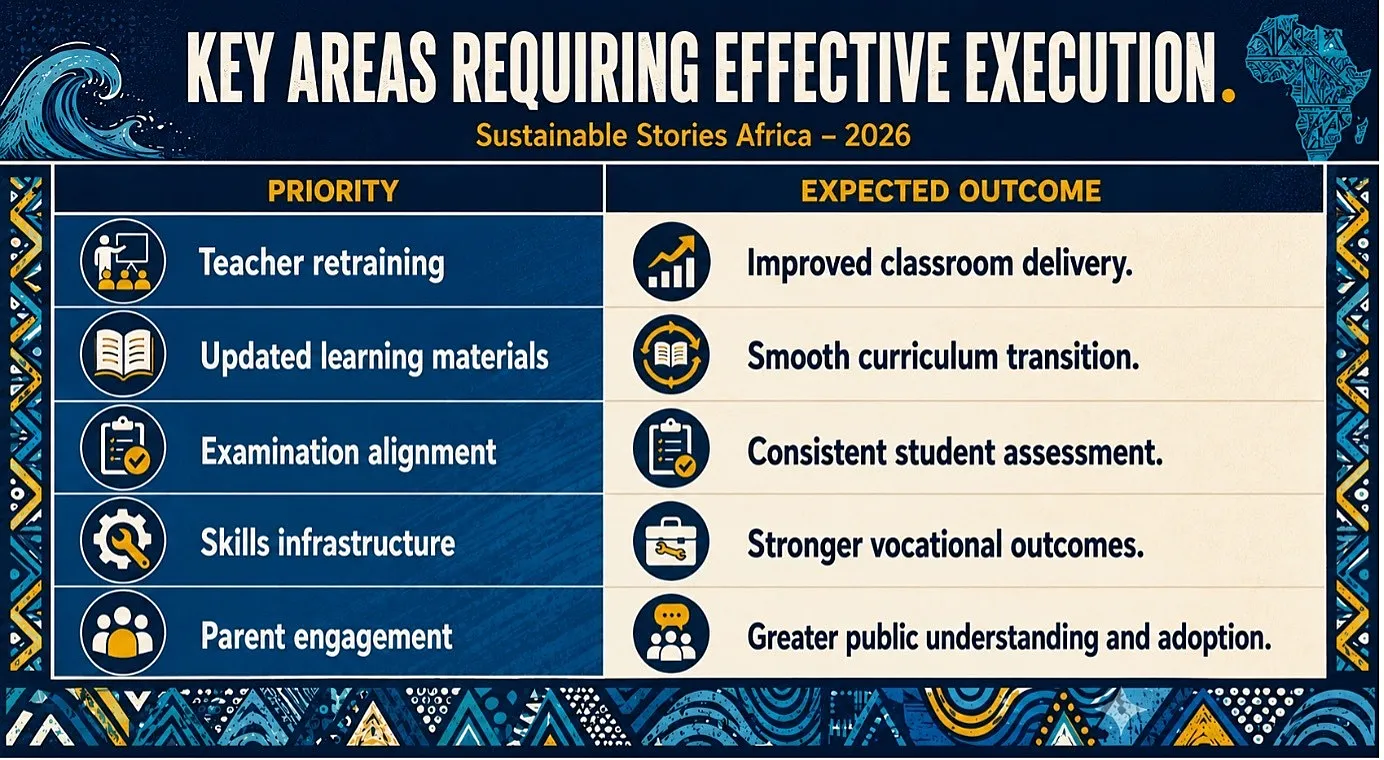
The Ministry has assured parents, teachers and students that adequate support will be provided to facilitate a smooth transition to the revised curriculum.
However, the press release does not specify detailed implementation timelines beyond commencement in the 2025/26 academic session, nor does it explain how teacher retraining, instructional materials and funding will be facilitated.
Path Forward – Building Skills Through Smarter Education Reform
Nigeria's curriculum overhaul reflects an effort to shift education from content accumulation toward capability development.
Success will depend on sustained investment in teachers, learning resources and institutional coordination.
If implementation matches policy ambition, the reforms could strengthen human capital, improve workforce readiness and support more inclusive, skills-driven economic growth to advance long-term education and sustainable development objectives across Africa.