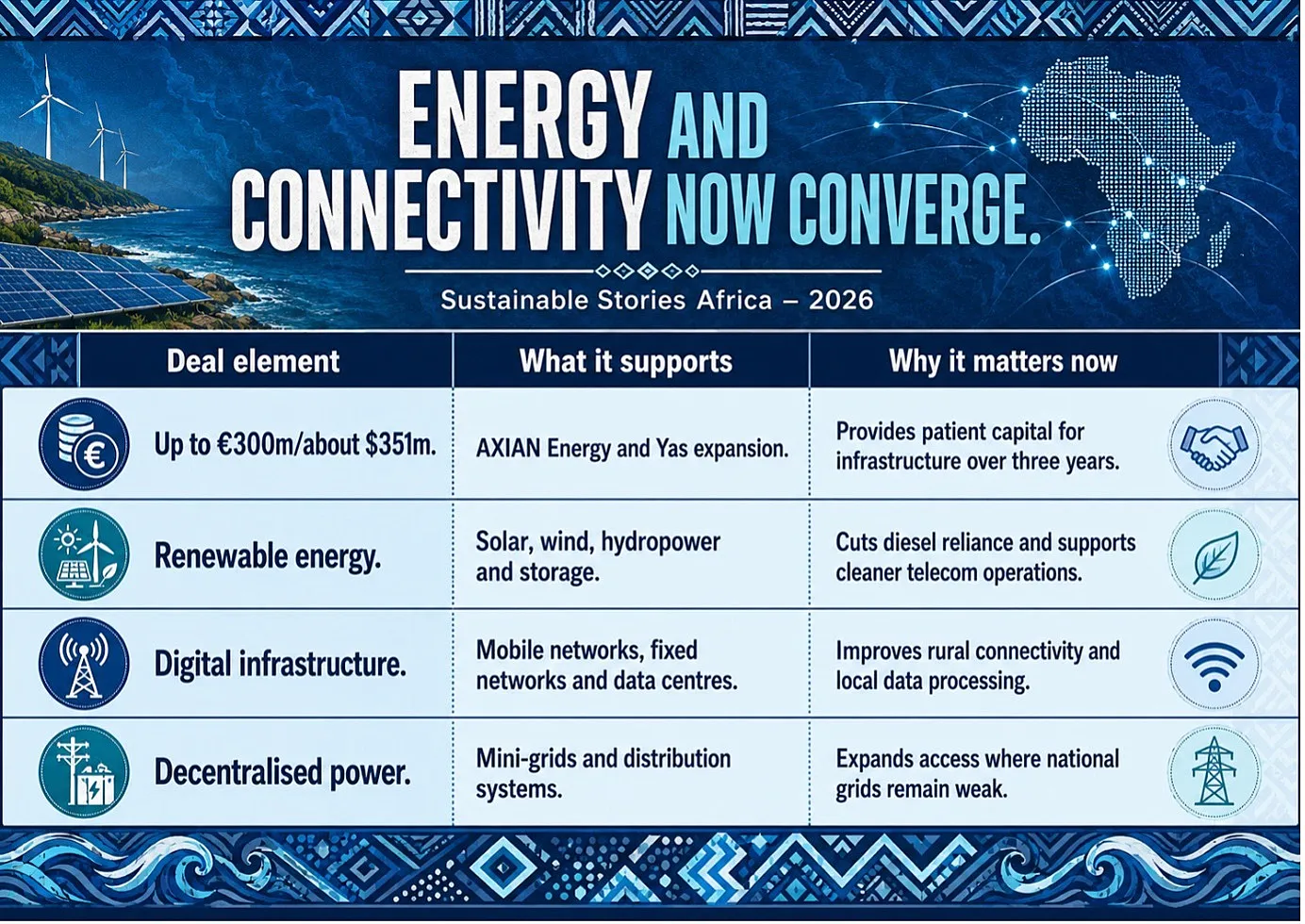
France’s Proparco has committed up to €300 million, roughly $351 million, to support AXIAN Energy and Yas across Africa.
The deal comes as digital access, clean power and rural connectivity increasingly define economic competitiveness.
For communities beyond reliable grids, the promise is simple: fewer diesel towers, more mini-grids, stronger networks and broader inclusion.
New Capital Targets Africa’s Access Deficit
France’s development finance institution, Proparco, has signed a strategic partnership with Yas and AXIAN Energy to provide up to €300 million over three years for digital infrastructure and renewable energy projects across Africa, in a deal that links clean power, telecom expansion and financial inclusion into one development bet. (
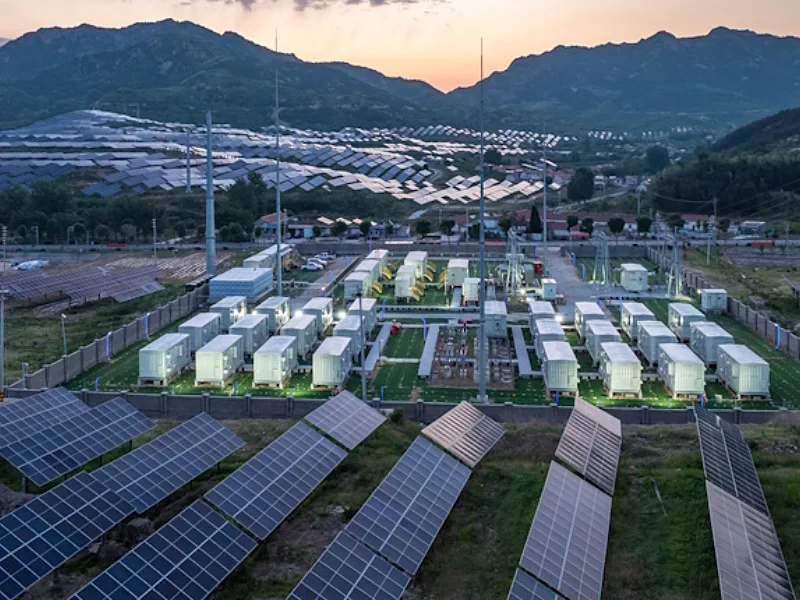
The agreement, signed in Nairobi during the Africa Forward Summit organised by France and Kenya on May 11–12, is designed to support fixed and mobile networks, data centres, solar, wind, hydropower, battery storage, mini-grids, electricity transmission, distribution networks and electric mobility infrastructure.
For Africa, the timing is important. The continent’s next development frontier is not only whether households can switch on lights, but whether businesses, schools, clinics, farms and digital platforms can rely on affordable, cleaner and more resilient power.
That is why the $351 million headline matters beyond finance: it reflects a growing recognition that energy access and digital access are now the same economic story.
Energy And Connectivity Now Converge
A new partnership between Proparco, Yas, owned by AXIAN Telecom, and AXIAN Energy is targeting one of Africa's most persistent development gaps: the communities where weak grids and poor connectivity still suppress enterprise growth, mobile money penetration, health delivery and local commerce.
Proparco describes digital and energy access as "a cornerstone of sustainable development." AXIAN Group CEO Hassanein Hiridjee frames it more directly: digital and energy are not separate stories but a single narrative of social inclusion and economic opportunity.
That convergence is increasingly visible across African markets. Telecom towers are shifting toward cleaner power to reduce diesel dependence.
Data centres require reliable electricity to keep African data closer to African users. Mini-grids are transforming isolated communities into productive local economies, while battery storage makes renewable power more dependable.
Together, these systems lower network operating costs while extending services to places traditional infrastructure has consistently failed to reach.
Cleaner Infrastructure Can Unlock Growth
The opportunity extends well beyond environmental gains. Executed effectively, this financing could lower energy costs for telecom operators, improve service reliability and extend digital finance platforms to underserved populations, delivering tangible benefits for rural traders, clinics and young entrepreneurs whose productivity depends on connectivity and reliable power.
The deal sits within a broader capital mobilisation moment. At the same Nairobi summit, French and African leaders announced over $11 billion in renewable energy investments spanning solar, wind, hydropower, sustainable aviation fuel and clean cooking.
France also used the occasion to reframe its Africa strategy, shifting from aid to investment, with President Macron announcing a €23 billion package: €14 billion from French entities and €9 billion from African investors, targeting energy transition, artificial intelligence, agriculture and the maritime economy.
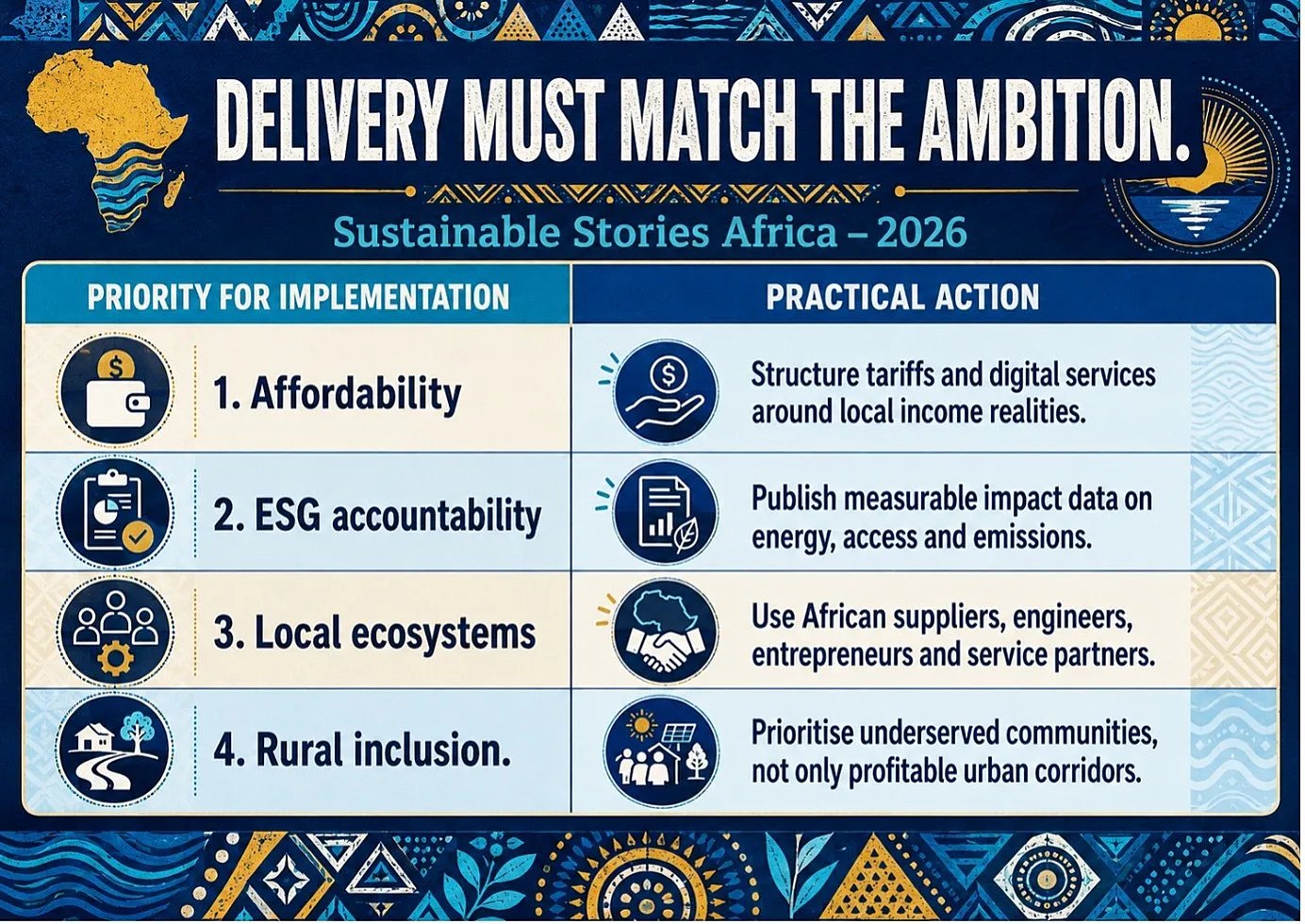
Delivery Must Match The Ambition
The promise is large, but so is the test of execution. Infrastructure finance in Africa often fails not because capital is absent, but because projects are slowed by currency risk, weak regulation, land issues, tariff uncertainty, permitting delays and limited last-mile affordability.
For this deal to deliver measurable impact, Proparco, AXIAN Energy and Yas will need to prioritise bankable projects with clear community benefits, transparent ESG reporting and strong local partnerships.
The capital should not only build assets; it should improve access, reliability, affordability and local value creation.
That means tracking how many sites shift from diesel to renewables, how many rural users gain coverage, how many mini-grid customers are connected, how much emissions intensity falls, and whether women-led businesses, young entrepreneurs and informal traders can benefit from the infrastructure.
Partnerships Must Turn Finance Into Access
Africa’s energy and digital transitions will not be won by announcements alone.
- Governments must create predictable rules for renewable power, telecom infrastructure, rights-of-way, data centres and mini-grid licensing.
- Development finance institutions must use concessional and blended finance to reduce risk.
- Private firms must prove that cleaner infrastructure can be commercially viable while serving communities that have long been excluded.
The Proparco-AXIAN partnership is therefore best understood as a test case. If it succeeds, it can show how development finance can crowd in private capital for systems that are both profitable and socially useful.
If it stalls, it will become another reminder that Africa’s infrastructure gap is not solved by money alone, but by execution, governance and trust.
Path Forward – Financing Must Now Become Real Access
The path forward is to convert the $351 million commitment into visible infrastructure: cleaner telecom power, stronger rural networks, mini-grids, data centres and inclusive digital finance.
For African markets, the priority is clear: align capital, regulation, and ESG accountability so energy and connectivity become foundations for jobs, productivity and resilience, rather than privileges for already-served communities.
Culled From: France commits $351m to African energy+