Ghana’s proposed 24-hour economy could reshape not only business productivity but also the financial trajectory of its national power utility.
Extended commercial activity is expected to increase electricity demand, potentially stabilising revenue flows for the state-owned distributor.
However, analysts caution that higher consumption must be matched with grid reliability and payment discipline to convert demand into sustainable gains.
Ghana’s 24-Hour Economy Lifts Power Utility Outlook
Ghana’s plan to implement a 24-hour economy, encouraging continuous industrial and commercial operations, is expected to drive higher electricity demand, offering potential financial relief for the country’s state power distributor, the Electricity Company of Ghana (ECG).
Policy advocates argue that sustained nighttime economic activity could improve capacity utilisation across sectors, from manufacturing to logistics.
For ECG, whose revenues fluctuate with consumption cycles and collection efficiency, a more balanced load profile may translate into steadier cash flows.
However, energy economists stress that demand growth alone will not guarantee financial recovery without structural reforms in billing, infrastructure and loss reduction.
Demand Expansion Meets Structural Constraints
Ghana’s electricity demand has historically peaked during daytime hours, leaving portions of installed generation underutilised overnight.
A 24-hour economy aims to flatten this demand curve.
Variable | Current Pattern | Under 24-Hour Model |
|---|---|---|
Industrial activity | Daytime-heavy | Continuous |
Grid utilisation | Uneven | More balanced |
Revenue stability | Volatile | Potentially improved |
Transmission losses | Persistent challenge | Reform-dependent |
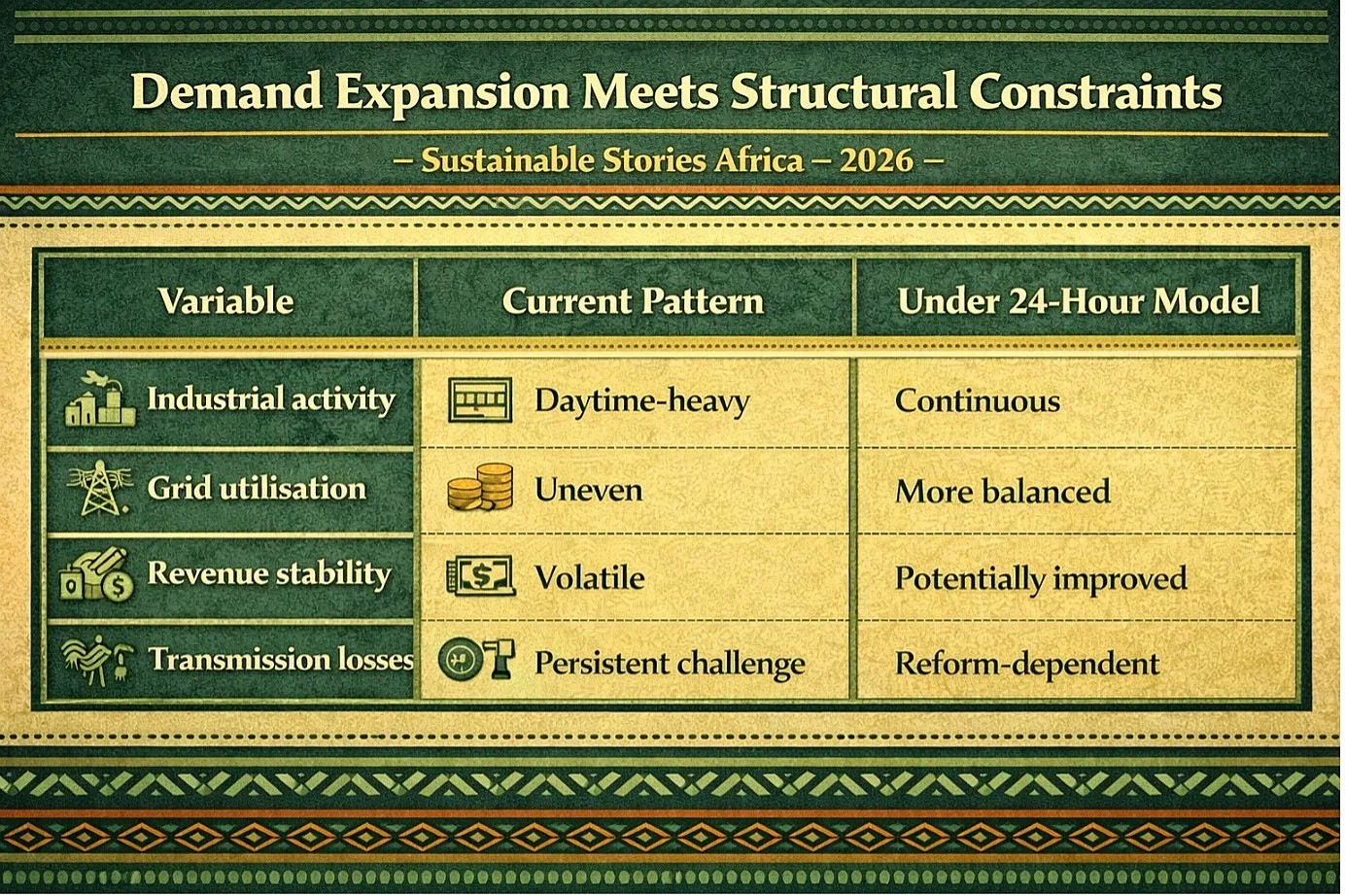
Analysts say that if managed effectively, round-the-clock operations could reduce strain during peak hours and improve overall system efficiency.
However, ECG continues to face challenges, including technical losses, recovery of tariff gaps and delayed payments from public institutions.
Revenue Opportunity Versus Infrastructure Risk
Images of Accra’s illuminated skyline and night-shift factories capture the ambition behind the policy.
Continuous lighting and machinery operation signal economic vibrancy, but also greater strain on distribution networks.
Energy planners caution that grid reinforcement, substation upgrades and deployment of smart metering will be necessary to accommodate increased nighttime load.
Without improvements in reliability, extended operating hours could expose businesses to outages, undermining investor confidence.
Potential Gains and Risks
Opportunity | Benefit to ECG | Associated Risk |
|---|---|---|
Higher consumption | Increased revenue base | Capacity constraints |
Industrial night shifts | Improved load balance | Maintenance pressure |
Expanded SME activity | Broader billing pool | Collection inefficiencies |
Digital metering | Better revenue tracking | Capital investment needs |
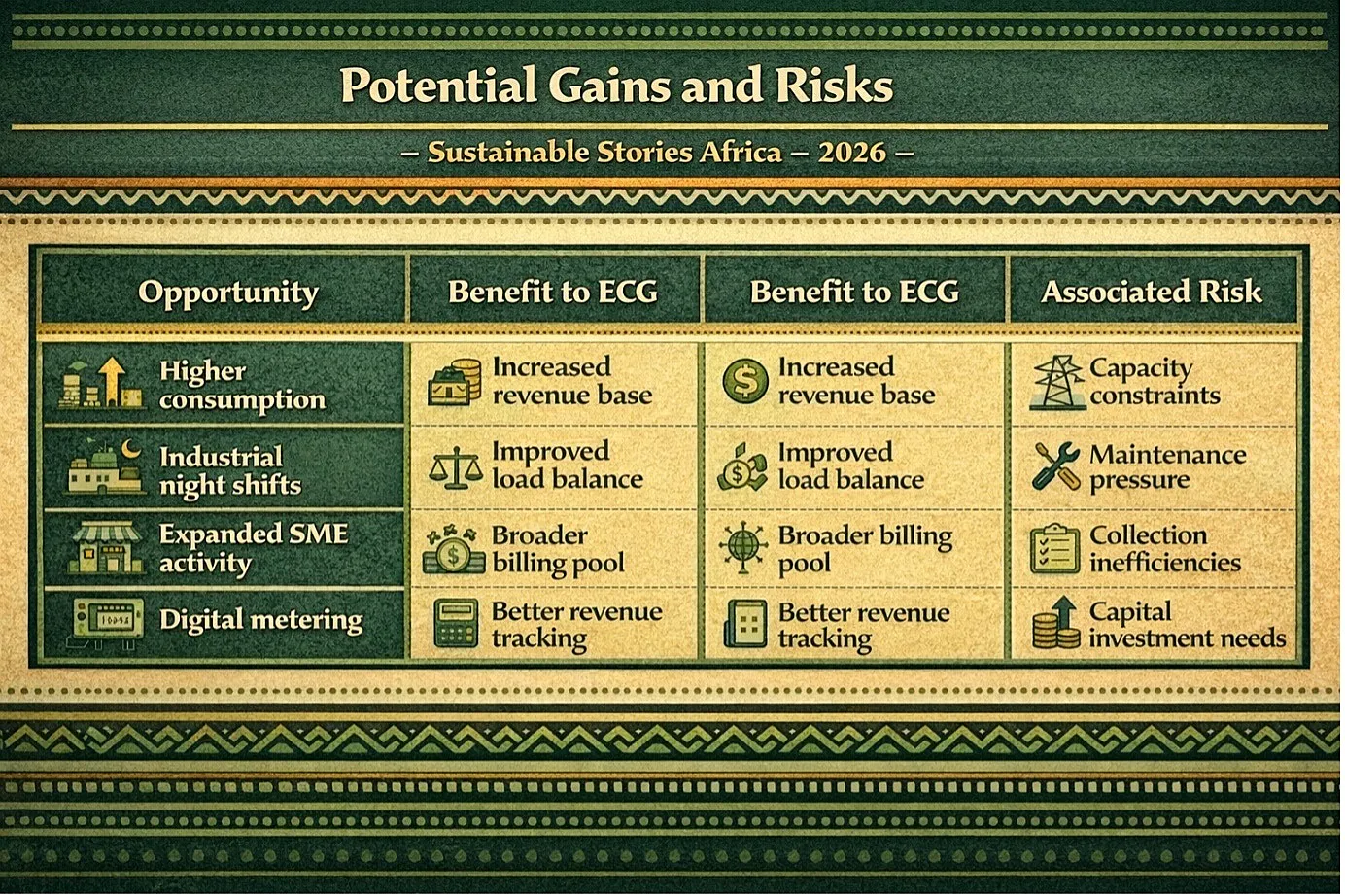
Policy analysts note that if billing reforms and digitalisation accompany the expansion of demand, ECG’s financial sustainability could improve materially.
Align Economic Reform With Energy Reform
Experts emphasise that the 24-hour economy must be paired with tariff transparency, improved governance and targeted infrastructure spending.
Ghana’s policymakers are exploring digital payment systems, smart meters and partnerships to reduce commercial losses.
Regional integration within the West African Power Pool could also help stabilise supply.
“Demand is the opportunity; efficiency is the safeguard,” one energy analyst remarked, highlighting the need for synchronised economic and power-sector reform.
Path Forward – Stabilise Grid, Modernise Revenue Systems
Ghana must invest in grid reliability and billing transparency to convert rising demand into sustainable utility gains.
By pairing 24-hour productivity with digital metering, infrastructure upgrades and disciplined collections, ECG can transform policy ambition into durable financial resilience.
Culled From: Ghana's utility to gain from 24 hour economy