
GHG Protocol and ISO will consolidate their main corporate greenhouse gas accounting standards into one co-branded framework, with a public consultation planned for the second quarter of 2027.
The move aims to reduce duplication and improve comparability.
Existing standards remain in force until the new framework is published and transition arrangements are announced, meaning companies should continue current reporting while preparing to engage.
Two rulebooks move toward one
The Greenhouse Gas Protocol and the International Organisation for Standardisation are aligning their corporate carbon-accounting programmes around a single co-branded standard, to reduce one of the biggest sources of complexity in emissions reporting.
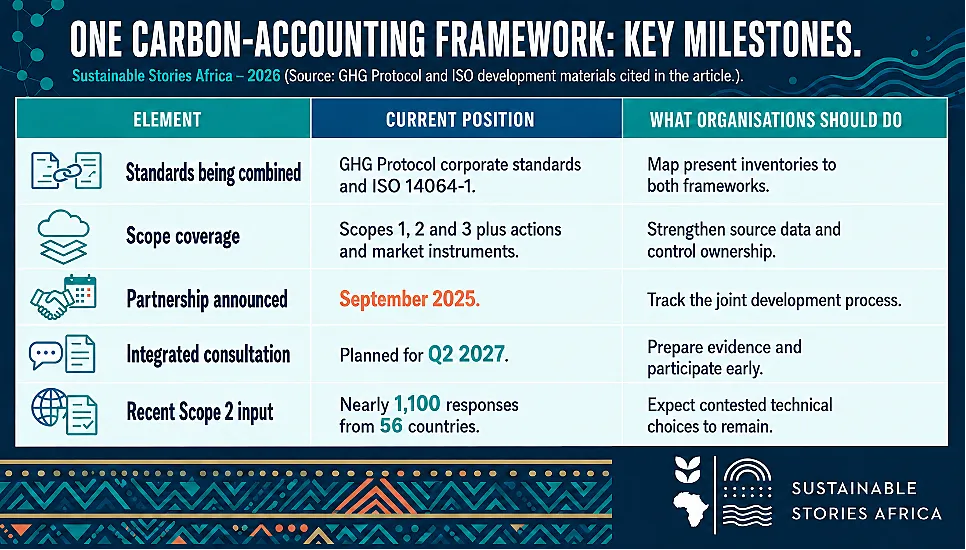
The planned framework will bring together GHG Protocol’s Scope 1, Scope 2, Scope 3 and Actions and Market Instruments standards with ISO 14064-1.
An integrated public consultation is scheduled for the second quarter of 2027.
The decision builds on the partnership announced in September 2025 and responds to demands from companies, auditors, investors and regulators for a more consistent global language.
It is also described as a milestone under the COP30 Action Agenda.
Fragmentation created cost and confusion
GHG Protocol and ISO standards are widely used, but they developed through separate systems.
Companies operating across markets can face duplicated processes, differences in terminology and uncertainty about how reported inventories compare.
A consolidated standard could simplify internal controls and external assurance and provide stakeholders with a single coordinated consultation instead of parallel rulemaking exercises.
GHG Protocol chief executive Tim Mohin said the change should allow companies to spend less time navigating duplication and more time reducing emissions.
The work extends beyond the corporate inventory.
The partnership also covers product carbon footprints, project accounting and verification, though some guidance, such as GHG Protocol’s Land Sector and Removals Guidance, currently sits outside the joint scope.
Hard accounting choices remain
Harmonisation does not eliminate policy debates embedded in carbon accounting.
- Scope 2 treatment of purchased electricity is a leading example.
- A recent consultation received nearly 1,100 responses from 56 countries and revealed different views on renewable-energy purchases, market instruments, accuracy and comparability.
Technical groups and independent governance bodies will still need to decide how location-based and market-based claims work, how value-chain emissions are estimated and how companies demonstrate real-world change.
- A single standard will be valuable only if it is rigorous enough for assurance and practical enough for users in markets with limited data.
Existing GHG Protocol and ISO standards remain valid until the co-branded standards are published.
Transition periods will be announced to reduce the risk of a sudden reporting gap.
African companies need a seat
African businesses often report into global supply chains using methodologies designed elsewhere.
- Harmonisation can lower costs, but only if the process accounts for regional data gaps, informal suppliers, electricity market structures and the needs of small and medium-sized enterprises.
- Companies, professional bodies and regulators should participate in the consultation, test draft methods with local data and document areas where global assumptions do not fit.
- Universities and assurance providers can help build the measurement skills needed for adoption.
Assurance will be one of the decisive tests.
- Auditors and verifiers need clear boundaries, evidence requirements and treatment of estimates so that a unified rulebook produces comparable results rather than identical labels on inconsistent data.
- Software providers will also have to update calculation engines and audit trails.
- Companies can prepare by strengthening source documentation, supplier engagement and change controls now.
The transition should not be treated as a reason to delay emissions action; better accounting is valuable because it supports better decisions, not because reporting is an end in itself.
Path Forward – Prepare now and participate before adoption
The path forward is continuity and engagement. Companies should maintain current inventories, improve controls and map where ISO and GHG Protocol methods produce different results.
When consultation opens, African stakeholders should submit evidence rather than wait for a finished rulebook.
One global standard can improve trust and investment; however, legitimacy will depend on whose operating realities shape it.
Culled From: GHG Protocol and ISO to Merge Carbon Accounting Standards Into One