
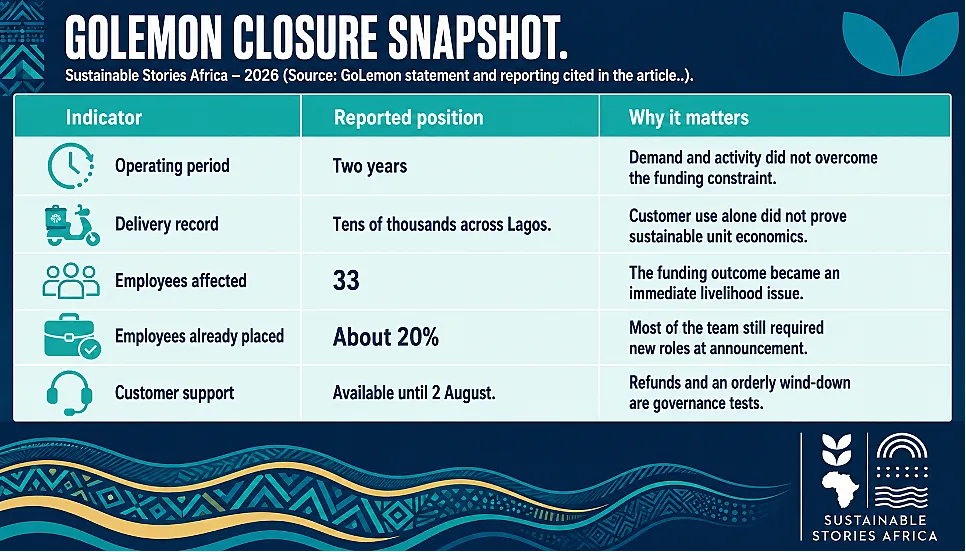
Lagos grocery-delivery startup GoLemon has closed after two years, saying it could not raise enough capital to continue sustainably.
The company has stopped taking orders, completed outstanding refunds and is helping employees seek new roles.
Its shutdown turns a funding problem into a human one, while raising fresh questions about the unit economics of convenience businesses in Nigeria.
The final delivery has arrived
GoLemon, the Lagos-based grocery-delivery startup founded by former Paystack employees, has shut down after two years of operation due to an inability to secure additional funding.
The company announced the closure on July 29, saying it had explored alternatives but could not find a sustainable path before time ran out.
It has stopped accepting new orders, processed outstanding refunds and said customer support would remain available until August 2.
GoLemon built its technology and fulfilment network from scratch and said it completed tens of thousands of deliveries across Lagos.
Its closure shows that customer demand and visible activity do not automatically produce a business capable of surviving high logistics costs and tighter capital.
Workers carry the immediate cost
The shutdown affects 33 employees, according to reporting on the company’s statement.
GoLemon said about 20% had already secured new positions and appealed to employers to consider the remaining team across fulfilment, engineering, product, growth, customer support and finance.
That appeal gives the story a dimension often lost in statistics on startup closures.
- Behind every failed funding round are people whose salaries, career plans and household budgets are disrupted.
- Suppliers, farmers and service partners may also have to replace a route to market.
The company said business partners could continue to contact it during the wind-down.
Processing refunds before closure and maintaining a support channel are important governance steps; however, they do not remove the need for transparent treatment of staff and creditors.
Convenience has difficult unit economics
Online grocery businesses combine thin retail margins with warehousing, inventory risk, fulfilment and last-mile delivery.
In cities facing inflation, currency volatility, fuel costs and uneven addressing systems, every order can require significant working capital and operational discipline.
GoLemon’s exit follows similar closures in the Nigerian food and delivery industry.
- The pattern suggests that growth cannot remain a substitute for sustainable unit economics.
- Startups must understand contribution margins by order, customer acquisition payback, inventory losses, as well as financing needed to serve each neighbourhood.
Investors also face a choice. Pulling back from capital-intensive models can protect portfolios, but a complete retreat risks starving useful infrastructure companies before they reach scale.
The answer is more selective capital linked to measurable operating milestones, not growth at any price.
Responsible shutdowns should become standard
Nigeria’s ecosystem needs clearer playbooks for business distress.
- Boards should monitor runway early, test restructuring options and communicate before a liquidity crisis eliminates choices.
- Investors can support orderly wind-downs, staff placement and supplier settlement instead of treating closure as a private founder problem.
The Government cannot finance every failing startup;
- However, it can reduce structural costs through reliable power, efficient payments, better logistics infrastructure and predictable regulation.
- Those improvements strengthen viable businesses without rewarding weak models.
The closure also raises questions about the preparedness of founders and boards.
- Venture-backed companies should agree in advance what triggers a hiring freeze, cost reset, strategic sale or orderly wind-down.
- Waiting until cash is nearly exhausted reduces the chance of protecting employees, customers and suppliers.
- Better governance will not prevent every failure; risk is inherent in entrepreneurship, but it can make failure less chaotic.
The ecosystem should value transparent closures as part of responsible company-building, while helping experienced teams recycle their skills into the next generation of Nigerian businesses.
Path Forward – Build companies that survive capital cycles
The path forward is to pair ambition with disciplined economics.
Founders should test profitability at the smallest repeatable unit, preserve runway and build contingency plans before fundraising becomes existential.
For GoLemon’s former employees, the immediate priority is rapid placement and fair closure.
For the wider ecosystem, the lesson is equally direct: innovation becomes sustainable only when customer value, worker protection and financial resilience move together.
Culled From: Nigerian Startup GoLemon Shuts Down Operations After 2 Years, Leaves Workers Seeking New Jobs - Legit.ng