Green bond issuance reached $168.39 billion in the first quarter of 2026, confirming sustainable debt as a major transition-finance tool.
But Africa remains underrepresented in the market.
That gap matters because climate finance is no longer just an environmental issue. It is now a competitiveness, infrastructure, jobs and resilience for African economies.
Africa Risks Missing Green Bond Momentum
Global green bond issuance reached $168.39 billion in Q1 2026, according to Cbonds data reported by Financial Afrik, showing that sustainable debt markets remain resilient despite tighter financing conditions and higher interest-rate pressure.
The figure covers 440 new green bond and Eurobond issues placed between January and March 2026, with the total outstanding volume of green bonds and Eurobonds reaching about $3.35 trillion by the end of March.
However, Africa’s share remains thin. Europe and developed markets continue to dominate issuance, African economies still face shallow capital markets, high sovereign risk premiums, currency volatility, limited project pipelines and weak green-finance infrastructure.
For the continent, this is not simply a market-statistics problem. It affects whether cities can fund climate-resilient drainage, whether utilities can build renewable power, whether banks can finance clean agriculture, and whether communities can withstand floods, heat, and food shocks.
Global Capital Is Moving Fast
Green bonds are designed to raise capital for projects with environmental benefits, including renewable energy, clean transport, energy efficiency, water systems and pollution control. CBonds defines green bonds as instruments whose proceeds support environmentally related projects.
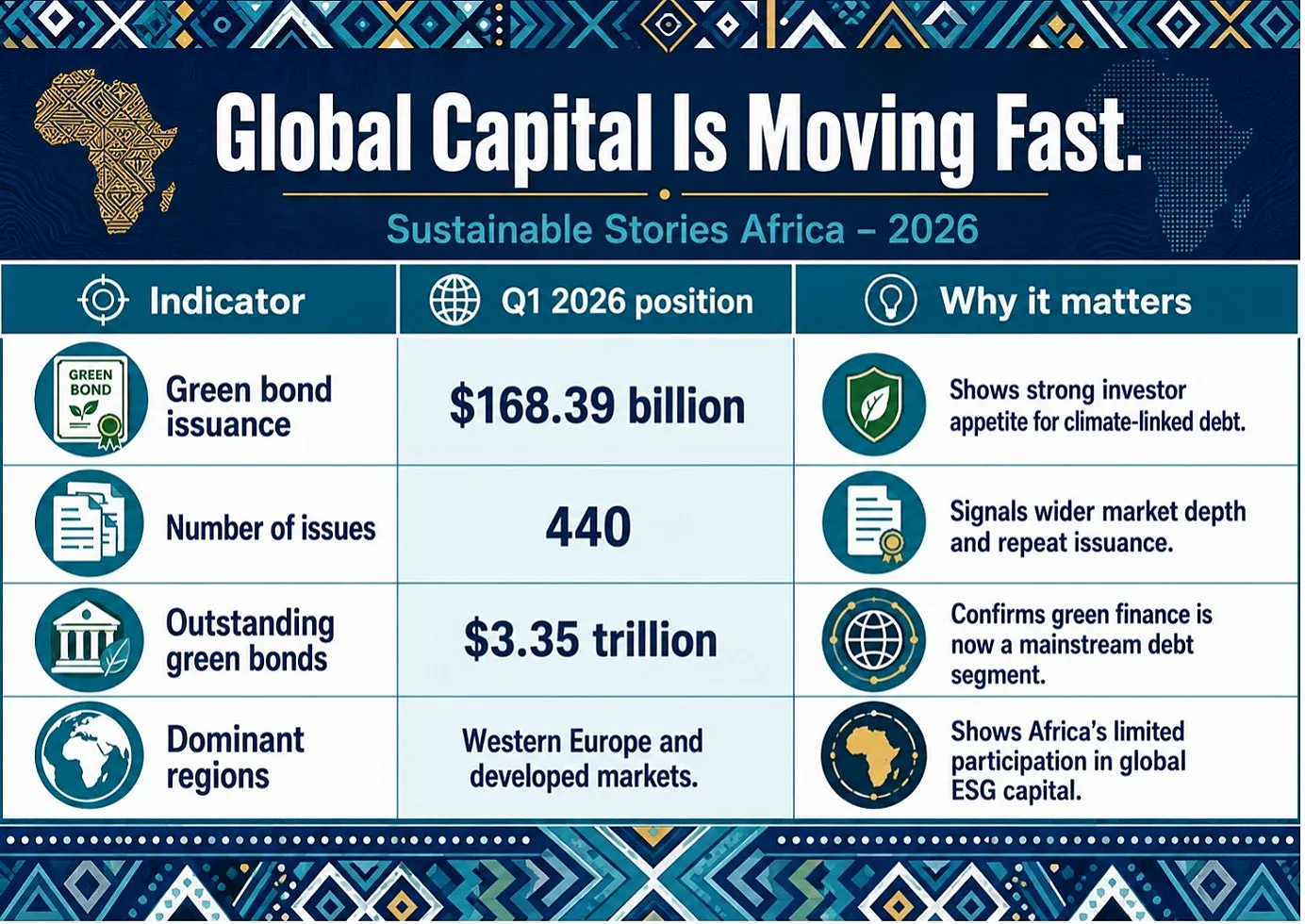
The regional imbalance is striking. CBonds data shared publicly showed Western Europe accounted for 68.13% of new Q1 2026 issues, while developed markets outside Europe accounted for 16.56%.
That leaves emerging and frontier markets competing for a much smaller pool, even though many African countries carry some of the world’s highest climate adaptation needs.
Green Finance Could Reshape Development
For Africa, deeper green bond markets could change the development equation.
Instead of relying mainly on budget allocations, donor grants or expensive short-term borrowing, governments, banks and corporates could raise longer-term capital for bankable climate projects.
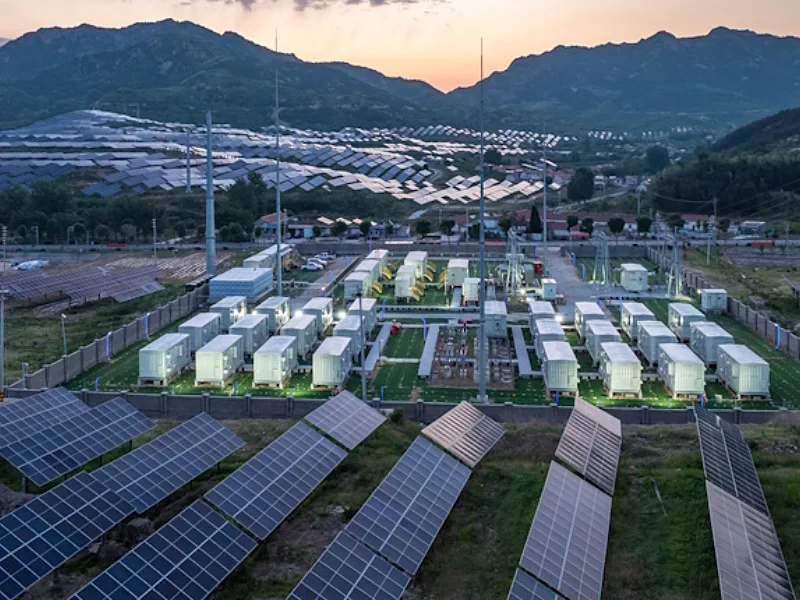
The gains could be practical: solar mini-grids for rural communities, water infrastructure for fast-growing cities, resilient roads for flood-prone trade corridors, and clean cooking solutions that reduce household air pollution.
However, the risks are equally clear. If Africa remains outside the green bond boom, the continent may pay more for climate adaptation, import more clean-energy technology, and lose value from sectors where it has natural advantages, including renewable power, critical minerals, sustainable agriculture and biodiversity.
Markets Need Stronger African Pipelines
The next phase is institutional. African governments and regulators need clearer taxonomies, credible project pipelines, stronger disclosure rules and local-currency instruments that reduce exchange-rate risk.
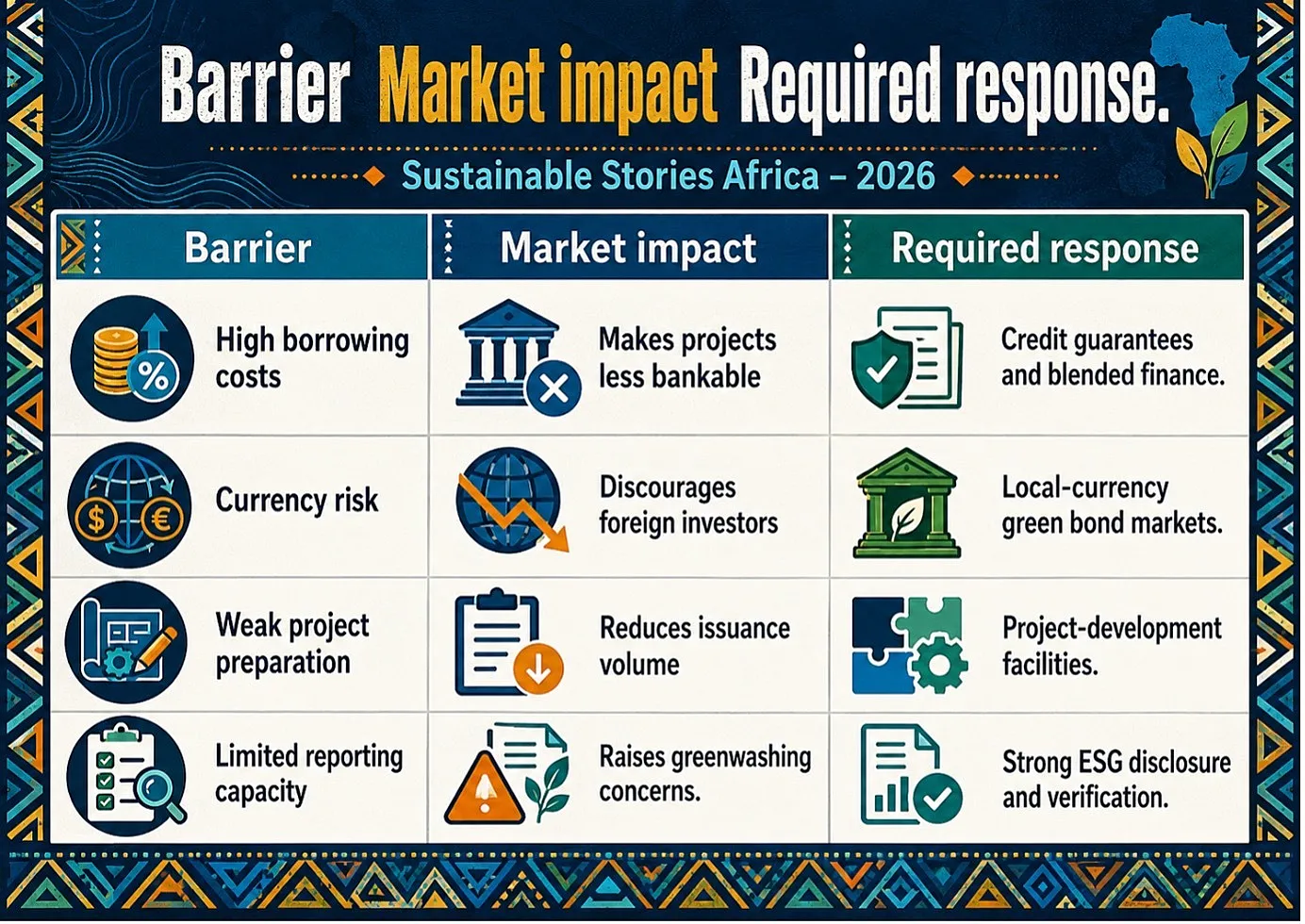
Development finance institutions, stock exchanges, pension funds and commercial banks must also help build the market.
That means using guarantees, anchor investments, technical assistance and transparent impact reporting to turn climate ambition into investable assets.
The Financial Afrik report shows a clear warning: global ESG capital is available, but it will not automatically flow to African markets without the right structures, trust and execution.
Path Forward – Build Africa’s Green Finance Infrastructure
Africa’s priority is to move from climate-finance advocacy to market execution: credible pipelines, transparent standards, local-currency instruments, and stronger public-private coordination.
Green bonds can fund real resilience, but only if African issuers are prepared to meet investor expectations and protect public value. The opportunity is not just to borrow greener, but to build economies that are cleaner, more competitive and more climate-secure.
Culled From: ESG Markets: $168 billion of green bonds in Q1 2026, Africa lagging behind - Financial Afrik