
GRI and the IFRS Foundation have reaffirmed their commitment to complementary sustainability disclosure standards.
The move aims to reduce duplication, fragmentation and reporting complexity for companies using both GRI and ISSB Standards.
For African businesses, it could make ESG reporting clearer, more comparable and easier to connect with investor expectations.
Disclosure Complexity Is Being Challenged
The Global Reporting Initiative and the IFRS Foundation have renewed their commitment to make sustainability reporting more efficient, reinforcing the idea that companies should be able to use GRI and ISSB Standards together without creating duplicated disclosure systems.
The announcement follows continuing collaboration between GRI’s Global Sustainability Standards Board and the IFRS Foundation’s International Sustainability Standards Board.
Their shared objective is to align common disclosures where possible while preserving the distinct purposes of both frameworks.
For companies, investors and regulators, the message is practical: sustainability reporting should become less fragmented, not more burdensome.
Two Standards, Different Purposes
The GRI Standards focus on how organisations affect the economy, environment and people. ISSB Standards, including IFRS S1 and IFRS S2, focus on sustainability-related risks and opportunities that may affect enterprise value and investor decision-making.
That distinction matters. A bank, cement producer, and an agribusiness in Africa may need to explain both how climate, water, labour and community risks affect their financial outlook and how its activities affect workers, communities and ecosystems.
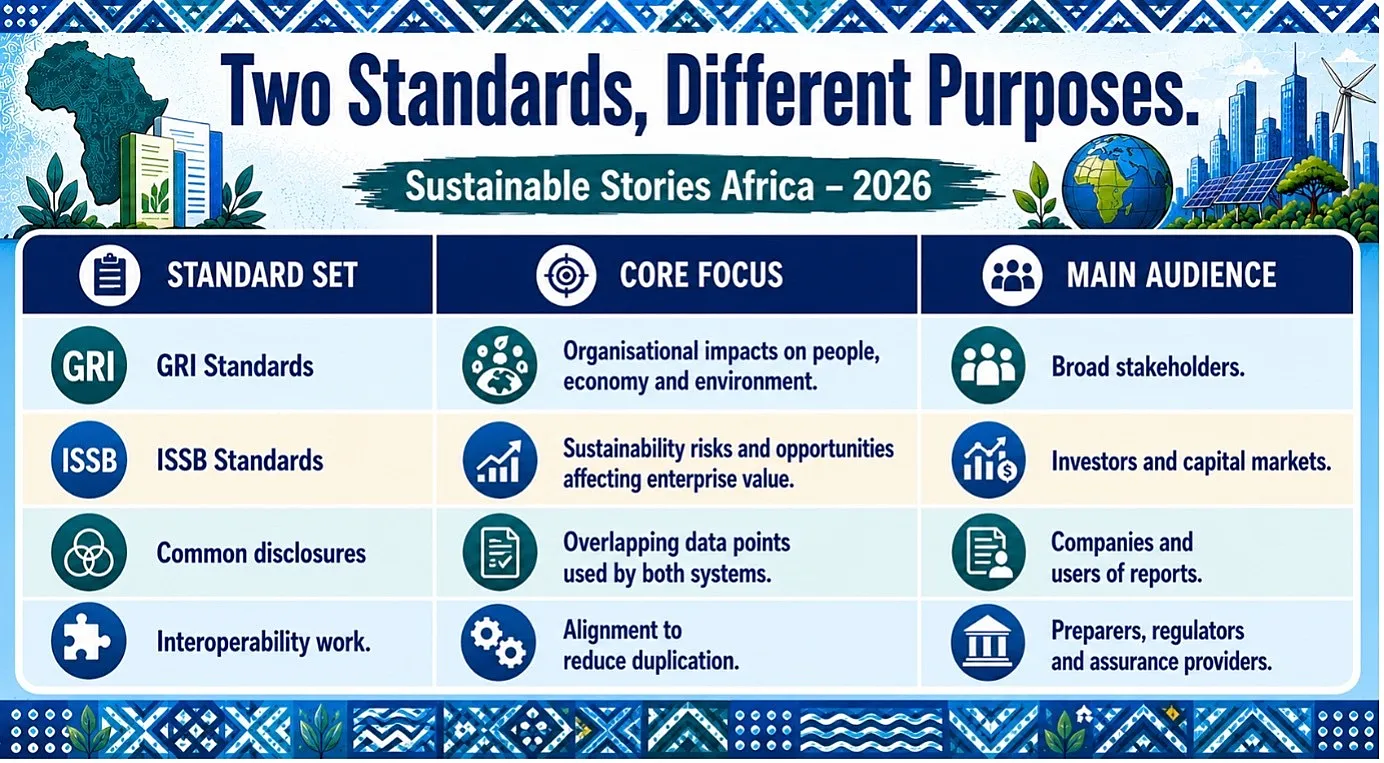
This is why the renewed commitment matters for African markets. Many businesses already face pressure from lenders, export buyers, regulators and global supply chains to produce credible ESG data.
Where standards overlap but do not align, reporting teams can spend more time reconciling templates than improving performance.
Better Alignment Can Unlock Trust
If the collaboration works, companies could collect sustainability data once and use it more efficiently across investor-focused and impact-focused reporting.
That can reduce compliance fatigue. It can also improve trust.
- Investors need consistent information to price risk.
- Regulators need comparable disclosures to supervise markets.
- Communities need clearer reporting on impacts that affect livelihoods, health, land and resilience.
For sustainability professionals, the benefit is not only technical.
- Better alignment can shift reporting from a defensive compliance exercise into a management tool.
- Companies can identify climate exposure, labour risks, biodiversity impacts and governance gaps earlier, then connect disclosure to strategy.
In African markets, where reporting capacity varies widely, simplicity is not a luxury. It is a condition for wider adoption.
Build Reporting Systems Early
The next step is for companies, regulators and professional bodies to prepare for a more connected disclosure environment.
- Businesses should map where GRI and ISSB data requirements overlap, strengthen internal controls and train finance, sustainability, risk and legal teams to work together.
- Regulators should support phased adoption, capacity-building and assurance readiness.
- Investors should encourage consistency without overloading companies with separate questionnaires.
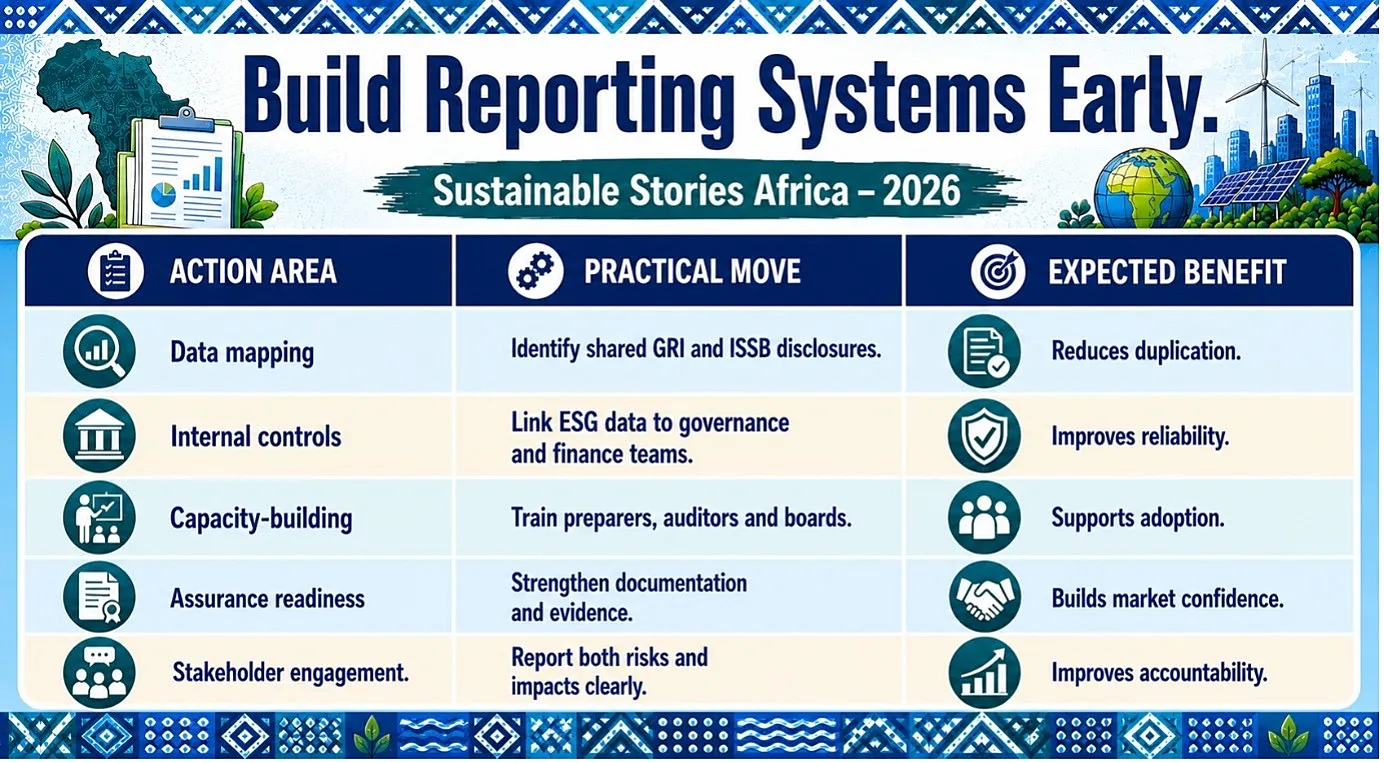
The call to action is clear: African companies should not wait for disclosure pressure to become a crisis. They should build systems now.
Path Forward – Make ESG Reporting More Usable
The priority is practical interoperability: fewer duplicate disclosures, clearer data systems and stronger links between sustainability impacts and financial risk.
For African markets, this supports ESG credibility, investor confidence and better corporate accountability.
The promise is a reporting system that is not only compliant, but also useful for decision making, trust and long-term resilience.
Culled From: GRI and IFRS Foundation Reaffirm Commitment to Complementary Sustainability Disclosure Standards