
GRI has welcomed Europe’s revised sustainability reporting standards but warned that simplification must not weaken transparency.
The organisation wants stronger global alignment, fewer value-chain data restrictions, and removal of a proposed asset-manager exemption.
For African markets, the debate matters because EU disclosure rules increasingly shape capital access, investor expectations, and ESG reporting practices.
Europe’s ESG Rulebook Faces a Credibility Test
Europe’s sustainability reporting reset has entered a decisive phase, with the Global Reporting Initiative welcoming progress on the revised European Sustainability Reporting Standards while warning that simplification must not come at the cost of transparency, comparability, or investor confidence.
In a 4 June 2026 response to European Commission consultations, GRI said the revised ESRS should preserve double materiality, strengthen alignment with international standards, remove a proposed exemption for assets under management, reduce restrictions on value chain data, and improve the voluntary standard for companies that are no longer in mandatory reporting.
The issue is bigger than Brussels.
- For companies across Africa and the Global South, the ESRS is becoming a reference point for how sustainability information is collected, assured, financed, and trusted.
- A cocoa exporter in Ghana, a minerals supplier in Zambia, or a bank-financed infrastructure project in Nigeria may not be headquartered in Europe; however, its ESG data may still travel through European supply chains, investors, lenders, and customers.
Simplification Meets the Demand for Comparable Data
The revision of Europe's Corporate Sustainability Reporting Directive exposes a core tension: companies want lighter reporting burdens; investors, regulators, workers, and communities want credible, decision-grade information.
GRI supports simplification; however, it insists that Europe must remain anchored in global frameworks, the GRI Standards and the ISSB, to prevent fragmentation.
GRI CEO Robin Hodess welcomed Europe's signal of keeping impact and financial materiality on equal footing.
Double materiality asks two questions simultaneously:
- How sustainability risks affect the company.
- How the company affects people, the economy, and the environment.
Dropping either question weakens the framework's integrity.
For African firms, the stakes are practical. ESG questionnaires from global buyers, development finance institutions, banks, insurers, and export partners are already routine.
Standards fragmentation makes compliance more expensive and duplicative.
Convergence offers the opposite: report once, deploy the same data across multiple markets.
The architecture of global standards is not a European debate; it is an African business cost.
Better Rules Can Strengthen Capital Flows
The most contested issue is the proposed exemption for assets under management.
GRI argues that excluding managed assets could undermine transparency requirements for asset managers and weaken alignment with global best practice.
Other investors and sustainability groups share that concern. Shift, WWF, Eurosif, EFFAS, Frank Bold and others have urged the European Commission to drop the exemption, arguing that portfolio holdings show how policies translate into practice and that removing transparency could increase the risk of greenwashing.
For markets trying to attract long-term capital, this matters deeply. Asset managers do not just observe the economy; they help direct capital through portfolio construction, voting, stewardship, and engagement.
If disclosures exclude key managed assets, investors and beneficiaries may struggle to assess whether sustainability commitments are real.
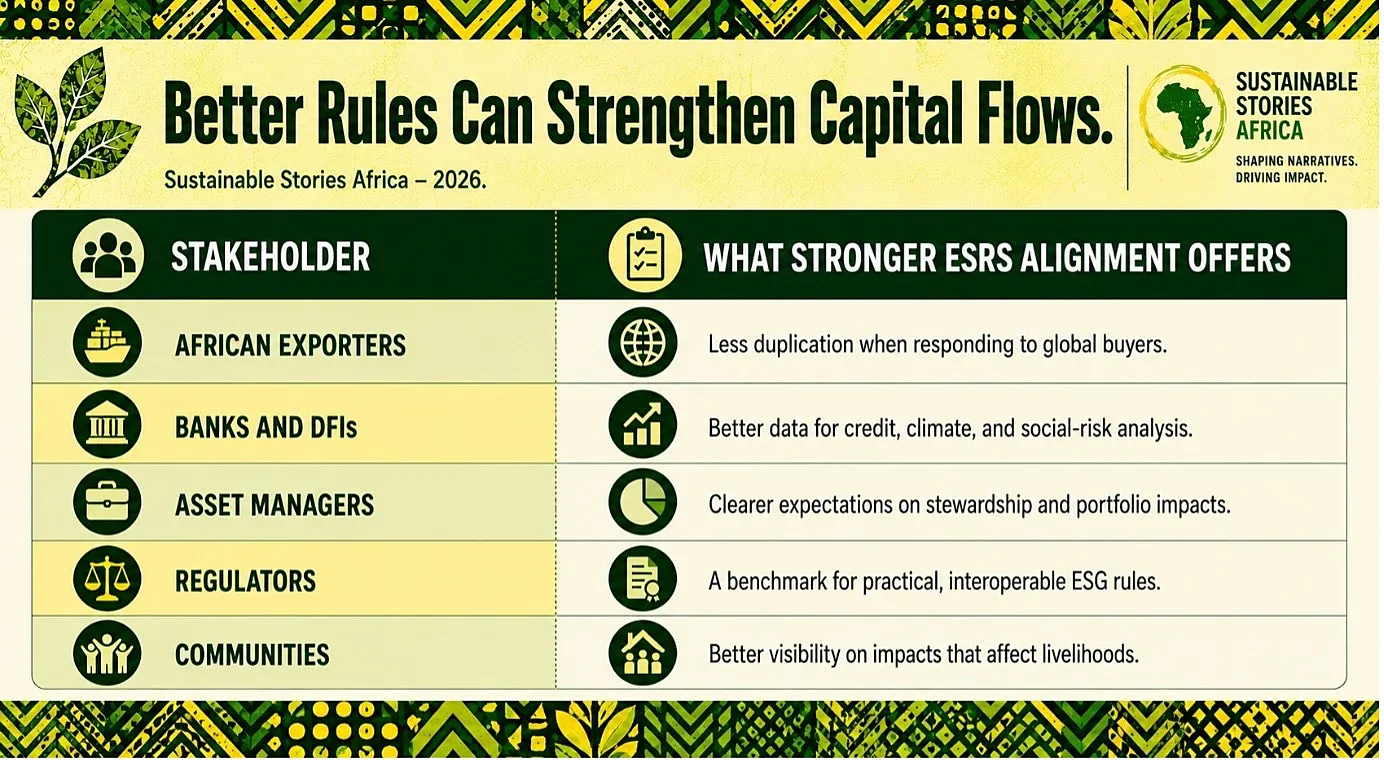
The positive pathway is clear: simpler rules, stronger alignment, and better data can reduce compliance fatigue while preserving trust.
The danger is equally clear: over-simplification could create blind spots just as climate, nature, labour, and governance risks are becoming financially material.
Africa Should Read the ESRS Debate Strategically
African policymakers, exchanges, banks, and reporting bodies should treat the ESRS revision as a live case study in regulatory design.
The lesson is not to copy Europe verbatim. The lesson is to build ESG systems that are proportionate, interoperable, and useful.
Reporting should help companies improve strategy, investors price risk, regulators monitor conduct, and communities understand impacts.
- For firms, the practical action is to strengthen internal ESG data systems now. Waiting for perfect regulation is risky.
Global buyers and financiers are already asking for emissions data, labour practices, governance controls, value-chain information, and transition plans.
- For regulators, the priority is clarity. Rules should reduce duplication without removing accountability.
They should support smaller firms without creating loopholes for major capital allocators. They should recognise that sustainability reporting is no longer public relations. It is market infrastructure.
Path Forward – Align Standards, Protect Market Trust
The revised ESRS should simplify reporting while ensuring strong transparency.
GRI’s message is that global alignment, double materiality, value chain data, and asset-manager accountability must remain central.
For African markets, the opportunity is to prepare early.
Strong ESG data systems can improve access to capital, protect communities, and help local companies compete in a reporting environment where credibility increasingly determines market access.
Culled From: GRI Welcomes Revised ESRS While Calling for Stronger Global Alignment and Removal of Asset Manager Exemption