
Global investors are increasingly turning their gaze toward Nigeria's banking sector, seeing the potential for outsized returns as reforms and market dynamics align.
Global capital eyes Nigeria's banking boom
Nigeria's banking sector is entering a critical phase of opportunity, one in which international investors perceive significant upside.
A recent commentary by Bamidele Ogunwusi in the Independent Newspapers highlights how global capital is poised for entry into Nigeria's banking industry, as structural reforms and macro shifts converge.
With Africa's largest economy still under-penetrated in terms of financial services and domestic banks under-capitalised relative to their potential, we could be witnessing a "banking boom".
The commentary starts with attention to the biggest players: foreign direct investment flows into Nigerian banks, secondary listings abroad, and recapitalisation mandates from the Central Bank of Nigeria (CBN).
These factors set the stage for a sectoral inflexion point in the country's financial ecosystem.
Investor Appetite and Sector Valuations
International investors are currently reassessing Nigeria's banking stocks with fresh interest, driven in part by regulatory impetus and value opportunities.
This signals that entry barriers are lowering and that the combination of recapitalisation needs, restructuring mandates, and comparative valuation gaps is creating opportunities.
Economic and Social Outcomes
For Nigeria, the potential gains are numerous, from strengthened banking institutions, deeper financial inclusion, improved credit flows, and spill-over into broader economic growth.
If Nigerian banks are better-capitalised and can underwrite more SMEs lending, then job creation and structural diversification get a boost, only we manage the inherent risks such as macroeconomic volatility, currency risk, and governance more efficiently.
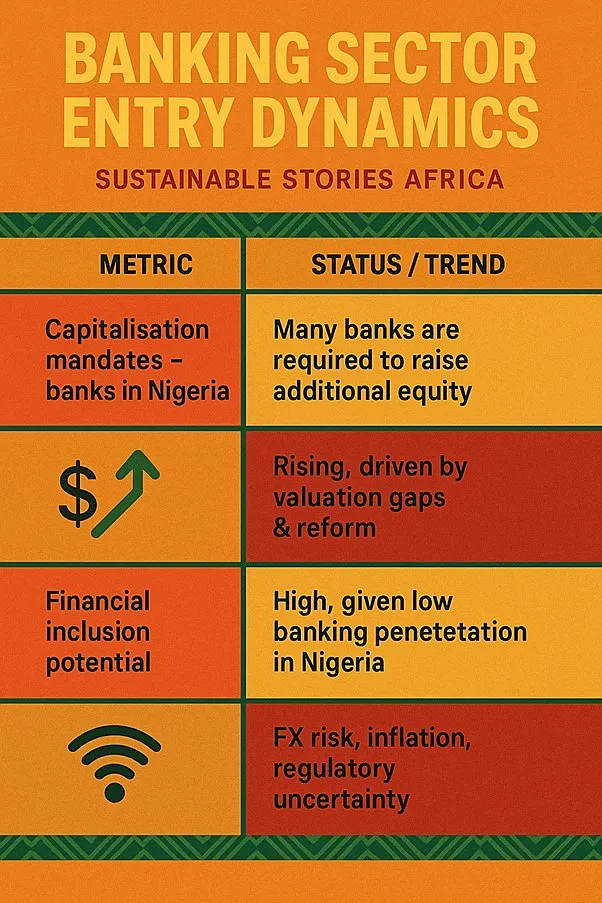
Banking sector entry dynamics
| Metric | Status / Trend |
| Capitalisation mandates – banks in Nigeria | Many banks are required to raise additional equity |
| Foreign investor interest | Rising, driven by valuation gaps & reform |
| Financial inclusion potential | High, given low banking penetration in Nigeria |
| Risk factors | FX risk, inflation, regulatory uncertainty |
ESG and Sustainability Dimension
From a sustainable-growth perspective, the banking sector's transformation will be relevant to areas such as SDG 8 (Decent Work & Economic Growth) and SDG 9 (Industry, Innovation & Infrastructure).
Well-capitalised banks can support productive investment rather than simply trading. But investor discipline in governance, transparency and climate risk management will be a huge determinant.
Regulatory and Structural Reform
A key driver is the regulatory push by the CBN for stronger banking sector resilience.
The writer notes that the banks face recapitalisation and consolidation pressure, which creates both challenges and opportunities for investors.
Valuation Gaps and Market Positioning
Nigerian banks may trade at attractive valuations relative to regional peers, especially when adjusted for growth potential and reform tailwinds.
This calls attention from global investors seeking frontier-market upside.
Economic and Demographic Tailwinds
With over 200 million people, a large youth proportion and under-banked segments, Nigeria offers fertile ground for expanding credit, payments and digital banking.
Operational Leverage and Fintech Disruption
Banks that harness digital platforms and fintech partnerships can leapfrog legacy constraints.
These dynamic bolsters will appeal to investors seeking growth rather than just conservative banking traditions.
Bank Recapitalisation and Listing Activity
Some major Nigerian banks are moving to raise new equity and/or explore secondary listings abroad to access global capital and meet regulatory targets.
The recent listing activity by Guaranty Trust Holding Company (GTCO), serves as a good example
Partnerships and Foreign Participation
More Banks are opening to the idea of joint ventures, foreign strategic partners and capital inflows, which create governance, operational and competitive upgrades.
Digital and Inclusive Finance Initiatives
Domestic banks are increasingly deploying digital channels, payment infrastructure and retail banking initiatives to capture underserved segments.
For investors, this means growth beyond corporate/wholesale banking.
Implementation Challenges and Steps Ahead
- Banks should prioritise risk management, especially in FX and interest-rate exposure, to ensure growth does not lead to fragility.
- Transparent reporting and governance will be critical to attract global institutional capital.
- Nigeria's macro-environment remains volatile (inflation, FX, commodity dependency), which may dampen returns or increase risk.
- Legacy banks may lag fintech disruptors; investors should assess digital readiness and management track record.
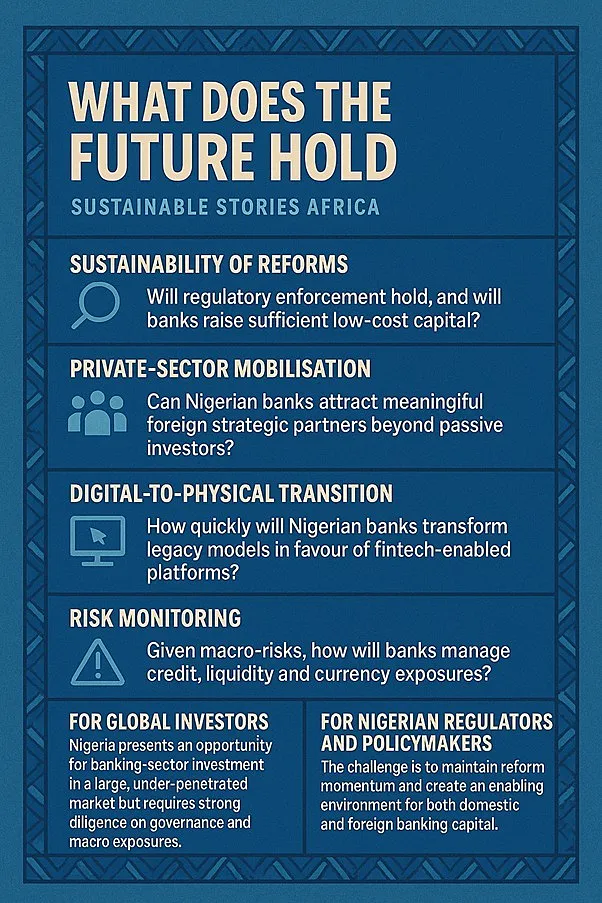
Path Forward – What does the Future Hold
Nigeria's banking resurgence signals a turning point for frontier and transition economies. As reforms and regulations begin to align, opportunities in high-reward banking are widening.
This shift promises more resilient banks, streamlined intermediation, and a stronger financial ecosystem that could anchor sustainable, broad-based economic growth across the region.
- Sustainability of reforms: Will regulatory enforcement hold, and will banks raise sufficient low-cost capital?
- Private-sector mobilisation: Can Nigerian banks attract meaningful foreign strategic partners beyond passive investors?
- Digital-to-physical transition: How quickly will Nigerian banks transform legacy models in favour of fintech-enabled platforms?
- Risk monitoring: Given macro-risks, how will banks manage credit, liquidity and currency exposures?
- For global investors: Nigeria presents an opportunity for banking-sector investment in a large, under-penetrated market but requires strong diligence on governance and macro exposures.
- For Nigerian regulators and policymakers: The challenge is to maintain reform momentum and create an enabling environment for both domestic and foreign banking capital.
- For domestic banks and consumers: Improved competition and access may lead to better services, but only if banks scale effectively and responsibly.
The banking sector in Nigeria is emerging as a frontier play for global investors, driven by regulatory upshifts, demographic tailwinds and latent value.
The path ahead, though promising, must be guarded. The success will hinge on reform execution, bank governance, digital transformation and macro-resilience.
Culled From: https://independent.ng/global-investors-eye-nigerias-banking-boom-set-for-entry/