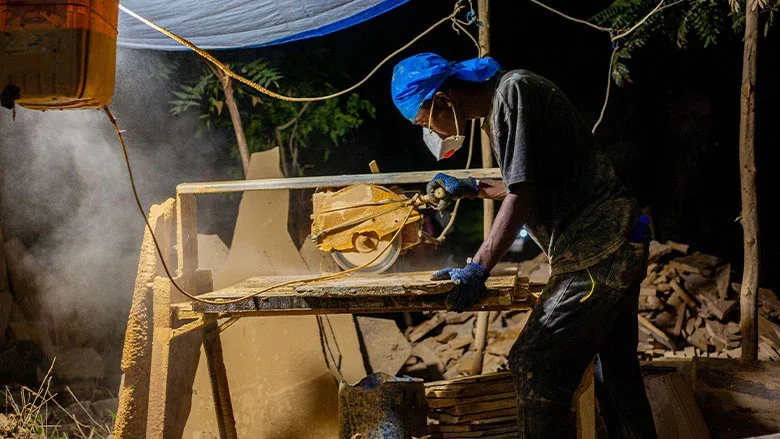
Electricity has reached Jah Kunda, a rural community in The Gambia’s Upper River Region, cutting business costs and changing daily life.
For welder Muhammed Kandeh, grid power has replaced expensive gasoil generators and opened room for better earnings.
The shift shows how rural electrification can support jobs, safety, education and local enterprise.
Power Is Rewriting Rural Opportunity
For years, every welding job in Jah Kunda began with a calculation: how much gasoil could Muhammed Kandeh afford before the work became unprofitable?
That calculation is changing. Jah Kunda, a small off-road village in
The Gambia’s Upper River Region is among 706 communities newly connected to the national grid through the Gambia Electricity Restoration and Modernisation Project and the ECOWAS Regional Electricity Access Project, backed by the World Bank, European Union and European Investment Bank.
The expansion has helped raise national electricity access from 60% in 2018 toward a projected 90% today.
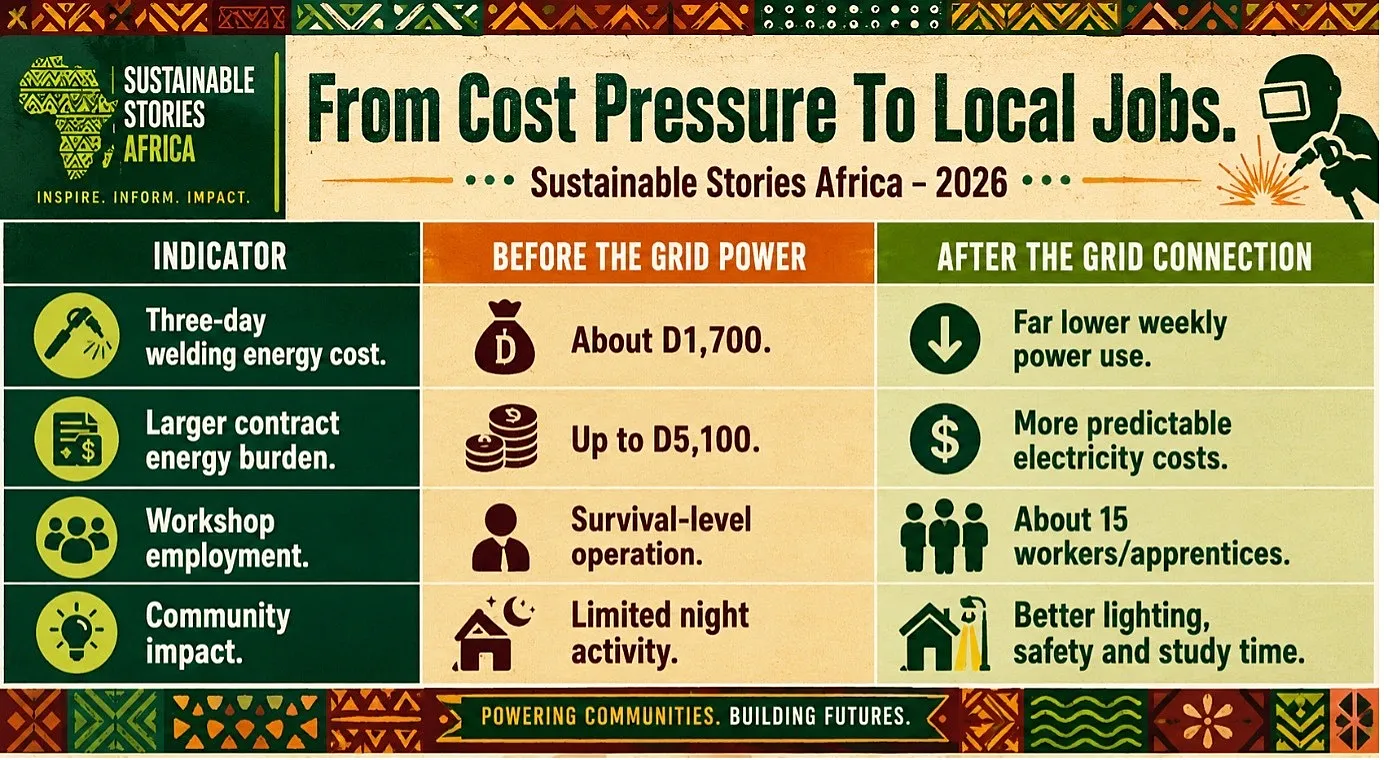
For Kandeh, the change is immediate. A three-day welding job once consumed about 20 litres of gasoil, costing around D1,700, while larger contracts could require three 20-litre bottles, costing D5,100. Now, he says D200 worth of electricity can last a full week.
From Cost Pressure To Local Jobs
The transformation is not only about one machine or one workshop. It is about what happens when energy becomes reliable enough for a rural business to plan, price and grow.
Kandeh works in a welding shop owned by Mbakey Ceesay, a long-time welder who has seen the limits of generator-powered enterprise. The workshop supported about 15 young people, including apprentices learning metalwork skills that can become a source of income.
This matters because rural electricity is often discussed as infrastructure, but in Jah Kunda, it functions as economic policy.
It lowers operating costs, protects margins, supports apprenticeships and reduces pressure on young people to leave their communities in search of work.
Electricity has also changed household life. Families can refrigerate water, businesses can operate more safely, and children can study after dark.
Village head Alkalo Barrow said lighting has helped reduce fears of robbery and theft in homes and local businesses.
Electricity Turns Access Into Agency
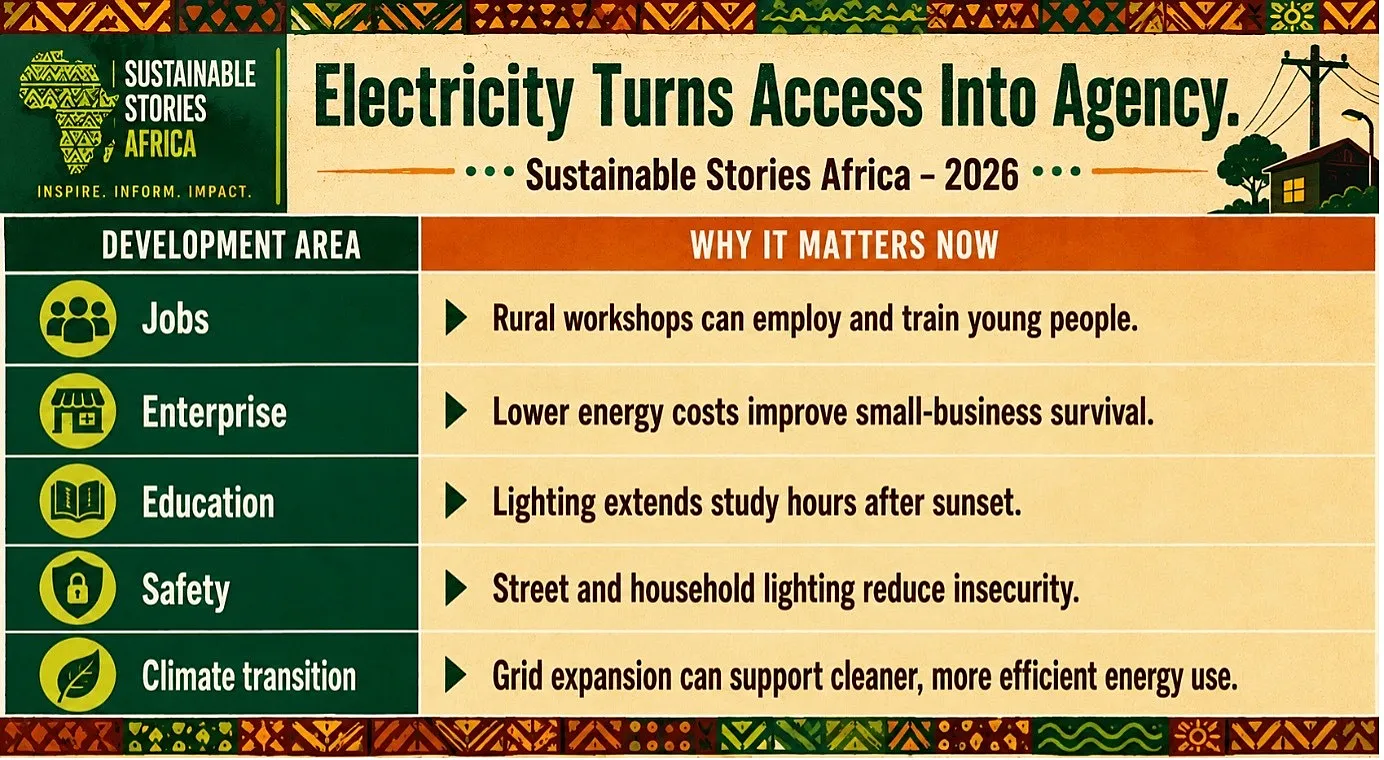
The promise of rural electrification is not simply that villages become brighter. It is that people gain more control over time, income and opportunity.
- For a welder, that means accepting more jobs without fearing fuel costs will erase profit.
- For apprentices, it means learning a trade where machines work consistently. For households, it means cold water, safer nights and more usable evening hours.
This is the real ESG case for rural power: energy access supports social inclusion, local enterprise, skills development and safer communities.
It turns a grid connection into a development multiplier.
Rural Power Needs Patient Investment
Jah Kunda’s story also shows what must happen next. Electrification cannot stop at grid connection. Communities need affordable tariffs, reliable service, maintenance capacity and finance for small businesses to buy productive equipment.
- For policymakers, the priority is to treat rural power as an economic enabler, not a social add-on.
- For financiers, the opportunity is to back productive-use energy models that help workshops, agro-processors, cold-storage operators and local service businesses grow.
- For development partners, the lesson is clear: infrastructure works best when it reaches the people who can turn it into livelihoods.
Path Forward – Power Must Become Productive Growth
The next phase should focus on reliability, affordability and productive use. Grid access must help rural firms expand, not only light homes.
For The Gambia and wider African markets, Jah Kunda offers a practical lesson: electrification advances ESG goals by creating jobs, strengthening communities and giving young people reasons to build futures where they live.
Culled From: The Gambia: How Rural Electrification is Transforming a Welder's Life in Jah Kunda