ISO has opened public consultation on ISO/DIS 14060, a draft international standard for net-zero-aligned organisations, launched on 17 June 2026.
The process matters because climate claims are moving from public promises to verifiable business plans, supply-chain scrutiny and investor confidence.
For African and Global South markets, the standard could become a new language of trust for exporters, banks, utilities, manufacturers and regulators.
A New Rulebook For Credible Net Zero
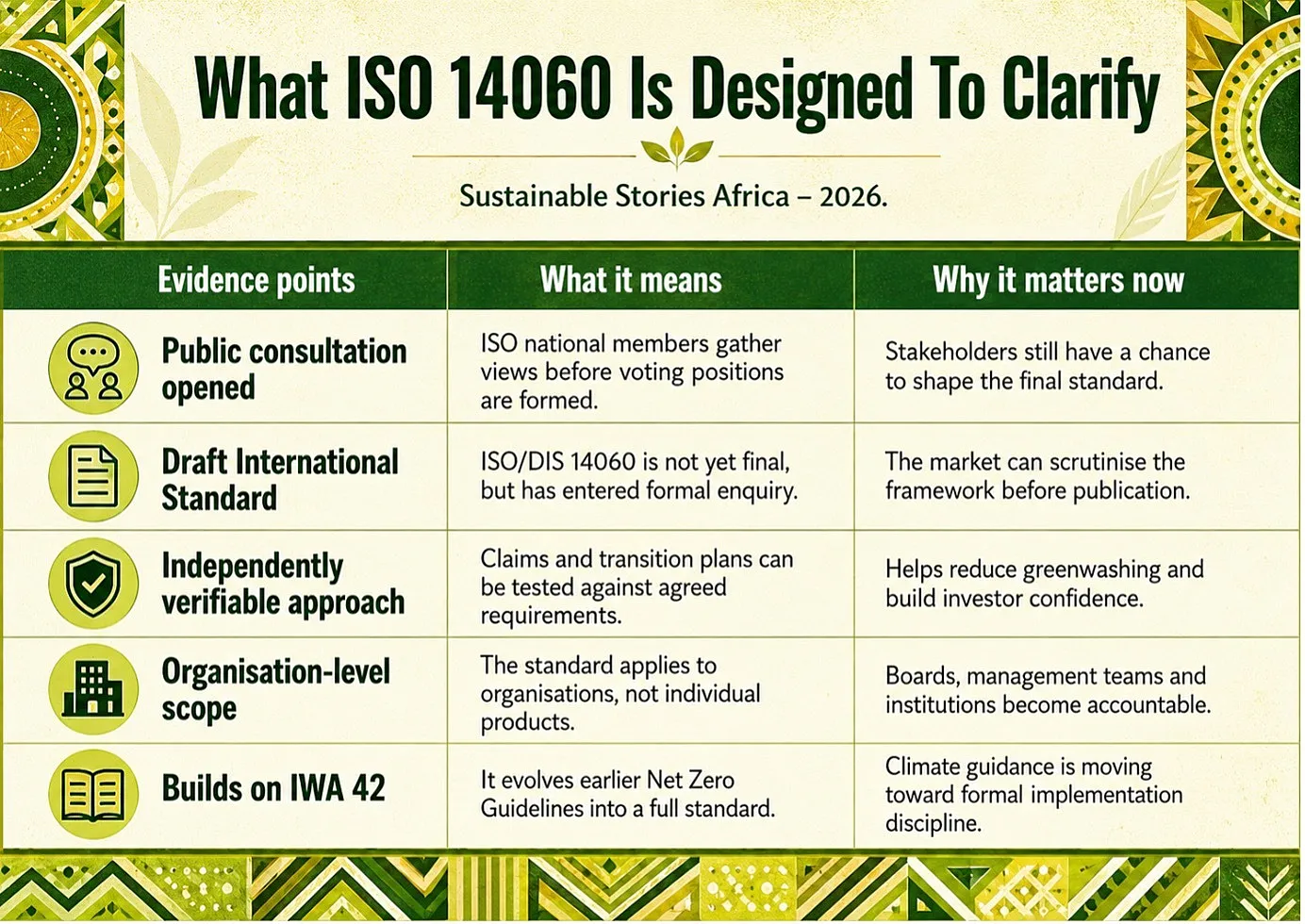
The International Organisation for Standardisation has opened public consultation on ISO/DIS 14060, a draft Net Zero Aligned Organisations Standard that could fundamentally reshape how climate ambition is measured, verified, and held accountable.
Launched in London on 17 June 2026, ahead of London Climate Action Week, the 12-week consultation invites ISO national members across more than 170 countries to form national positions on the proposed framework.
- What it does: Supports organisations in building credible, comprehensive, and independently verifiable net-zero transition plans, covering targets, delivery pathways, governance systems, and tested evidence.
- Why it matters: In markets crowded with carbon-neutral claims and sustainability reports, net zero must become a structured business discipline, not a communications strategy.
- How it was built: Nearly two years of international negotiations involving business, government, academia, civil society, and standards bodies informed the draft.
ISO's Head of Sustainability and Partnerships, Noelia Garcia Nebra, described it as a globally agreed framework for "credible transition plans" that can support resilience, innovation, and long-term growth.
Why The Consultation Matters For Markets
The draft standard arrives at a difficult moment for climate governance. Companies are under pressure to decarbonise, but many also face energy insecurity, inflation, supply-chain disruption, regulatory fragmentation and investor scepticism.
That tension is especially visible in African and Global South markets. A manufacturer in Lagos, a mining supplier in Lusaka, a cocoa exporter in Abidjan or a renewable-energy developer in Nairobi may all be expected to meet global climate expectations while operating in power systems, financial markets and infrastructure environments that remain uneven.
This is where ISO 14060 could matter. It offers a common reference point for how organisations demonstrate that their net-zero strategies, targets and delivery plans are compatible with the wider transition to global net zero.
It is not just about emissions accounting. It is about whether an organisation’s business model is being adapted for a lower-carbon economy.
What Credible Alignment Could Unlock Next
If well implemented, ISO/DIS 14060 could move organisations from broad climate ambition to measurable transition planning.
For African businesses, it carries genuine competitive potential, not merely a compliance burden.
- Exporters could use stronger transition plans to retain access to climate-sensitive markets.
- Banks could assess borrowers' transition readiness.
- Utilities could align capital expenditure with credible decarbonisation pathways.
- Regulators could improve market discipline without building isolated national frameworks from scratch.
Critically, credible transition plans should also clarify where jobs may shift and how companies intend to manage climate risks without transferring costs to households, suppliers, or informal workers.
However, the risks are equally real. If African voices remain weak during consultation, the final standard risks encoding the priorities of better-resourced markets, adding compliance pressure to businesses already navigating high energy costs, limited climate finance, and fragile supply chains.
African Institutions Need A Strong Voice
The consultation phase should therefore be treated as a strategic opening. National standards bodies, chambers of commerce, stock exchanges, securities regulators, sustainability professionals, banks, insurers, exporters, civil society groups and universities should review the draft and submit practical comments through their national standards systems.
The priority is not to dilute ambition. It is to make ambition implementable. African stakeholders should ask whether the draft standard properly reflects infrastructure gaps, informal supply chains, financing constraints, adaptation needs, energy access realities and the cost of verification for small and medium-sized enterprises.
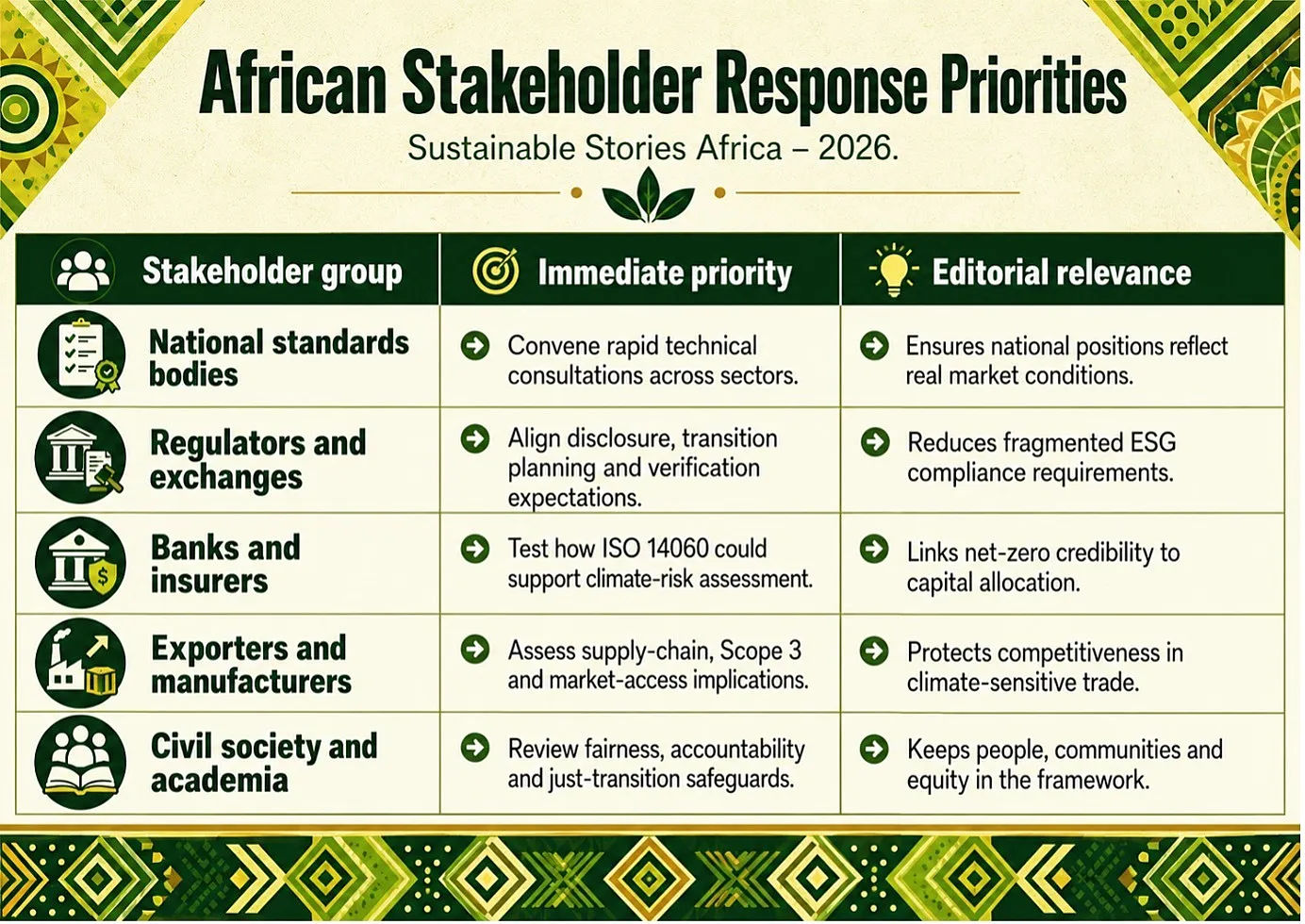
- The strongest response will come from coalitions, not isolated submissions. Business groups should work with climate scientists. Regulators should listen to SMEs.
- Financiers should engage real-economy companies.
- Civil society should insist that verification does not become a box-ticking exercise that ignores workers, communities and vulnerable households.
Path Forward – Turning Consultation Into African Market Confidence
African standards bodies, regulators and industry associations should convene rapid consultations, translate the draft’s implications into sector language, and ensure SMEs, exporters, financiers and civil society voices are represented before national positions close.
The promise is practical: climate claims that can be tested, transition plans that can be financed, and ESG systems that move from branding to resilience, competitiveness and measurable emissions reduction.
Culled From: ISO Launches Public Consultation on World's First Net Zero Aligned Organizations Standard