ISO has launched ISO 32212, a new standard for net zero transition planning by financial institutions.
The standard arrives as banks, insurers, and investors face rising scrutiny over climate pledges, financed emissions and transition-risk exposure.
For African markets, it could influence capital flows, ESG governance and the way lenders support real-economy decarbonisation.
A New Rulebook for Climate Finance
The International Organisation for Standardisation has launched ISO 32212, a new net zero transition planning standard designed to help financial institutions move from climate ambition to measurable execution.
The standard sets new requirements and recommendations for banks, insurers, investors and other financial institutions seeking to align strategy, governance, capital allocation, and client engagement with a net-zero and climate-resilient economy.
Its timing is significant. Across global finance, climate commitments are increasingly being tested by regulators, shareholders, civil society, and customers with a simple question: Where is the plan?
For African markets, the answer matters. Banks finance energy projects, infrastructure, agriculture, transport, housing and industry.
If their transition plans remain weak, capital may continue to flow into stranded assets, communities may face greater climate exposure, and institutions may struggle to attract sustainability-linked finance.
From Public Commitments to Practical Systems
ISO 32212 reflects a wider shift in sustainable finance. Net zero is no longer just a headline target for annual reports. It is becoming an operating discipline.
The standard asks financial institutions to understand their current climate position, assess risks and opportunities, define transition objectives, integrate targets into financing decisions, and review performance over time.
That is important because financial institutions not only reduce emissions through their own offices, branches or vehicles.
Their greater influence often sits in lending books, investment portfolios, insurance underwriting and advisory relationships.
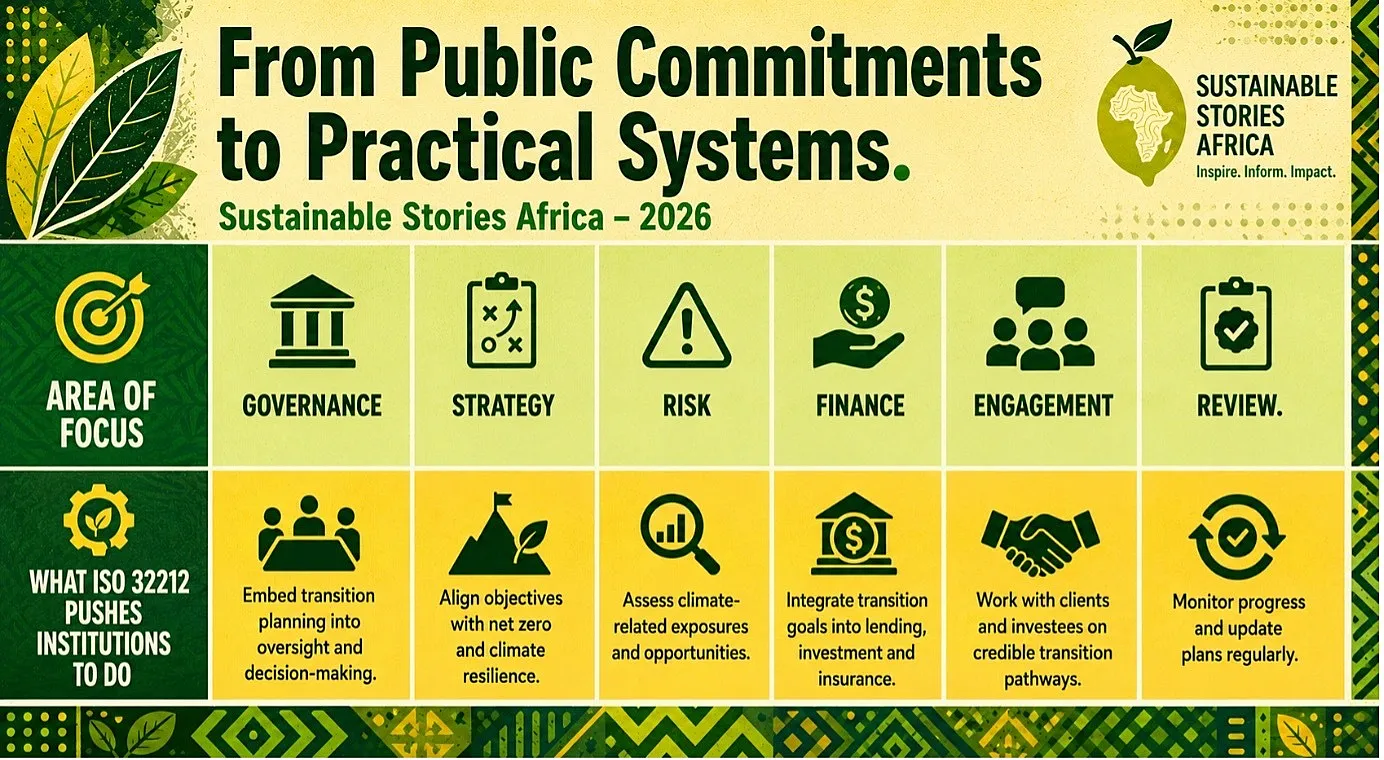
For an African commercial bank, this could mean assessing whether its power-sector lending supports gas lock-in, renewable expansion or grid resilience.
- For an insurer, it could mean reassessing exposure to flood-prone assets.
- For a pension fund, it could mean asking portfolio companies for credible decarbonisation plans before allocating long-term capital.
The standard also arrives as companies and financial institutions face growing pressure to show that their ESG claims are not vague promises. Transition planning is becoming a credibility test.
What Better Transition Planning Can Unlock
If implemented well, ISO 32212 could help financial institutions become more disciplined allocators of climate capital.
The strongest benefit is clarity. A common transition-planning standard can make it easier for boards, regulators, investors and clients to clearly understand whether a financial institution has a credible route from today’s portfolio to tomorrow’s climate-aligned economy.
For Africa, this could support better access to green and transition finance. Local banks that can demonstrate credible transition governance may be better positioned to work with development finance institutions, climate funds and international investors.
The potential gains are not only institutional. Better transition planning can shape real-world outcomes: cleaner power, lower climate exposure, more resilient food systems, improved urban infrastructure and more credible sustainability-linked finance.
However, weak implementation carries risks. A transition plan that remains a document rather than a management system will not protect value. It may only create another compliance burden.
Regulators, Boards and Lenders Must Move
The launch of ISO 32212 should prompt financial institutions to review the gap between climate pledges and operating practices.
- Boards need to ask whether transition planning is properly embedded in governance.
- Risk teams need to assess how climate scenarios affect credit, underwriting and investment decisions.
- Relationship managers need tools to engage clients without simply cutting off finance to hard-to-abate sectors.
Regulators across African markets should also pay attention. ISO 32212 can provide a useful reference point as central banks, securities regulators, and stock exchanges strengthen climate-risk disclosure, sustainable finance taxonomies and ESG supervision.
The priority is not to mechanically import standards. It is to adapt them intelligently to local realities: energy access gaps, industrialisation needs, climate vulnerability, sovereign debt pressures and the need for a just transition.
Financial institutions should begin with practical steps: map exposures, identify high-impact sectors, set realistic targets, build internal capacity, improve data systems and disclose progress transparently.
The message is clear. Net zero finance is moving from aspiration to accountability.
Path Forward – Turning Climate Commitments Into Bankable Action
ISO 32212 gives financial institutions a clearer framework for credible transition planning, but implementation will determine its value.
African banks, insurers, investors and regulators should use the standard to strengthen governance, improve climate-risk management and channel capital toward resilient, inclusive and low-carbon growth.
Culled From: ISO Launches Net Zero Transition Planning Standard for Financial Institutions Under ISO 32212