World Bank Fragility Forum speakers say jobs, income and technology must sit at the centre of development in fragile settings.
The debate reflects a wider shift from traditional aid delivery toward private capital, productivity and local enterprise.
For Africa, the opportunity is clear: youth talent can become resilience infrastructure if ecosystems, finance and institutions work.
Jobs Are Now The Stability Question
Fragile economies do not only need more aid. They need jobs that create income, income that creates dignity, and dignity that rebuilds confidence in the future.
That was one of the strongest messages from the World Bank Group’s high-level plenary on development in fragile and conflict-affected settings.
Speakers argued that the shifting international order demands a different development model, one that combines public finance, private capital, local political leadership, technology and real job creation.
The issue is urgent because the development landscape is changing. Traditional aid flows are under pressure.
- Public budgets are stretched.
- Conflict is spilling across borders.A
- Climate shocks are intensifying.
At the same time, young populations are expanding across many African countries, creating both risk and opportunity.
If those young people are excluded, fragility can deepen. If they are connected to skills, finance, technology and markets, they can become one of the strongest engines of resilience.
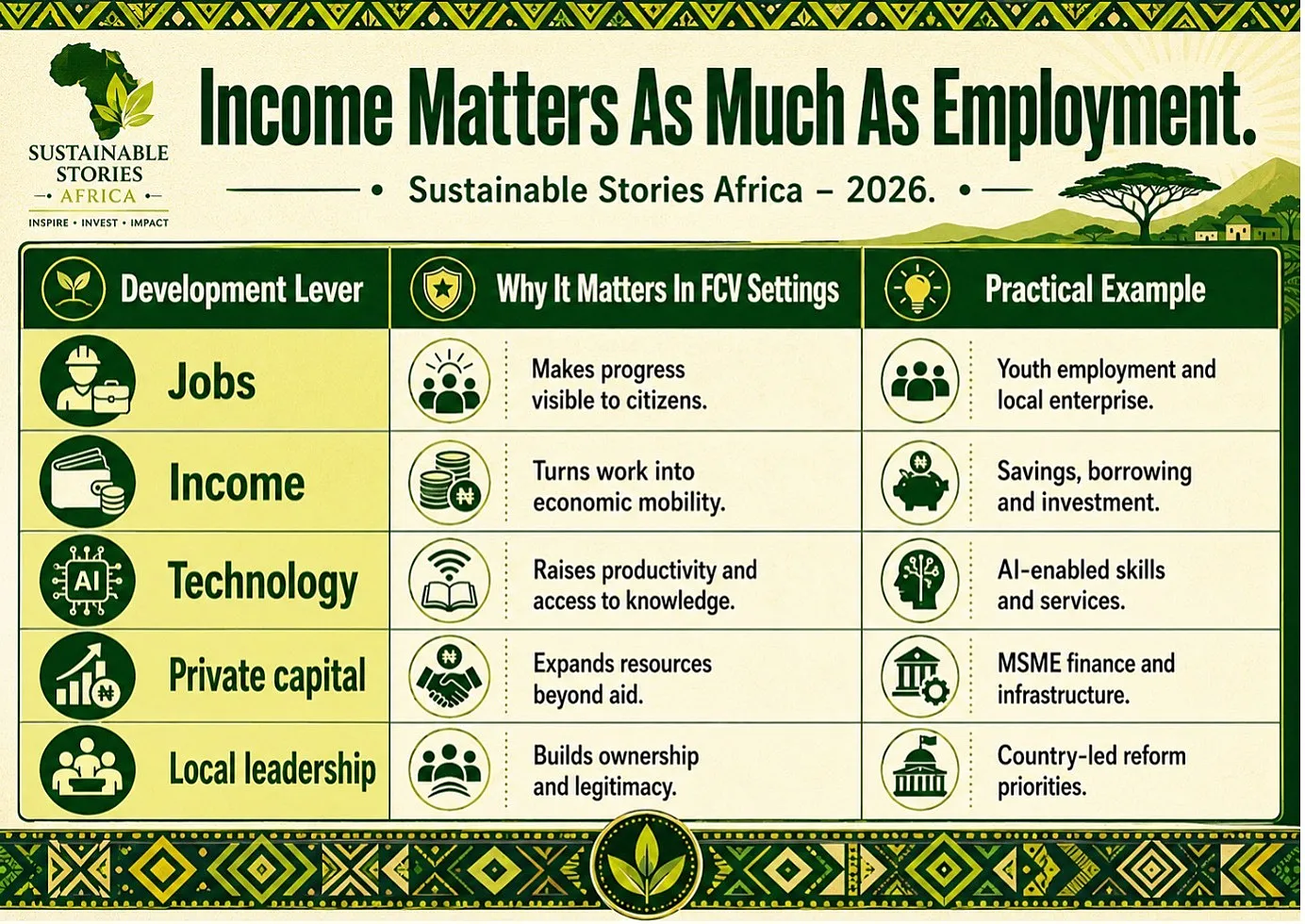
Income Matters As Much As Employment
The goal is not simply work; it is income that produces economic progress.
That distinction, drawn by UNDP Administrator Alexander De Croo at Fragility Forum 2026, completely reframes the conversation about jobs.
In fragile settings, many people are already working, trading, farming, repairing, and building.
However, much of that activity happens at a survival level, without enough surplus to save, invest or build resilience.
Technology, including artificial intelligence, can help fragile economies leapfrog barriers to knowledge and capacity; however, only through close collaboration between international institutions, development organisations, local private-sector actors and political leadership.
Mali-based Agro Biotech founder Birama B. Sidibé further grounded the discussion. In fragile contexts, large companies leave, and medium firms scale back.
What remains are micro and nano enterprises, including shopkeepers, mechanics, food sellers and repair workers, quietly keeping communities functional.
His conclusion was direct: if these are the actors that stay, development policy must see them, protect them and support them.
Local Enterprise Can Become Resilience
Resilience can be built from the bottom up.
A mechanic keeping vehicles running in a conflict-affected town, a solar installer powering a small business cluster, or a farmer using better seed technology is not marginal to development; they are the local economic system that helps communities absorb shocks.
For African markets, this is especially relevant. Informal and micro businesses already power many economies, providing the last layer of services when formal systems weaken.
Supporting them with energy, market infrastructure, digital tools, and access to finance can convert survival into productive enterprise, reducing social tension, improving service delivery and helping families move from hand-to-mouth survival toward savings and investment.
The risk of ignoring them is equally clear: development systems focused only on large projects may miss the most durable local engines of recovery.
Build Ecosystems Around Local Firms
The next step is to design FCV development around local enterprise ecosystems, not just national plans or donor projects.
- Governments should create simplified regulatory pathways for micro and nano businesses in fragile regions.
- Development finance institutions should support local banks, cooperatives and fintech platforms that can reach smaller firms.
- Energy access should be treated as a business survival tool.
- Market infrastructure should be built around clusters where traders, artisans, farmers and repair services already operate.
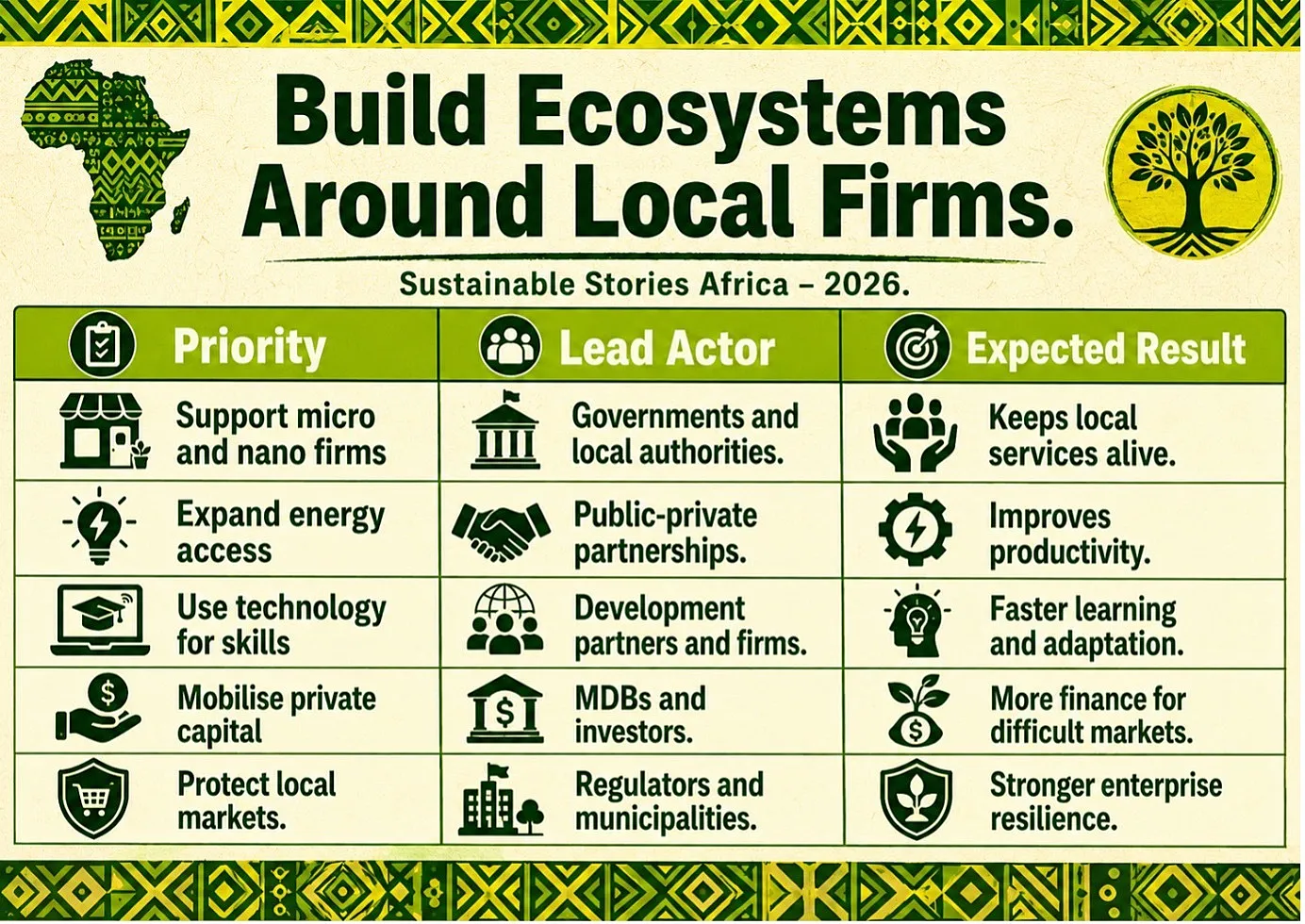
For Africa, this is not only an FCV agenda. It is an inclusive growth agenda.
The same tools needed in fragile settings, such as reliable energy, finance, skills, market access and fair rules, are tools needed to build stronger local economies everywhere.
The plenary’s deeper message was that fragile settings contain talent, enterprise and ambition.
The development task is to stop seeing people only as beneficiaries and start co-creating with them as problem-solvers.
Path Forward – Turn Local Enterprise Into Resilience
African governments and partners should finance micro-enterprise clusters, productive energy, digital skills, AI-enabled learning and local market infrastructure in fragile and at-risk regions.
This advances ESG by linking decent work, inclusion, resilience and poverty reduction. Fragile economies can recover faster when development starts with the people and businesses already holding communities together.