
Kenya has emerged as Africa's most assertive enforcer of climate finance rules, signalling a shift from policy promises to measurable accountability.
Enforcement Moves From Policy to Practice
New analysis highlights how Nairobi is translating green regulations into compliance mechanisms, audits and penalties, while many peers still rely on voluntary disclosures.
The implications stretch beyond East Africa, reshaping how investors assess governance risk across the continent.
Kenya has taken a decisive lead in enforcing climate finance regulations across Africa, marking a rare pivot from aspirational frameworks to binding oversight.
According to new findings, the country is not only publishing sustainable finance policies but actively monitoring compliance through its central bank, capital markets regulator and environmental authorities.
While many African jurisdictions have drafted green taxonomies and climate disclosure guidelines, enforcement remains uneven.
Kenya's shift matters because investors are increasingly pricing climate governance into capital allocation decisions. In a continent seeking billions in transition finance, regulatory credibility is fast becoming currency.
Data Reveals Africa's Compliance Gap
The latest assessment highlights a stark divide between regulatory ambition and enforcement capacity across Africa.
Several countries have introduced climate finance rules aligned with global standards such as the Task Force on Climate-related Financial Disclosures (TCFD) and emerging ISSB frameworks. However, few have embedded clear penalties or compliance audits.
Kenya stands out for embedding supervisory reviews within its financial system. The Central Bank of Kenya now requires banks to integrate climate risk into credit and capital planning frameworks.
The Capital Markets Authority has also advanced sustainability disclosure obligations for listed entities.
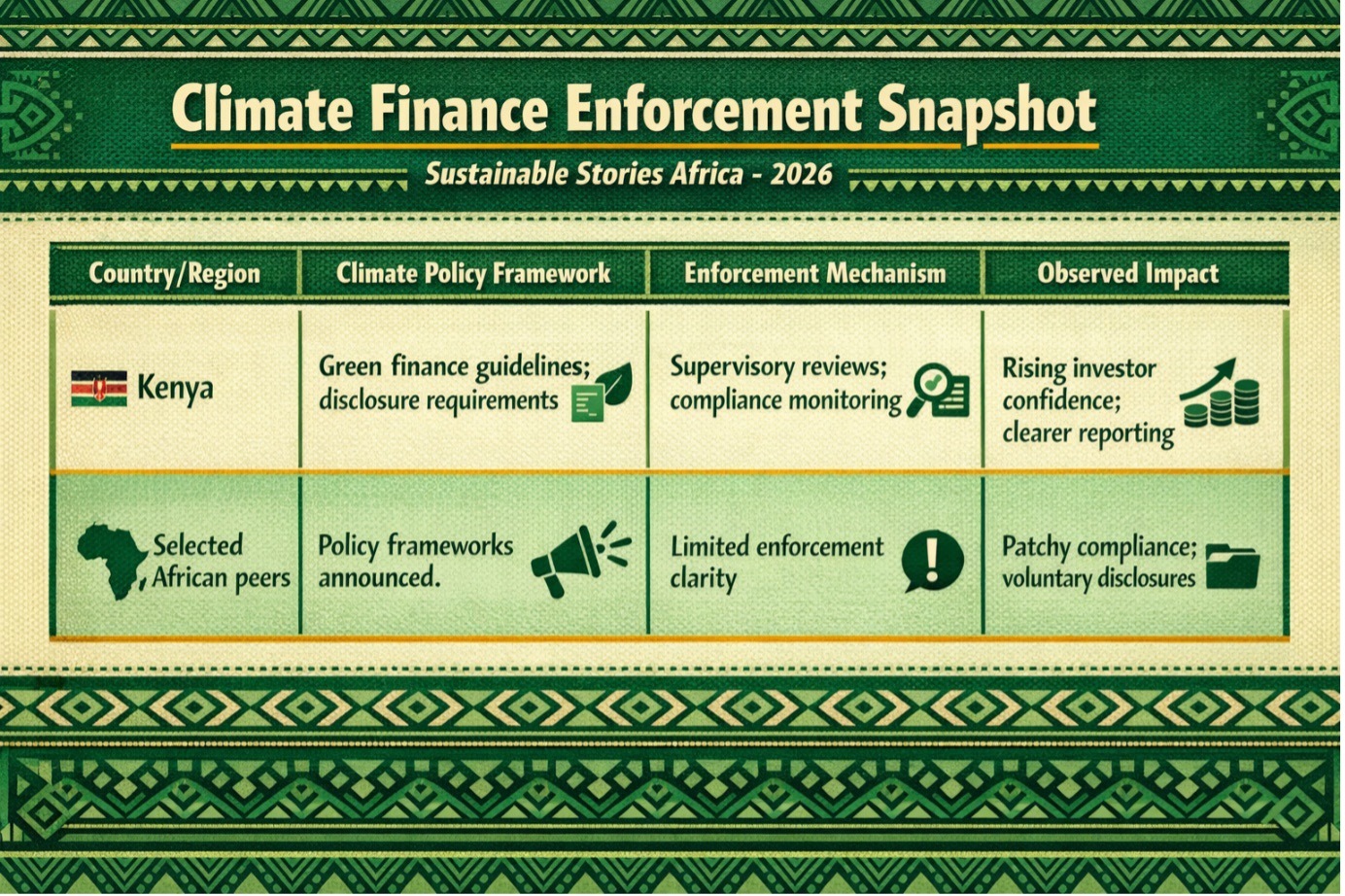
Climate Finance Enforcement Snapshot
| Country/Region | Climate Policy Framework | Enforcement Mechanism | Observed Impact |
|---|---|---|---|
| Kenya | Green finance guidelines; disclosure requirements | Supervisory reviews; compliance monitoring | Rising investor confidence; clearer reporting |
| Selected African peers | Policy frameworks announced | Limited enforcement clarity | Patchy compliance; voluntary disclosures |
Analysts note that without enforcement, policies risk becoming symbolic. "Disclosure without supervision is narrative, not governance," one regional policy expert observed. Kenya's approach seeks to close that credibility gap.
Beyond regulation, Kenya's climate finance strategy links compliance to broader economic priorities. As the country positions itself as a regional green finance hub, enforcement becomes part of its competitiveness strategy.
Investors evaluating African sovereign and corporate debt are increasingly examining whether climate-related disclosures are verified or merely declared.
Why Strong Enforcement Changes Capital Flows
The stakes extend beyond administrative compliance. Strong enforcement can lower perceived risk premiums, improve transparency and unlock concessional funding.
For pension funds, development banks and private equity firms, regulatory certainty reduces due diligence costs and strengthens trust.
Kenya's proactive stance also aligns with its broader climate commitments under the Paris Agreement and its nationally determined contributions (NDCs).
By ensuring financial institutions measure and manage climate risks, Nairobi is embedding resilience into its financial architecture.
Failure to act, by contrast, carries costs. Weak enforcement can deter climate funds, expose banks and undermine public trust. As global capital increasingly screens for ESG integrity, African markets risk being sidelined if governance standards appear cosmetic.
Enforcement vs Policy in Africa
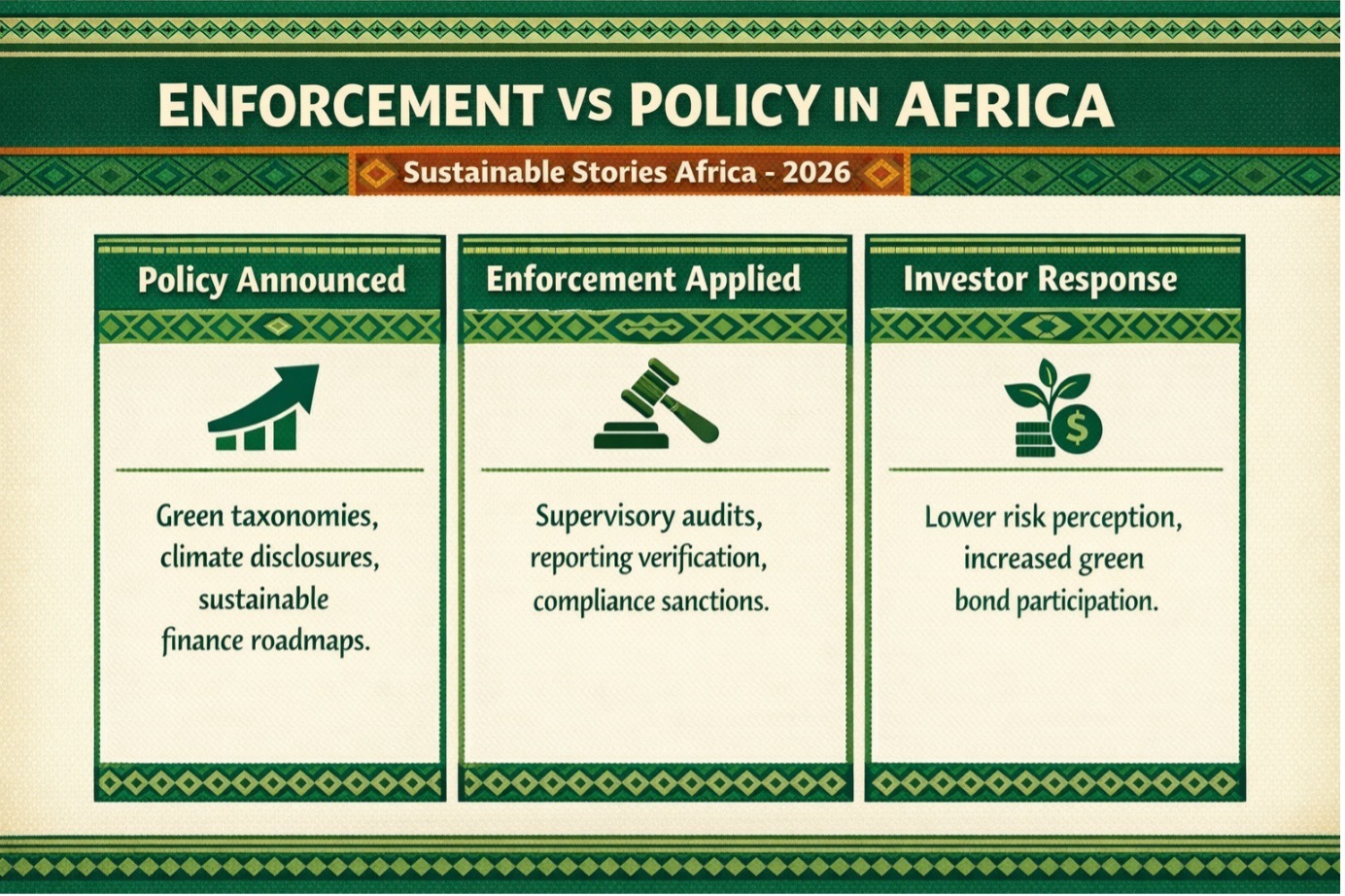
Kenya currently moves further along that chain than most regional peers.
The Continent's Regulatory Inflexion Point
For policymakers across Africa, Kenya's example underscores a critical lesson: drafting frameworks is only the first step. Implementation, monitoring and sanctioning mechanisms determine credibility.
Financial regulators must now integrate climate supervision into routine oversight. Stock exchanges can require sustainability reporting tied to listing rules. Ministries of finance may embed climate accountability within fiscal policy design.
For corporations, the message is equally clear. Climate reporting is evolving from a reputational exercise to a compliance obligation. Boards must treat sustainability oversight as a fiduciary responsibility, not a marketing function.
Investors, meanwhile, can use enforcement benchmarks to differentiate markets. Where oversight is strong, capital can flow with greater confidence.
Path Forward – Enforce Rules, Build Trust, Unlock Capital
Kenya's experience signals that credible enforcement strengthens Africa's case for climate finance.
The priority now is scaling supervisory capacity, harmonising standards regionally and embedding climate risk within financial governance frameworks.
If replicated thoughtfully, enforcement-led reform could transform Africa from a policy-rich but compliance-light region into a credible destination for sustainable capital. The opportunity is not merely regulatory; it is economic.
Culled From: https://big3africa.org/2026/01/19/kenya-leads-africas-climate-finance-enforcement/