Development finance institutions are becoming more selective about African energy investments, favouring markets with credible regulation, bankable projects and structures that can mobilise private capital.
Kenya’s growing share of East African commitments highlights the reward for institutional development.
However, it also raises questions about countries left outside concentrated financing flows.
Capital follows credible energy markets
Africa’s development finance landscape is shifting from broad project support to more concentrated investment in markets able to reduce risk and attract commercial capital alongside concessional funding.
Kenya has become a leading example. Analysis cited by Africa Sustainability Matters says the country accounts for nearly half of development finance institutions' commitments to East Africa, supported by renewable resources, expanded electricity access and a long record of collaboration among government, lenders and private developers.
This trend does not mean development lenders are abandoning Africa’s energy transition.
It means scarce public and concessional capital is increasingly expected to mobilise larger private flows, making regulation, revenue quality and institutional capacity central to investment decisions.
The financing gap demands leverage
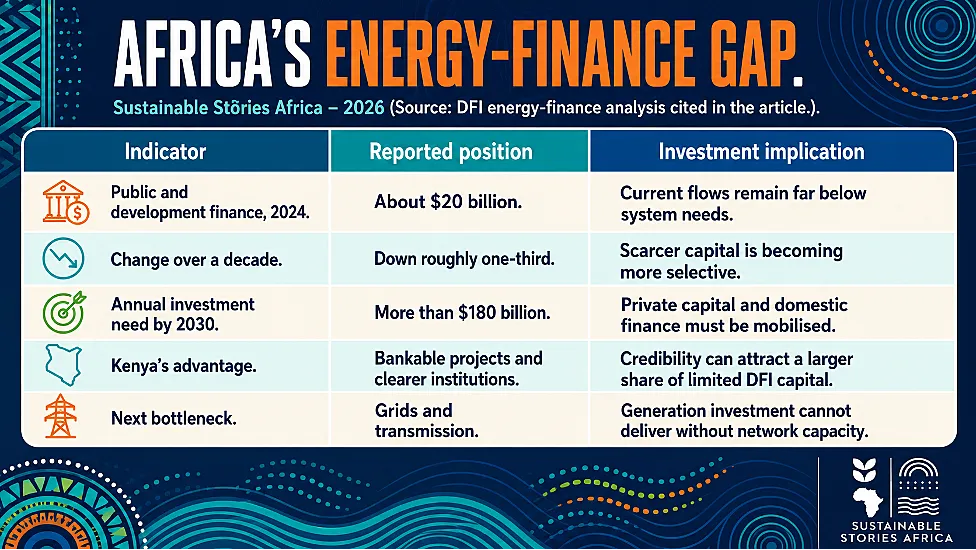
Public and development finance for Africa’s energy sector was estimated at $20 billion in 2024, having declined by approximately one-third over a decade.
Annual energy investment needs, meanwhile, are expected to exceed $180 billion by 2030.
No development institution can close that gap through direct lending alone.
Capital is therefore being used in guarantees, subordinated debt, insurance and blended-finance vehicles that absorb specific risks and make senior commercial investment more viable.
This catalytic approach can multiply available finance, but it also creates concentration.
Markets with functioning utilities, predictable procurement and credible counterparties can attract repeat transactions, while countries with weaker institutions struggle to move even high-impact projects to financial close.
Kenya built confidence over time
Kenya’s position reflects decades of investment rather than a single policy change.
- Geothermal development created reliable renewable generation, while wind, hydro and distributed solar broadened the energy mix.
- Expanded electrification produced customer and payment histories that support investment decisions.
Early DFI interventions helped manage political, construction and offtaker risks.
- Later structures could draw on a more mature ecosystem of developers, regulators, banks and technical expertise.
- That progression illustrates how concessional finance can help build markets when it is paired with institutional reform.
Kenya still faces challenges, including utility finances, grid constraints and affordability.
- Its experience nevertheless shows that the cost of renewable technology is only one part of bankability.
- Investors price policy reversals, delayed payments, currency exposure and unclear procurement into the cost of capital.
Grids become the next bottleneck
Generation has attracted more attention than transmission and distribution; however, weak networks can prevent new renewable assets from serving customers.
Grid congestion, losses and delayed connections reduce project revenue and system reliability.
DFIs are consequently broadening their focus to storage, transmission, distribution, electric mobility, clean manufacturing and selected transition infrastructure.
The aim is to finance systems and value chains rather than isolated power plants.
This wider lens links energy finance to industrial policy.
- Reliable electricity supports mining, agriculture, manufacturing, digital services and regional trade.
- A country’s clean-energy investment case is therefore also an argument about productivity, exports and employment.
Selectivity creates a continental policy challenge
Countries cannot compete for capital on solar irradiation, wind speeds or hydropower potential alone.
They must show transparent procurement, stable regulation, credible demand, workable tariffs and institutions capable of honouring long-term agreements.
Development institutions also have a responsibility not to reinforce permanent financing divides.
Fragile and lower-capacity markets may require more project preparation, first-loss capital, currency solutions and technical assistance precisely because commercial investors will not enter unaided.
The policy goal should be to expand the number of bankable markets, not simply concentrate finance indefinitely in today’s strongest destinations.
Kenya provides lessons, but each country will need reforms suited to its own power system and political economy.
Bankability is an institutional outcome
Kenya’s emergence as a clean-energy financing hub shows that reliable policy and project structures can lower risk perceptions and attract repeat capital.
The larger African lesson is that bankability is built through institutions, not announced through project pipelines.
Governments that connect credible planning, utility reform, grid investment and transparent contracting will be better placed to turn natural resources into affordable energy and productive growth.
Path Forward – Governments, DFIs Must Broaden Africa’s Bankability
African governments should strengthen utilities, procurement, project preparation and revenue frameworks while prioritising grid capacity alongside generation.
DFIs should use guarantees, local-currency tools and technical assistance to help more markets cross the bankability threshold, rather than allowing catalytic finance to remain concentrated.