At London Climate Action Week (LCAW) 2026, the conversation shifted decisively from climate ambition to implementation.
However, participants warned that while projects are increasingly investment-ready, capital deployment continues to lag behind demand.
The disconnect threatens to slow the global transition, particularly across emerging economies where financing needs remain greatest.
The Conversation Has Changed. The Money Hasn't.
Climate conversations are no longer dominated by promises; they are increasingly defined by delivery.
That was one of the clearest messages emerging from London Climate Action Week (LCAW) 2026, where policymakers, investors, development institutions and business leaders agreed that the global climate agenda has entered a new phase.
The challenge is no longer identifying what needs to be done; it is financing and executing it at the required speed and scale.
Across panel discussions and investment forums, the emphasis shifted from net-zero commitments to project pipelines, permitting, industrial capacity, adaptation finance and infrastructure deployment.
However, despite this growing operational focus, speakers repeatedly highlighted a persistent obstacle: capital is still not flowing quickly enough to where it is needed most.
For Africa and other emerging markets, that financing gap remains one of the greatest barriers to achieving climate resilience and sustainable economic growth.
Execution Has Outpaced Investment
The tone at LCAW reflected a broader evolution in global climate policy.
Over the past decade, governments and businesses have announced ambitious emissions targets and sustainability commitments.
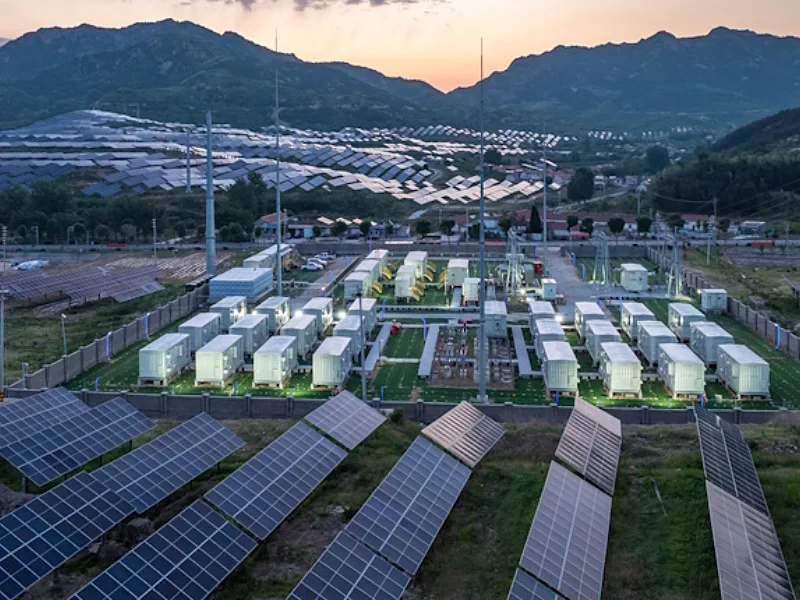
Today, attention has shifted towards implementation, building renewable energy projects, modernising electricity grids, scaling green industries, protecting natural ecosystems and strengthening climate resilience.
The challenge is that investment has failed to keep pace.
According to the International Energy Agency (IEA), global clean energy investment is expected to exceed $2 trillion annually.
However, investment remains heavily concentrated in advanced economies and China.
Many developing countries continue to receive only a small share of global climate finance despite facing disproportionately high climate risks.
The United Nations estimates that developing countries require trillions of dollars annually to meet both climate mitigation and adaptation objectives, highlighting the scale of the financing challenge.
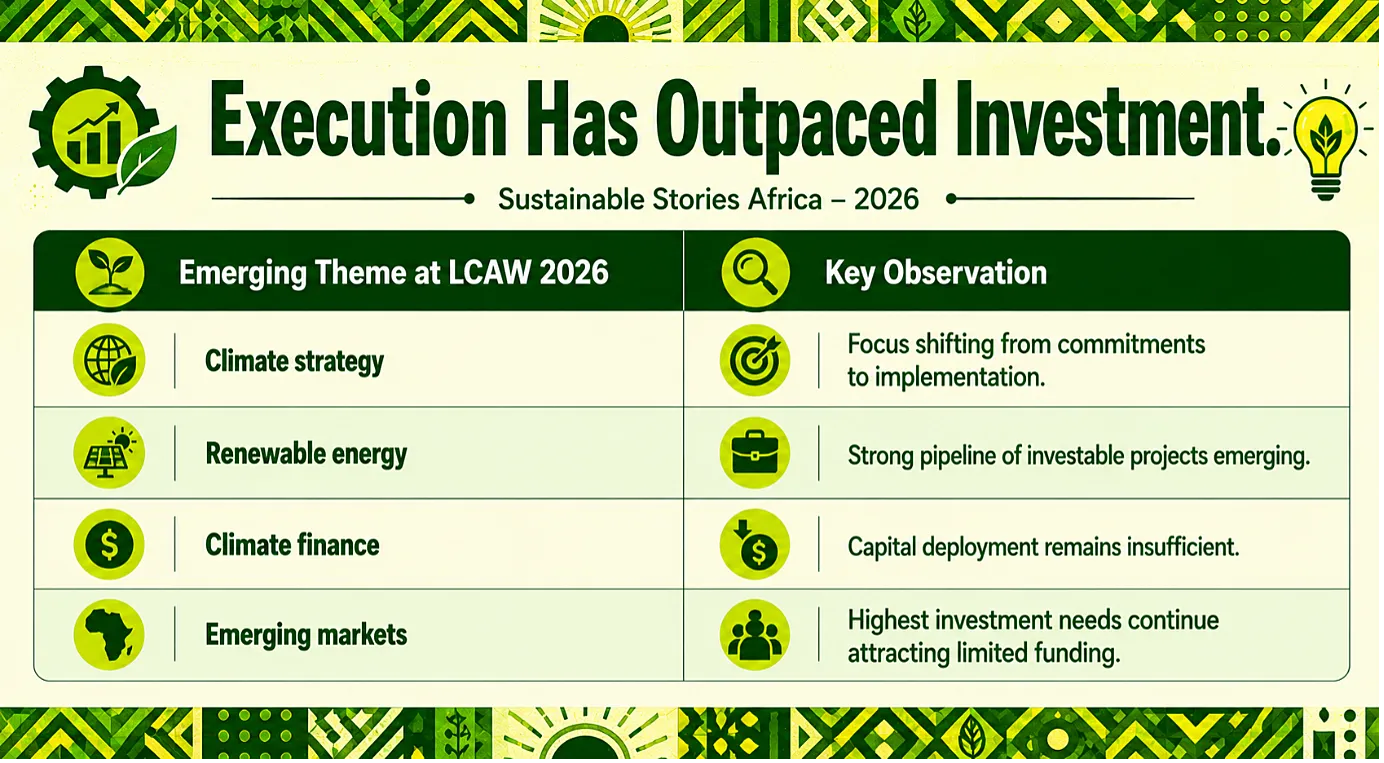
Participants also noted that the conversation increasingly revolves around execution quality rather than climate ambition alone.
Investors are asking whether projects are bankable, governments are focused on implementation capacity, and businesses are seeking regulatory certainty before committing capital.
Closing The Gap Creates Opportunity
The financing gap should not be viewed solely as a challenge; it also represents one of the world's largest investment opportunities.
Africa possesses abundant renewable energy resources, expanding digital infrastructure, critical minerals and one of the world's youngest workforces.
These advantages position the continent as a major destination for sustainable investment if financing structures evolve to match project realities.
Accelerated deployment of capital would enable countries to expand renewable electricity capacity, strengthen climate adaptation, modernise transport systems, improve food security and create millions of new jobs across clean industries.
Conversely, delayed investment risks slowing the energy transition, increasing climate vulnerability and widening global development inequalities.
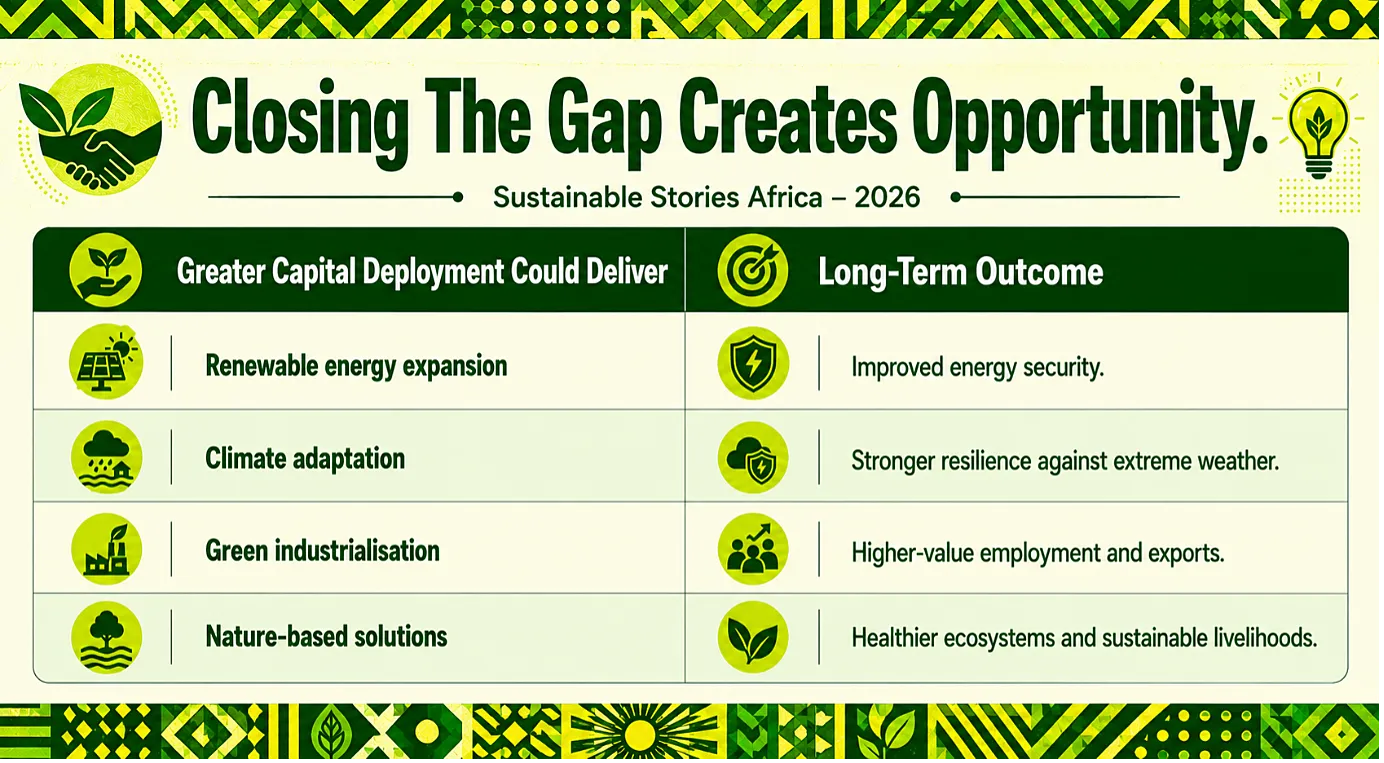
The message from LCAW was clear: implementation capacity is growing; however, financial systems must evolve to support it.
Finance Must Match Climate Ambition
Closing the execution gap will require more than larger funding commitments.
- Governments must continue to improve investment environments through predictable policies, streamlined permitting and stronger project preparation.
- Development finance institutions should expand guarantees, blended finance and first-loss mechanisms that reduce investment risk
- Private investors must increasingly recognise climate infrastructure as a long-term growth opportunity rather than a niche asset class.
Capital markets also play an important role in developing innovative financing instruments that can mobilise institutional investment into emerging economies.
For Africa, success will depend on building stronger pipelines of investment-ready projects while ensuring climate finance that supports local development priorities alongside reducing global emissions goals.
There are no longer any constraints on ideas. It is increasingly constrained by the speed at which finance moves from commitment to construction.
Path Forward – Finance Must Accelerate Climate Delivery
LCAW 2026 underscored a fundamental shift from climate ambition towards measurable implementation supported by stronger public-private collaboration.
The next phase will require financial innovation, faster capital deployment and more equitable investment flows to emerging markets so that climate execution advances alongside inclusive economic development and long-term sustainability.
Culled From: LCAW 2026: Climate's Language Has Shifted to Execution. The Capital Hasn't.