Malawi’s off-grid solar revolution is transforming energy access for rural areas.
However, beneath the rapid rollout lies a mounting environmental and public health risk: the discharge of lead-acid battery waste.
As informal recyclers dismantle ageing batteries to recover valuable metals, experts warn that toxic exposure could undermine the very development gains solar power promises.
Malawi’s Solar Boom Leaves Toxic Lead Trail
Malawi’s push to electrify rural communities through off-grid solar is accelerating.
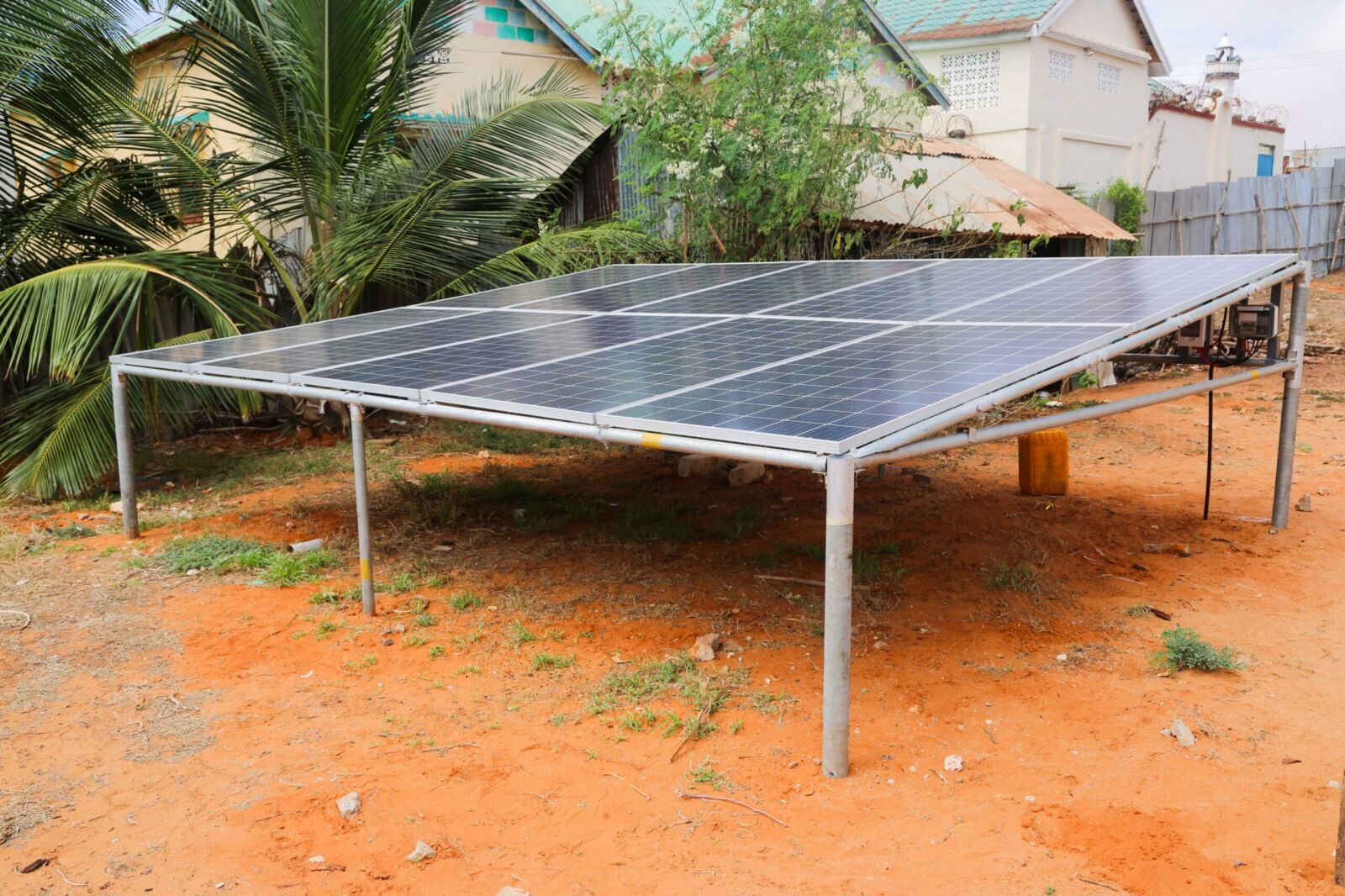
Solar home systems and mini grids are lighting homes, powering clinics, and enabling access to small businesses across districts cut off from the national grid.
However, as deployment expands, so does a quieter crisis: the accumulation of used lead-acid batteries.
With limited formal recycling infrastructure, many end-of-life batteries are entering informal recovery channels where lead is extracted through rudimentary smelting, often in residential areas.
Environmental health specialists say the implications are serious. Lead exposure, especially for children, can impair neurological development, reduce cognitive capacity and trigger long-term organ damage.
The country’s solar success story now risks being shadowed by a toxic legacy.
Energy Access Meets Toxic Exposure
Malawi’s electrification rate remains among the lowest in sub-Saharan Africa. Off-grid solar has emerged as a pragmatic solution, supported by development finance institutions and private operators.
Solar home systems typically rely on lead-acid batteries due to their affordability and availability.
However, lead-acid batteries have a finite lifespan, ranging from three to five years.
As first-generation systems reach the end of their life span, discarded batteries are increasingly dismantled in informal settlements.
Investigations reveal that recyclers break battery casings and heat lead components in open-air furnaces without protective equipment.
Public health researchers warn that such practices release toxic fumes and contaminate soil and water. In communities where informal recycling is a recurring feature, elevated blood lead levels have been detected in children.
Informality Fills Regulatory Gaps
Malawi lacks a comprehensive extended producer responsibility (EPR) administrative framework for the disposal of solar batteries.
While environmental management laws exist, enforcement capacity is limited. Formal recycling facilities remain scarce, and collection systems for expired batteries are fragmented.
This regulatory gap creates space for informal operators. Scrap metal dealers purchase used batteries from households or technicians. The recovered lead is then resold into regional supply chains.
The solar value chain thus externalises disposal costs. While households benefit from affordable energy, waste management remains largely unpriced. Without structured take-back schemes or mandatory recycling standards, toxic handling becomes an unintended byproduct of clean energy expansion.
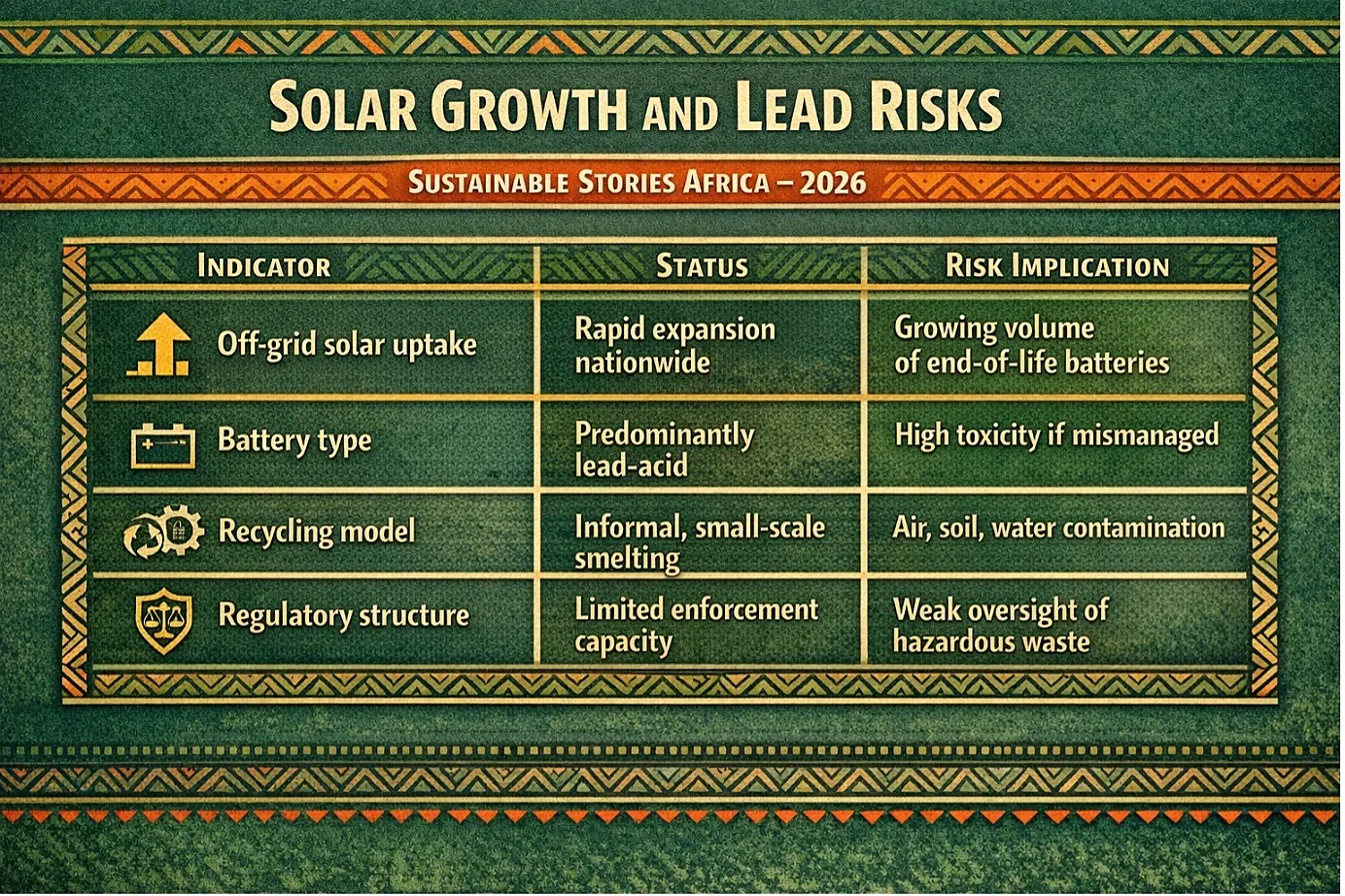
Solar Growth and Lead Risks
| Indicator | Status | Risk Implication |
|---|---|---|
| Off-grid solar uptake | Rapid expansion nationwide | Growing volume of end-of-life batteries |
| Battery type | Predominantly lead-acid | High toxicity if mismanaged |
| Recycling model | Informal, small-scale smelting | Air, soil, and water contamination |
| Regulatory structure | Limited enforcement capacity | Weak oversight of hazardous waste |
Align Clean Energy with Clean Disposal
Development agencies and environmental advocates argue that solar expansion must integrate lifecycle management. Proposed measures include:
- Mandatory take-back schemes for solar distributors
- Incentives for formal recycling facilities
- Import standards favouring safer battery technologies
- Public awareness campaigns on hazardous disposal
Lithium-ion alternatives are entering African markets, although cost remains a barrier. Scaling safer technologies will require blended finance, concessional funding and regulatory clarity.
International partners financing solar access programmes are also being urged to incorporate waste governance benchmarks into funding criteria. Clean energy, experts say, cannot be decoupled from safe materials management.
Path Forward – Clean Energy Requires Clean Governance
Malawi’s solar transition now faces a pivotal test. Electrification gains must be matched with structured battery collection systems, formal recycling infrastructure and enforceable environmental standards.
Without integrating waste accountability into energy policy, today’s access solution risks becoming tomorrow’s health crisis.
Sustainable power must translate to sustainable materials across the full lifecycle.