Brookings says microinsurance could help sustain Africa’s small businesses by offering affordable protection against shocks.
The issue matters now because more than 97% of Africa’s population remains formally uninsured.
For traders, farmers, tailors and transporters, the right insurance model could turn business-ending losses into manageable setbacks.
Africa’s Small Firms Need Protection
In markets from Lagos to Nairobi, small businesses carry Africa’s daily economy on their backs.
They sell food, repair phones, sew clothes, process crops, run kiosks and move goods. Yet one fire, flood, illness or theft can erase years of savings overnight.
A Brookings analysis argues that microinsurance could become one of the continent’s most practical tools for protecting informal and small enterprises.
The report, written by Pierre Nguimkeu and Omer Zang, says the problem is not that African entrepreneurs face too little risk. It is that existing insurance products rarely fit their lives.
Brookings notes that more than 97% of Africa’s population remains formally uninsured. Micro and small informal enterprises employ about 83.1% of the continent’s workforce and generate between 50% and 80% of GDP in sub-Saharan Africa.
That means a huge share of African economic activity is exposed to shocks without reliable protection.
Existing Insurance Misses Informal Realities
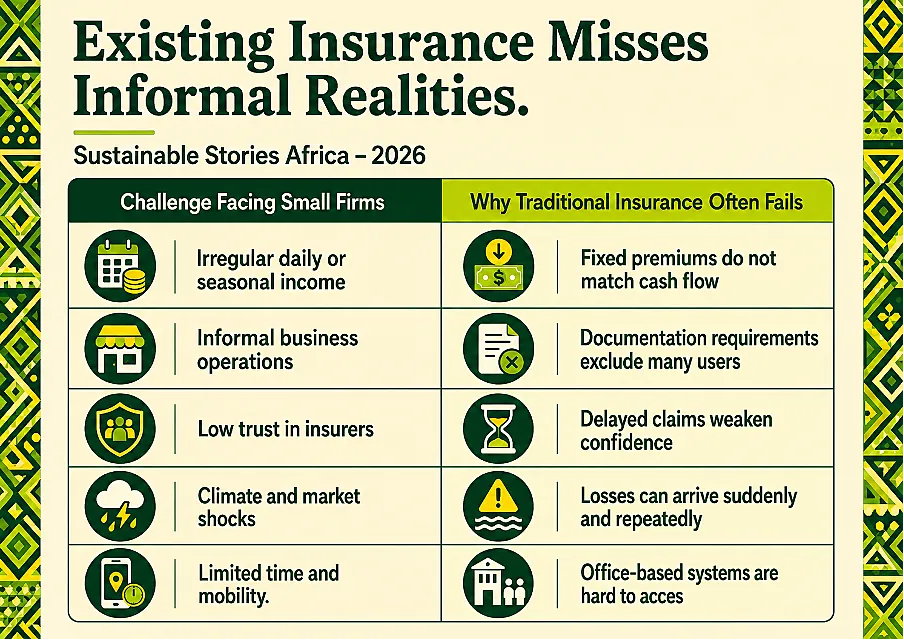
Traditional insurance often assumes predictable income, formal paperwork, fixed premiums and slow claims processing.
However, many small businesses in Africa operate differently.
- A market trader may earn strongly on one day and almost nothing the next.
- A farmer’s income may depend on rainfall, harvest timing and seasonal demand.
- A mechanic or food vendor may not have audited accounts, formal registration or time to chase paperwork.
Brookings argues that this mismatch has kept insurance outside the daily risk-management tools available to small businesses.
For many entrepreneurs, insurance feels expensive, distant and unreliable. Delayed or denied claims can also damage trust across entire communities.
The Brookings analysis points to a different model: simple, affordable, mobile-enabled protection that works through channels people already use.
These may include mobile money, savings groups, cooperatives, microcredit networks, airtime purchases and community associations.
In practical terms, that could mean a tomato seller paying a tiny premium through a mobile wallet, a farmer receiving fast support after drought triggers a parametric payout, or a small borrower gaining protection if illness or disaster disrupts repayment.
Resilience Can Unlock Growth
Microinsurance is not just about compensation after loss. Well done, it can change how small firms plan, invest and recover.
- A trader who knows that fire damage will not destroy her entire inventory may be more willing to restock.
- A rural processor covered against climate shocks may keep workers employed after a bad season.
- A farmer protected by weather-index insurance may buy improved seeds instead of holding back out of fear.
Brookings highlights several pathways for scale.
- Embedded insurance can attach coverage to products people already trust, such as mobile airtime, loans, savings accounts or merchant payments.
- Pay-as-you-go premiums can allow entrepreneurs to pay in small amounts daily, weekly or per transaction.
- Index-based insurance can trigger faster payouts using rainfall, temperature or vegetation indicators, reducing the need for costly physical assessments.
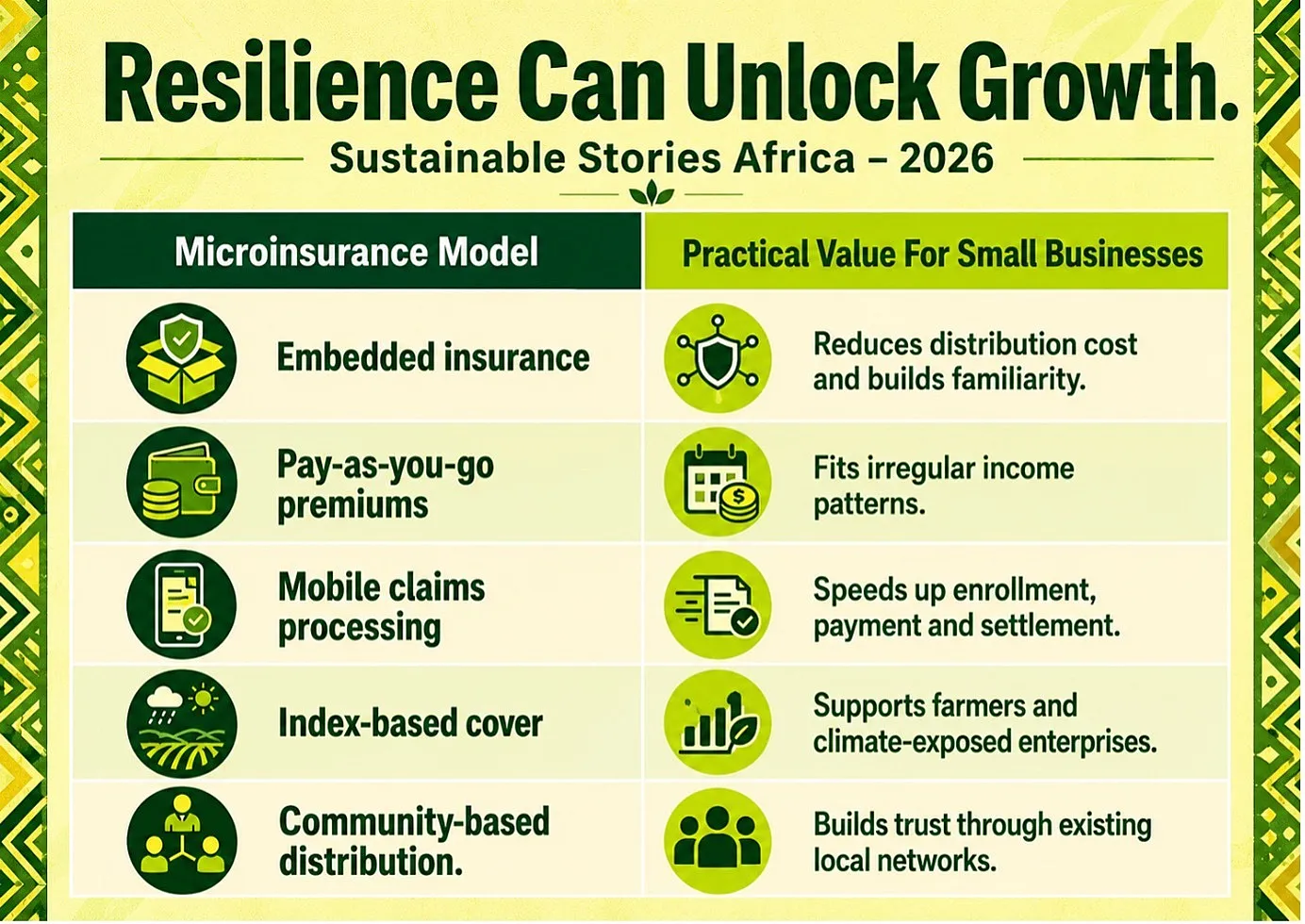
For Africa’s ESG and sustainability agenda, the case is clear: protecting small businesses strengthens economic resilience, financial inclusion and climate adaptation simultaneously.
Regulators, Insurers, and Financiers Must Adapt
The next step is not to copy conventional insurance and sell it in smaller packages.
It is to redesign protection to face African realities.
- Governments should create flexible regulatory regimes for microinsurers, support mobile and community-based distribution, and improve data systems for climate-linked products.
- Insurers need simpler language, faster claims and products that match daily cash flows.
- Development partners can help de-risk early innovation, while banks, fintechs and cooperatives can distribute protection through trusted relationships.
The strongest models will meet entrepreneurs where they already are on their phones, in their markets, within savings groups, and across informal business networks.
Path Forward – Build Protection Around Real Lives
Microinsurance can help African small businesses move from survival to stability.
The priority is affordable, trusted, mobile-enabled cover that protects traders, farmers and informal workers from shocks.
For African markets, the opportunity is bigger than insurance.
It is about building resilience into the real economy, supporting inclusive growth, and ensuring small enterprises are not one crisis away from collapse.
Culled From: How microinsurance can sustain small businesses in Africa | Brookings